🍲 BeautifulSoup Mastery: Parse HTML Like a Pro
📚 What You'll Learn
By the end of this lesson, you will be able to:
- Choose the right parser (
html.parser,lxml, orhtml5lib) for a given page - Load messy real-world HTML into a navigable BeautifulSoup tree
- Locate elements with
find(),find_all(), and CSSselect()queries - Traverse the tree using parent, child, and sibling relationships instead of repeated searches
- Clean extracted text by stripping whitespace, decoding HTML entities, and guarding against
None - Handle missing elements and malformed markup gracefully
⏱️ Estimated Time: 45–60 minutes
🎯 Project: Build a news-headline scraper that parses an HTML page and extracts each article's title and link into a clean, structured list.
BeautifulSoup is the Swiss Army knife of HTML parsing - elegant, powerful, and forgiving. It turns messy HTML soup into a beautiful, navigable tree structure. Like a skilled chef who can create a masterpiece from any ingredients, BeautifulSoup helps you extract exactly what you need from the chaos of real-world HTML. Let's become HTML parsing maestros! 🎨
The BeautifulSoup Architecture
Think of BeautifulSoup as a sophisticated GPS for HTML documents. It doesn't just find elements; it understands relationships, navigates complex structures, and even handles broken HTML gracefully. It's your trusty companion for turning web pages into structured data!
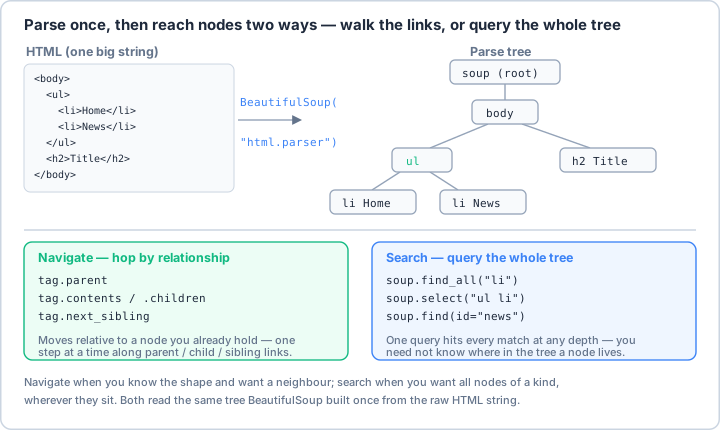
.parent, .next_sibling), or search when you want all elements of a kind wherever they live (find_all, select). Knowing which mode fits the question is what keeps scraping code short and resilient to messy markup.Real-World Scenario: The News Aggregator 📰
You're building a news aggregation system that collects articles from dozens of news websites. Each site has different HTML structures, encoding issues, broken tags, and dynamic content. You need to extract headlines, articles, authors, dates, images, and metadata while handling all the quirks of real-world HTML. Let's master BeautifulSoup to handle it all!
from bs4 import BeautifulSoup, NavigableString, Tag, Comment
from bs4.element import ResultSet
import requests
import re
from typing import List, Dict, Optional, Any, Union, Callable, Tuple
from urllib.parse import urljoin, urlparse
import html
from datetime import datetime
import json
import logging
from dataclasses import dataclass
from functools import wraps
import time
import hashlib
from collections import defaultdict
@dataclass
class Article:
"""Represents a parsed article."""
title: str
content: str
author: Optional[str] = None
published_date: Optional[datetime] = None
image_url: Optional[str] = None
tags: List[str] = None
url: Optional[str] = None
metadata: Dict[str, Any] = None
class BeautifulSoupMaster:
"""
Comprehensive BeautifulSoup toolkit for advanced HTML parsing.
"""
def __init__(self, parser: str = 'html.parser'):
"""
Initialize with specified parser.
Parser options:
- 'html.parser': Built-in, no dependencies, moderate speed
- 'lxml': Fast, requires lxml, handles broken HTML well
- 'html5lib': Most lenient, slow, creates valid HTML5
- 'xml': XML parser (requires lxml)
"""
self.parser = parser
self.setup_logging()
self.cache = {}
def setup_logging(self):
"""Setup logging configuration."""
logging.basicConfig(
level=logging.INFO,
format='%(asctime)s - %(name)s - %(levelname)s - %(message)s'
)
self.logger = logging.getLogger(__name__)
# ==================== Parsing & Creation ====================
def parse_html(self, html_content: str,
encoding: Optional[str] = None) -> BeautifulSoup:
"""
Parse HTML content into BeautifulSoup object.
"""
# Handle encoding issues
if encoding:
if isinstance(html_content, bytes):
html_content = html_content.decode(encoding, errors='ignore')
# Create soup with specified parser
soup = BeautifulSoup(html_content, self.parser)
# Log parsing info
self.logger.info(f"Parsed HTML with {self.parser} parser")
return soup
def parse_from_url(self, url: str, **kwargs) -> Optional[BeautifulSoup]:
"""
Fetch and parse HTML from URL.
"""
try:
headers = kwargs.get('headers', {
'User-Agent': 'Mozilla/5.0 (Windows NT 10.0; Win64; x64) AppleWebKit/537.36'
})
response = requests.get(url, headers=headers, timeout=10)
response.raise_for_status()
# Detect encoding
if response.encoding:
content = response.content.decode(response.encoding)
else:
content = response.text
soup = self.parse_html(content)
# Store base URL for relative link resolution
soup._base_url = url
return soup
except Exception as e:
self.logger.error(f"Failed to parse from URL {url}: {e}")
return None
def create_soup(self, tag_name: str = 'html') -> BeautifulSoup:
"""
Create a new BeautifulSoup object from scratch.
"""
soup = BeautifulSoup(f'<{tag_name}></{tag_name}>', self.parser)
return soup
# ==================== Navigation Methods ====================
def navigate_tree(self, element: Tag) -> Dict[str, Any]:
"""
Navigate and map the element tree structure.
"""
tree_map = {
'tag': element.name if hasattr(element, 'name') else None,
'text': element.get_text(strip=True) if hasattr(element, 'get_text') else str(element),
'attributes': dict(element.attrs) if hasattr(element, 'attrs') else {},
'parent': element.parent.name if element.parent else None,
'children': [],
'siblings': {
'previous': [],
'next': []
}
}
# Map children
if hasattr(element, 'children'):
for child in element.children:
if isinstance(child, Tag):
tree_map['children'].append(child.name)
# Map siblings
for sibling in element.previous_siblings:
if isinstance(sibling, Tag):
tree_map['siblings']['previous'].append(sibling.name)
for sibling in element.next_siblings:
if isinstance(sibling, Tag):
tree_map['siblings']['next'].append(sibling.name)
return tree_map
def find_parent_with_class(self, element: Tag, class_name: str) -> Optional[Tag]:
"""
Find the first parent with specified class.
"""
parent = element.parent
while parent:
if hasattr(parent, 'attrs') and 'class' in parent.attrs:
if class_name in parent.attrs['class']:
return parent
parent = parent.parent
return None
def get_breadcrumbs(self, element: Tag) -> List[str]:
"""
Get breadcrumb path from root to element.
"""
breadcrumbs = []
current = element
while current and current.name:
# Build identifier for current element
identifier = current.name
if current.get('id'):
identifier += f'#{current.get("id")}'
elif current.get('class'):
identifier += f'.{current.get("class")[0]}'
breadcrumbs.insert(0, identifier)
current = current.parent
return breadcrumbs
# ==================== Advanced Search Methods ====================
def find_with_text(self, soup: BeautifulSoup, text_pattern: Union[str, re.Pattern],
tag: Optional[str] = None) -> List[Tag]:
"""
Find elements containing specific text.
"""
if isinstance(text_pattern, str):
# Convert to regex for flexible matching
pattern = re.compile(re.escape(text_pattern), re.IGNORECASE)
else:
pattern = text_pattern
if tag:
elements = soup.find_all(tag, string=pattern)
else:
elements = soup.find_all(string=pattern)
# Get parent tags of text nodes
elements = [el.parent for el in elements if el.parent]
return elements
def find_between(self, soup: BeautifulSoup, start_element: Tag,
end_element: Tag) -> List[Tag]:
"""
Find all elements between two elements.
"""
elements = []
current = start_element.next_sibling
while current and current != end_element:
if isinstance(current, Tag):
elements.append(current)
current = current.next_sibling
return elements
def find_by_partial_attribute(self, soup: BeautifulSoup, attr_name: str,
partial_value: str) -> List[Tag]:
"""
Find elements with attribute containing partial value.
"""
def has_partial_attr(tag):
if tag.has_attr(attr_name):
attr_value = tag[attr_name]
if isinstance(attr_value, list):
return any(partial_value in str(v) for v in attr_value)
return partial_value in str(attr_value)
return False
return soup.find_all(has_partial_attr)
def find_with_multiple_conditions(self, soup: BeautifulSoup,
conditions: List[Callable]) -> List[Tag]:
"""
Find elements matching multiple custom conditions.
"""
def match_all_conditions(tag):
return all(condition(tag) for condition in conditions)
return soup.find_all(match_all_conditions)
# ==================== Text Extraction Methods ====================
def extract_text_preserve_structure(self, element: Tag,
separator: str = '\n') -> str:
"""
Extract text while preserving structure with separators.
"""
texts = []
for item in element.descendants:
if isinstance(item, NavigableString) and not isinstance(item, Comment):
text = item.strip()
if text:
texts.append(text)
elif isinstance(item, Tag) and item.name in ['br', 'p', 'div', 'h1', 'h2', 'h3', 'h4', 'h5', 'h6']:
if texts and texts[-1] != separator:
texts.append(separator)
return ' '.join(texts).replace(f' {separator} ', separator)
def extract_text_with_links(self, element: Tag) -> List[Dict[str, str]]:
"""
Extract text with embedded links preserved.
"""
segments = []
for item in element.descendants:
if isinstance(item, NavigableString) and item.parent.name != 'a':
text = item.strip()
if text:
segments.append({'type': 'text', 'content': text})
elif isinstance(item, Tag) and item.name == 'a':
segments.append({
'type': 'link',
'text': item.get_text(strip=True),
'href': item.get('href', '')
})
return segments
def clean_text(self, text: str) -> str:
"""
Clean extracted text from HTML artifacts.
"""
# Decode HTML entities
text = html.unescape(text)
# Remove excessive whitespace
text = re.sub(r'\s+', ' ', text)
# Remove zero-width characters
text = re.sub(r'[\u200b\u200c\u200d\ufeff]', '', text)
# Remove control characters
text = ''.join(char for char in text if ord(char) >= 32 or char == '\n')
return text.strip()
# ==================== Data Extraction Patterns ====================
def extract_article(self, soup: BeautifulSoup) -> Optional[Article]:
"""
Extract article content using common patterns.
"""
article = Article(title='', content='')
# Extract title (try multiple strategies)
title_selectors = [
'h1',
'h1.title',
'h1.headline',
'.article-title',
'[itemprop="headline"]',
'meta[property="og:title"]'
]
for selector in title_selectors:
title_elem = soup.select_one(selector)
if title_elem:
if title_elem.name == 'meta':
article.title = title_elem.get('content', '')
else:
article.title = title_elem.get_text(strip=True)
if article.title:
break
# Extract content
content_selectors = [
'article',
'[role="main"]',
'.article-content',
'.article-body',
'.entry-content',
'.post-content',
'div[itemprop="articleBody"]'
]
for selector in content_selectors:
content_elem = soup.select_one(selector)
if content_elem:
# Remove unwanted elements
for unwanted in content_elem.select('script, style, nav, aside, .advertisement'):
unwanted.decompose()
article.content = self.extract_text_preserve_structure(content_elem)
if article.content:
break
# Extract author
author_selectors = [
'[rel="author"]',
'.author-name',
'.by-author',
'[itemprop="author"]',
'meta[name="author"]'
]
for selector in author_selectors:
author_elem = soup.select_one(selector)
if author_elem:
if author_elem.name == 'meta':
article.author = author_elem.get('content', '')
else:
article.author = author_elem.get_text(strip=True)
if article.author:
break
# Extract published date
date_selectors = [
'time[datetime]',
'[itemprop="datePublished"]',
'.publish-date',
'.article-date',
'meta[property="article:published_time"]'
]
for selector in date_selectors:
date_elem = soup.select_one(selector)
if date_elem:
date_str = date_elem.get('datetime') or date_elem.get('content') or date_elem.get_text()
article.published_date = self._parse_date(date_str)
if article.published_date:
break
# Extract main image
image_selectors = [
'meta[property="og:image"]',
'article img',
'.article-image img',
'figure img'
]
for selector in image_selectors:
image_elem = soup.select_one(selector)
if image_elem:
if image_elem.name == 'meta':
article.image_url = image_elem.get('content')
else:
article.image_url = image_elem.get('src') or image_elem.get('data-src')
if article.image_url:
# Make URL absolute if needed
if hasattr(soup, '_base_url'):
article.image_url = urljoin(soup._base_url, article.image_url)
break
# Extract tags/categories
tags = []
tag_elements = soup.select('[rel="tag"], .tag, .category, [itemprop="keywords"]')
for tag_elem in tag_elements:
tag_text = tag_elem.get_text(strip=True)
if tag_text and tag_text not in tags:
tags.append(tag_text)
article.tags = tags
# Extract metadata
article.metadata = self.extract_metadata(soup)
# Validate article
if article.title or article.content:
return article
return None
def extract_metadata(self, soup: BeautifulSoup) -> Dict[str, str]:
"""
Extract metadata from HTML head.
"""
metadata = {}
# Open Graph metadata
for meta in soup.find_all('meta', property=re.compile(r'^og:')):
key = meta.get('property', '').replace('og:', 'og_')
metadata[key] = meta.get('content', '')
# Twitter Card metadata
for meta in soup.find_all('meta', attrs={'name': re.compile(r'^twitter:')}):
key = meta.get('name', '').replace('twitter:', 'twitter_')
metadata[key] = meta.get('content', '')
# Standard metadata
standard_meta = ['description', 'keywords', 'author', 'viewport']
for name in standard_meta:
meta = soup.find('meta', attrs={'name': name})
if meta:
metadata[name] = meta.get('content', '')
# JSON-LD structured data
json_ld = soup.find('script', type='application/ld+json')
if json_ld:
try:
metadata['json_ld'] = json.loads(json_ld.string)
except:
pass
return metadata
def _parse_date(self, date_str: str) -> Optional[datetime]:
"""
Parse date string with multiple format attempts.
"""
if not date_str:
return None
date_formats = [
'%Y-%m-%d',
'%Y-%m-%dT%H:%M:%S',
'%Y-%m-%dT%H:%M:%SZ',
'%Y-%m-%d %H:%M:%S',
'%d/%m/%Y',
'%m/%d/%Y',
'%B %d, %Y',
'%b %d, %Y'
]
for fmt in date_formats:
try:
return datetime.strptime(date_str.strip(), fmt)
except:
continue
# Try dateutil parser as fallback
try:
from dateutil import parser
return parser.parse(date_str)
except:
return None
# ==================== Table Extraction ====================
def extract_table(self, table_element: Tag,
include_headers: bool = True) -> List[List[str]]:
"""
Extract data from HTML table.
"""
rows = []
headers = []
# Extract headers
if include_headers:
header_row = table_element.find('thead')
if header_row:
for th in header_row.find_all('th'):
headers.append(th.get_text(strip=True))
if headers:
rows.append(headers)
else:
# Check first row for headers
first_row = table_element.find('tr')
if first_row:
ths = first_row.find_all('th')
if ths:
for th in ths:
headers.append(th.get_text(strip=True))
rows.append(headers)
# Extract data rows
tbody = table_element.find('tbody') or table_element
for tr in tbody.find_all('tr'):
row = []
for cell in tr.find_all(['td', 'th']):
# Handle colspan
colspan = int(cell.get('colspan', 1))
cell_text = cell.get_text(strip=True)
row.extend([cell_text] * colspan)
if row and not all(h in row for h in headers if headers): # Skip if it's a header row
rows.append(row)
return rows
def extract_all_tables(self, soup: BeautifulSoup) -> Dict[str, List[List[str]]]:
"""
Extract all tables from page with identifiers.
"""
tables = {}
for i, table in enumerate(soup.find_all('table')):
# Try to find table identifier
table_id = table.get('id', '')
table_class = '.'.join(table.get('class', []))
# Look for caption or nearby heading
caption = table.find('caption')
if caption:
identifier = caption.get_text(strip=True)
elif table_id:
identifier = table_id
elif table_class:
identifier = table_class
else:
# Look for preceding heading
prev = table.find_previous_sibling(['h1', 'h2', 'h3', 'h4'])
if prev:
identifier = prev.get_text(strip=True)
else:
identifier = f'table_{i+1}'
tables[identifier] = self.extract_table(table)
return tables
# ==================== Form Handling ====================
def extract_form_data(self, form_element: Tag) -> Dict[str, Any]:
"""
Extract form structure and default values.
"""
form_data = {
'action': form_element.get('action', ''),
'method': form_element.get('method', 'get').upper(),
'enctype': form_element.get('enctype', 'application/x-www-form-urlencoded'),
'fields': {}
}
# Extract input fields
for input_elem in form_element.find_all('input'):
name = input_elem.get('name')
if not name:
continue
input_type = input_elem.get('type', 'text')
if input_type == 'checkbox':
if name not in form_data['fields']:
form_data['fields'][name] = []
if input_elem.get('checked'):
form_data['fields'][name].append(input_elem.get('value', 'on'))
elif input_type == 'radio':
if input_elem.get('checked'):
form_data['fields'][name] = input_elem.get('value', '')
else:
form_data['fields'][name] = input_elem.get('value', '')
# Extract select fields
for select_elem in form_element.find_all('select'):
name = select_elem.get('name')
if not name:
continue
selected_option = select_elem.find('option', selected=True)
if selected_option:
form_data['fields'][name] = selected_option.get('value',
selected_option.get_text(strip=True))
else:
first_option = select_elem.find('option')
if first_option:
form_data['fields'][name] = first_option.get('value',
first_option.get_text(strip=True))
# Extract textarea fields
for textarea_elem in form_element.find_all('textarea'):
name = textarea_elem.get('name')
if name:
form_data['fields'][name] = textarea_elem.get_text(strip=True)
return form_data
# ==================== Element Modification ====================
def add_css_class(self, element: Tag, class_name: str):
"""
Add CSS class to element.
"""
if 'class' in element.attrs:
if class_name not in element['class']:
element['class'].append(class_name)
else:
element['class'] = [class_name]
def remove_css_class(self, element: Tag, class_name: str):
"""
Remove CSS class from element.
"""
if 'class' in element.attrs and class_name in element['class']:
element['class'].remove(class_name)
if not element['class']:
del element['class']
def wrap_element(self, element: Tag, wrapper_tag: str,
wrapper_attrs: Dict[str, str] = None):
"""
Wrap element in a new tag.
"""
wrapper = BeautifulSoup(f'<{wrapper_tag}></{wrapper_tag}>', self.parser).find(wrapper_tag)
if wrapper_attrs:
for key, value in wrapper_attrs.items():
wrapper[key] = value
element.wrap(wrapper)
return wrapper
def clean_html(self, soup: BeautifulSoup,
remove_tags: List[str] = None,
remove_attrs: List[str] = None,
keep_tags: List[str] = None) -> BeautifulSoup:
"""
Clean HTML by removing unwanted tags and attributes.
"""
# Default tags to remove
if remove_tags is None:
remove_tags = ['script', 'style', 'meta', 'link', 'noscript']
# Remove specified tags
for tag in remove_tags:
for element in soup.find_all(tag):
element.decompose()
# Remove specified attributes from all tags
if remove_attrs:
for element in soup.find_all():
for attr in remove_attrs:
if attr in element.attrs:
del element.attrs[attr]
# Keep only specified tags (remove all others)
if keep_tags:
for element in soup.find_all():
if element.name not in keep_tags:
element.unwrap()
return soup
# ==================== Utility Methods ====================
def get_page_stats(self, soup: BeautifulSoup) -> Dict[str, Any]:
"""
Get statistics about the parsed page.
"""
stats = {
'title': soup.title.string if soup.title else None,
'total_tags': len(soup.find_all()),
'unique_tags': len(set(tag.name for tag in soup.find_all())),
'total_text': len(soup.get_text()),
'links': {
'total': len(soup.find_all('a')),
'internal': 0,
'external': 0
},
'images': len(soup.find_all('img')),
'forms': len(soup.find_all('form')),
'tables': len(soup.find_all('table')),
'scripts': len(soup.find_all('script')),
'stylesheets': len(soup.find_all('link', rel='stylesheet'))
}
# Count internal vs external links
base_domain = ''
if hasattr(soup, '_base_url'):
base_domain = urlparse(soup._base_url).netloc
for link in soup.find_all('a', href=True):
href = link['href']
if href.startswith('http'):
if base_domain and base_domain in href:
stats['links']['internal'] += 1
else:
stats['links']['external'] += 1
else:
stats['links']['internal'] += 1
return stats
def prettify_html(self, soup: BeautifulSoup, indent: int = 2) -> str:
"""
Pretty print HTML with custom indentation.
"""
return soup.prettify(formatter='html')
def minify_html(self, soup: BeautifulSoup) -> str:
"""
Minify HTML by removing unnecessary whitespace.
"""
html_str = str(soup)
# Remove whitespace between tags
html_str = re.sub(r'>\s+<', '><', html_str)
# Remove leading/trailing whitespace
html_str = html_str.strip()
return html_str
def cache_result(self, key: str, value: Any):
"""
Cache parsing results for reuse.
"""
self.cache[key] = {
'value': value,
'timestamp': time.time()
}
def get_cached_result(self, key: str, max_age: int = 3600) -> Optional[Any]:
"""
Get cached result if not expired.
"""
if key in self.cache:
cached = self.cache[key]
if time.time() - cached['timestamp'] < max_age:
return cached['value']
return None
class BeautifulSoupRecipes:
"""
Common BeautifulSoup recipes and patterns.
"""
@staticmethod
def extract_emails(soup: BeautifulSoup) -> List[str]:
"""
Extract all email addresses from page.
"""
emails = set()
# Look in href attributes
for link in soup.find_all('a', href=re.compile(r'mailto:')):
email = link['href'].replace('mailto:', '').split('?')[0]
emails.add(email)
# Look in text
email_pattern = re.compile(r'\b[A-Za-z0-9._%+-]+@[A-Za-z0-9.-]+\.[A-Za-z]{2,}\b')
for text in soup.stripped_strings:
for email in email_pattern.findall(text):
emails.add(email)
return list(emails)
@staticmethod
def extract_phone_numbers(soup: BeautifulSoup) -> List[str]:
"""
Extract phone numbers from page.
"""
phones = set()
# Common phone patterns
phone_patterns = [
re.compile(r'(\+\d{1,3}[-.\s]?)?\(?\d{1,4}\)?[-.\s]?\d{1,4}[-.\s]?\d{1,4}[-.\s]?\d{1,9}'),
re.compile(r'\b\d{3}[-.]?\d{3}[-.]?\d{4}\b'),
]
for pattern in phone_patterns:
# Look in href attributes
for link in soup.find_all('a', href=pattern):
phone = link['href'].replace('tel:', '')
phones.add(phone)
# Look in text
for text in soup.stripped_strings:
for phone in pattern.findall(text):
if isinstance(phone, tuple):
phone = ''.join(phone)
phones.add(phone)
return list(phones)
@staticmethod
def extract_social_media_links(soup: BeautifulSoup) -> Dict[str, List[str]]:
"""
Extract social media profile links.
"""
social_patterns = {
'facebook': r'facebook\.com/[\w\-\.]+',
'twitter': r'twitter\.com/[\w]+',
'instagram': r'instagram\.com/[\w\.]+',
'linkedin': r'linkedin\.com/(?:in|company)/[\w\-]+',
'youtube': r'youtube\.com/(?:channel|user|c)/[\w\-]+',
'github': r'github\.com/[\w\-]+',
}
social_links = defaultdict(list)
for platform, pattern in social_patterns.items():
regex = re.compile(pattern, re.IGNORECASE)
for link in soup.find_all('a', href=regex):
url = link['href']
if url not in social_links[platform]:
social_links[platform].append(url)
return dict(social_links)
# Example usage
if __name__ == "__main__":
# Sample HTML for testing - properly escaped
sample_html = """<!DOCTYPE html>
<html lang="en">
<head>
<title>Tech News - Latest Technology Updates</title>
<meta name="description" content="Latest technology news and updates">
<meta property="og:title" content="Breaking: New AI Breakthrough">
<meta property="og:image" content="https://example.com/ai-image.jpg">
</head>
<body>
<header>
<nav>
<a href="/">Home</a>
<a href="/tech">Tech</a>
<a href="/science">Science</a>
</nav>
</header>
<article>
<h1 class="article-title">Revolutionary AI System Achieves Human-Level Performance</h1>
<div class="article-meta">
<span class="author" rel="author">Dr. Jane Smith</span>
<time datetime="2024-01-15T10:30:00Z">January 15, 2024</time>
</div>
<div class="article-content">
<p>Scientists at TechCorp have announced a <strong>breakthrough</strong> in artificial intelligence
that brings us closer to achieving artificial general intelligence (AGI).</p>
<p>The new system, called <a href="/projects/alphaai">AlphaAI</a>, demonstrated
unprecedented capabilities in multiple domains including:</p>
<ul>
<li>Natural language understanding</li>
<li>Complex reasoning</li>
<li>Creative problem solving</li>
</ul>
<figure>
<img src="/images/ai-breakthrough.jpg" alt="AI System Architecture">
<figcaption>The revolutionary AlphaAI architecture</figcaption>
</figure>
<blockquote>
"This represents a paradigm shift in how we approach machine intelligence,"
said lead researcher Dr. Smith.
</blockquote>
<h2>Technical Details</h2>
<p>The system uses a novel architecture that combines...</p>
<table id="performance-metrics">
<caption>Performance Comparison</caption>
<thead>
<tr>
<th>Metric</th>
<th>AlphaAI</th>
<th>Previous Best</th>
</tr>
</thead>
<tbody>
<tr>
<td>Accuracy</td>
<td>98.5%</td>
<td>92.3%</td>
</tr>
<tr>
<td>Speed (ms)</td>
<td>45</td>
<td>120</td>
</tr>
<tr>
<td>Memory (GB)</td>
<td>16</td>
<td>64</td>
</tr>
</tbody>
</table>
</div>
<footer class="article-footer">
<div class="tags">
<a href="/tag/ai" rel="tag">AI</a>
<a href="/tag/machine-learning" rel="tag">Machine Learning</a>
<a href="/tag/breakthrough" rel="tag">Breakthrough</a>
</div>
<div class="contact">
Contact: <a href="mailto:press@techcorp.com">press@techcorp.com</a>
Phone: +1 (555) 123-4567
</div>
</footer>
</article>
<aside>
<h3>Related Articles</h3>
<ul>
<li><a href="/article/ai-ethics">The Ethics of Advanced AI</a></li>
<li><a href="/article/future-work">AI and the Future of Work</a></li>
</ul>
</aside>
<form id="newsletter-form" action="/subscribe" method="post">
<h3>Subscribe to Newsletter</h3>
<input type="email" name="email" placeholder="Your email" required>
<input type="checkbox" name="weekly" value="yes" checked> Weekly updates
<select name="interests">
<option value="ai" selected>AI & ML</option>
<option value="robotics">Robotics</option>
<option value="quantum">Quantum Computing</option>
</select>
<textarea name="comments" placeholder="Comments (optional)"></textarea>
<button type="submit">Subscribe</button>
</form>
<script type="application/ld+json">
{
"@context": "https://schema.org",
"@type": "NewsArticle",
"headline": "Revolutionary AI System Achieves Human-Level Performance",
"author": "Dr. Jane Smith",
"datePublished": "2024-01-15"
}
</script>
</body>
</html>"""
# Decode HTML entities for processing
sample_html = html.unescape(sample_html)
# Initialize BeautifulSoup master
bs_master = BeautifulSoupMaster()
# Parse HTML
soup = bs_master.parse_html(sample_html)
soup._base_url = "https://example.com/article/ai-breakthrough"
print("🍲 BeautifulSoup Mastery Examples\n")
# Example 1: Navigation
print("1️⃣ Navigation:")
article = soup.find('article')
if article:
tree = bs_master.navigate_tree(article)
print(f" Article tree structure:")
print(f" Tag: {tree['tag']}")
print(f" Parent: {tree['parent']}")
print(f" Children: {tree['children'][:3]}...")
breadcrumbs = bs_master.get_breadcrumbs(article.h1)
print(f" Breadcrumbs to h1: {' > '.join(breadcrumbs)}")
# Example 2: Text extraction
print("\n2️⃣ Text Extraction:")
content_div = soup.find('div', class_='article-content')
if content_div:
# Extract with structure preserved
structured_text = bs_master.extract_text_preserve_structure(content_div)
print(f" Structured text (first 200 chars):")
print(f" {structured_text[:200]}...")
# Extract with links
text_with_links = bs_master.extract_text_with_links(content_div.find('p'))
print(f" Text with links:")
for segment in text_with_links[:3]:
if segment['type'] == 'link':
print(f" [LINK: {segment['text']} -> {segment['href']}]")
else:
print(f" {segment['content'][:50]}...")
# Example 3: Article extraction
print("\n3️⃣ Article Extraction:")
article_data = bs_master.extract_article(soup)
if article_data:
print(f" Title: {article_data.title}")
print(f" Author: {article_data.author}")
print(f" Date: {article_data.published_date}")
print(f" Content preview: {article_data.content[:100]}...")
print(f" Tags: {', '.join(article_data.tags) if article_data.tags else 'None'}")
# Example 4: Table extraction
print("\n4️⃣ Table Extraction:")
tables = bs_master.extract_all_tables(soup)
for table_name, table_data in tables.items():
print(f" Table: {table_name}")
for row in table_data[:3]:
print(f" {' | '.join(row)}")
# Example 5: Form extraction
print("\n5️⃣ Form Extraction:")
form = soup.find('form')
if form:
form_data = bs_master.extract_form_data(form)
print(f" Form action: {form_data['action']}")
print(f" Form method: {form_data['method']}")
print(f" Form fields:")
for field, value in form_data['fields'].items():
print(f" {field}: {value}")
# Example 6: Metadata extraction
print("\n6️⃣ Metadata Extraction:")
metadata = bs_master.extract_metadata(soup)
print(f" Open Graph:")
for key, value in metadata.items():
if key.startswith('og_'):
print(f" {key}: {value}")
if 'json_ld' in metadata:
print(f" JSON-LD Schema:")
print(f" Type: {metadata['json_ld'].get('@type')}")
print(f" Headline: {metadata['json_ld'].get('headline')}")
# Example 7: Advanced searching
print("\n7️⃣ Advanced Searching:")
# Find with text
elements_with_ai = bs_master.find_with_text(soup, re.compile(r'\bAI\b'))
print(f" Elements mentioning 'AI': {len(elements_with_ai)}")
# Find with multiple conditions
conditions = [
lambda tag: tag.name == 'a',
lambda tag: tag.has_attr('href'),
lambda tag: 'article' in tag.get('href', '')
]
article_links = bs_master.find_with_multiple_conditions(soup, conditions)
print(f" Article links found: {len(article_links)}")
# Example 8: Element modification
print("\n8️⃣ Element Modification:")
# Add CSS class
h1 = soup.find('h1')
if h1:
bs_master.add_css_class(h1, 'highlighted')
print(f" Added class to h1: {h1.get('class')}")
# Clean HTML
clean_soup = bs_master.clean_html(
soup,
remove_tags=['script', 'style'],
remove_attrs=['style', 'onclick']
)
print(f" HTML cleaned (removed scripts and styles)")
# Example 9: Utilities
print("\n9️⃣ Utilities:")
# Get page statistics
stats = bs_master.get_page_stats(soup)
print(f" Page Statistics:")
print(f" Total tags: {stats['total_tags']}")
print(f" Unique tags: {stats['unique_tags']}")
print(f" Links: {stats['links']['total']} ({stats['links']['internal']} internal, {stats['links']['external']} external)")
print(f" Images: {stats['images']}")
print(f" Forms: {stats['forms']}")
# Example 10: Recipes
print("\n🔟 Common Recipes:")
recipes = BeautifulSoupRecipes()
# Extract emails
emails = recipes.extract_emails(soup)
print(f" Emails found: {emails}")
# Extract phone numbers
phones = recipes.extract_phone_numbers(soup)
print(f" Phone numbers found: {phones}")
# Extract social media links
social = recipes.extract_social_media_links(soup)
print(f" Social media links: {list(social.keys())}")
print("\n✅ BeautifulSoup mastery demonstration complete!")
Key Takeaways and Best Practices 🎯
- Choose the Right Parser: html.parser for compatibility, lxml for speed, html5lib for broken HTML.
- Handle Encoding Properly: Always detect and handle character encoding correctly.
- Use Appropriate Search Methods: find() for single elements, find_all() for multiple, CSS selectors for complex queries.
- Navigate Efficiently: Use parent, children, siblings relationships instead of repeated searches.
- Clean Data Properly: Always strip whitespace, decode HTML entities, handle None values.
- Cache Parsed Results: Don't re-parse the same HTML multiple times.
- Handle Errors Gracefully: Always check if elements exist before accessing attributes.
BeautifulSoup Best Practices 📋
BeautifulSoup mastery transforms you from an HTML wrangler to a data extraction artist. You can now parse any HTML, no matter how messy, extract any data, no matter how nested, and handle any website's quirks. Whether you're building scrapers, analyzers, or automation tools, BeautifulSoup is your trusty companion! 🚀
Pro Tip: BeautifulSoup is forgiving but not magic - it's a tool that works best when you understand HTML structure. Always inspect the actual HTML you're parsing, not just what you see in the browser. Use Chrome DevTools to copy the actual HTML, not the selector. Remember that BeautifulSoup creates a parse tree in memory, so for huge documents, consider using iterative parsing or lxml's iterparse. When extracting data, always have fallbacks - if plan A fails (the nice semantic HTML), have plan B (the messy but consistent pattern). And most importantly: websites change, so make your parsers resilient with try-except blocks and multiple extraction strategies!