🍪 Handling Forms and Cookies: Master Web Interactions
📚 What You'll Learn
By the end of this lesson, you will be able to:
- Submit HTML forms with GET and POST requests using the
requestslibrary - Extract hidden fields and CSRF tokens from a page and include them in your submission
- Use a
Sessionobject to keep cookies and state across multiple requests - Persist cookies to disk and reload them to avoid logging in every time
- Set realistic headers and user agents so requests resemble a real browser
- Add retry logic and graceful error handling to multi-step workflows
⏱️ Estimated Time: 45–60 minutes
🎯 Project: Automate a login-and-submit workflow that authenticates to a site, captures its CSRF token, keeps the session cookie, and posts a form on your behalf.
Forms and cookies are the gateway to dynamic web interactions. Forms let you submit data, login to sites, and interact with web applications. Cookies maintain your session, remember preferences, and keep you logged in. Together, they're the key to automating any interactive website. Let's become masters of web interaction! 🔐
The Web Interaction Ecosystem
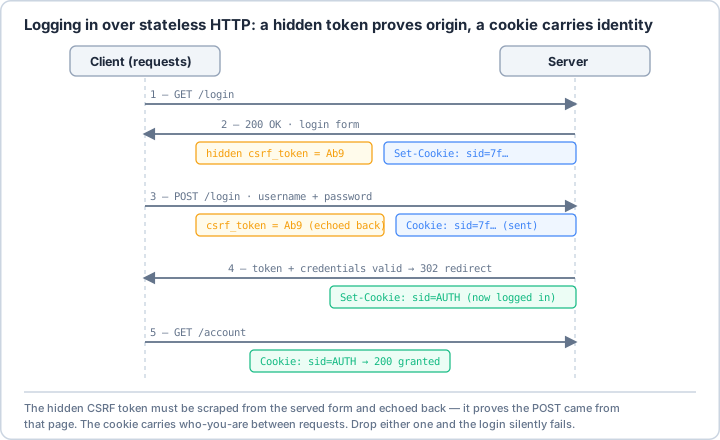
Think of forms as conversation starters with websites - you fill them out, submit them, and get responses. Cookies are like membership cards that websites give you, proving you belong and remembering who you are. Master both, and you can automate any web interaction from simple searches to complex multi-step workflows!
Real-World Scenario: The Multi-Site Authenticator 🔑
You're building an automation system that needs to login to multiple websites, submit forms, handle two-factor authentication, maintain sessions across requests, and deal with complex anti-bot measures. Each site has different form structures, CSRF protection, captchas, and cookie policies. Let's build a robust system that handles it all!
import requests
from requests.cookies import RequestsCookieJar, create_cookie
from http.cookiejar import CookieJar, MozillaCookieJar, LWPCookieJar
import http.cookiejar as cookiejar
from bs4 import BeautifulSoup
from urllib.parse import urljoin, urlparse, urlencode, parse_qs
import json
import re
import time
import pickle
import os
from typing import Dict, List, Optional, Any, Tuple, Union
from dataclasses import dataclass, field
from datetime import datetime, timedelta
import hashlib
import base64
from pathlib import Path
import logging
from enum import Enum
class FormMethod(Enum):
"""HTTP form methods."""
GET = "GET"
POST = "POST"
PUT = "PUT"
DELETE = "DELETE"
PATCH = "PATCH"
@dataclass
class FormField:
"""Represents a form field."""
name: str
field_type: str
value: Any = None
required: bool = False
options: List[str] = field(default_factory=list)
attributes: Dict[str, str] = field(default_factory=dict)
@dataclass
class Form:
"""Represents an HTML form."""
action: str
method: FormMethod
enctype: str = "application/x-www-form-urlencoded"
fields: Dict[str, FormField] = field(default_factory=dict)
metadata: Dict[str, Any] = field(default_factory=dict)
class FormHandler:
"""
Comprehensive form handling with CSRF protection, validation, and submission.
"""
def __init__(self, session: requests.Session = None):
self.session = session or requests.Session()
self.setup_logging()
# Default headers to appear more like a real browser
self.session.headers.update({
'User-Agent': 'Mozilla/5.0 (Windows NT 10.0; Win64; x64) AppleWebKit/537.36 (KHTML, like Gecko) Chrome/91.0.4472.124 Safari/537.36',
'Accept': 'text/html,application/xhtml+xml,application/xml;q=0.9,image/webp,*/*;q=0.8',
'Accept-Language': 'en-US,en;q=0.5',
'Accept-Encoding': 'gzip, deflate, br',
'DNT': '1',
'Connection': 'keep-alive',
'Upgrade-Insecure-Requests': '1'
})
def setup_logging(self):
"""Setup logging configuration."""
logging.basicConfig(
level=logging.INFO,
format='%(asctime)s - %(name)s - %(levelname)s - %(message)s'
)
self.logger = logging.getLogger(__name__)
def discover_forms(self, url: str) -> List[Form]:
"""
Discover all forms on a page.
"""
try:
response = self.session.get(url)
response.raise_for_status()
soup = BeautifulSoup(response.text, 'html.parser')
forms = []
for form_element in soup.find_all('form'):
form = self.parse_form(form_element, url)
forms.append(form)
self.logger.info(f"Found form: {form.action} [{form.method.value}]")
return forms
except Exception as e:
self.logger.error(f"Error discovering forms: {e}")
return []
def parse_form(self, form_element: BeautifulSoup, base_url: str) -> Form:
"""
Parse a form element into Form object.
"""
# Get form attributes
action = form_element.get('action', '')
if not action:
action = base_url
else:
action = urljoin(base_url, action)
method = form_element.get('method', 'get').upper()
enctype = form_element.get('enctype', 'application/x-www-form-urlencoded')
form = Form(
action=action,
method=FormMethod(method),
enctype=enctype
)
# Parse form fields
# Input fields
for input_elem in form_element.find_all('input'):
field = self._parse_input_field(input_elem)
if field:
form.fields[field.name] = field
# Select fields
for select_elem in form_element.find_all('select'):
field = self._parse_select_field(select_elem)
if field:
form.fields[field.name] = field
# Textarea fields
for textarea_elem in form_element.find_all('textarea'):
field = self._parse_textarea_field(textarea_elem)
if field:
form.fields[field.name] = field
# Button fields (that have name/value)
for button_elem in form_element.find_all('button'):
if button_elem.get('name'):
field = FormField(
name=button_elem.get('name'),
field_type='button',
value=button_elem.get('value', button_elem.get_text(strip=True)),
attributes=dict(button_elem.attrs)
)
form.fields[field.name] = field
# Extract CSRF token if present
csrf_token = self._find_csrf_token(form_element)
if csrf_token:
form.metadata['csrf_token'] = csrf_token
return form
def _parse_input_field(self, input_elem: BeautifulSoup) -> Optional[FormField]:
"""Parse input field."""
name = input_elem.get('name')
if not name:
return None
field_type = input_elem.get('type', 'text')
field = FormField(
name=name,
field_type=field_type,
value=input_elem.get('value', ''),
required=input_elem.has_attr('required'),
attributes=dict(input_elem.attrs)
)
# Handle specific input types
if field_type == 'checkbox':
field.value = input_elem.has_attr('checked')
elif field_type == 'radio':
field.value = input_elem.get('value') if input_elem.has_attr('checked') else None
elif field_type == 'file':
field.value = None # Will be set when submitting
return field
def _parse_select_field(self, select_elem: BeautifulSoup) -> Optional[FormField]:
"""Parse select field."""
name = select_elem.get('name')
if not name:
return None
field = FormField(
name=name,
field_type='select',
required=select_elem.has_attr('required'),
attributes=dict(select_elem.attrs)
)
# Extract options
for option in select_elem.find_all('option'):
option_value = option.get('value', option.get_text(strip=True))
field.options.append(option_value)
# Set default selected value
if option.has_attr('selected'):
field.value = option_value
# If no selected option, use first one
if not field.value and field.options:
field.value = field.options[0]
return field
def _parse_textarea_field(self, textarea_elem: BeautifulSoup) -> Optional[FormField]:
"""Parse textarea field."""
name = textarea_elem.get('name')
if not name:
return None
return FormField(
name=name,
field_type='textarea',
value=textarea_elem.get_text(strip=True),
required=textarea_elem.has_attr('required'),
attributes=dict(textarea_elem.attrs)
)
def _find_csrf_token(self, form_element: BeautifulSoup) -> Optional[str]:
"""
Find CSRF token in form.
"""
# Common CSRF token field names
csrf_names = [
'csrf_token', 'csrftoken', 'csrf', '_csrf_token', '_csrf',
'authenticity_token', 'token', '__RequestVerificationToken',
'csrf_middleware_token', 'csrfmiddlewaretoken'
]
for name in csrf_names:
# Check in form
token_field = form_element.find('input', {'name': name})
if token_field:
return token_field.get('value')
# Check with regex (case-insensitive)
token_field = form_element.find('input', {'name': re.compile(name, re.I)})
if token_field:
return token_field.get('value')
return None
def fill_form(self, form: Form, data: Dict[str, Any],
auto_complete: bool = True) -> Dict[str, Any]:
"""
Fill form with data.
Args:
form: Form object to fill
data: Data to fill the form with
auto_complete: Automatically fill required fields with defaults
"""
form_data = {}
for field_name, field in form.fields.items():
if field_name in data:
# Use provided data
value = data[field_name]
elif field.value is not None:
# Use existing field value (hidden fields, defaults)
value = field.value
elif auto_complete and field.required:
# Auto-complete required fields
value = self._generate_default_value(field)
else:
continue
# Handle different field types
if field.field_type == 'checkbox':
if value: # Only include if checked
form_data[field_name] = 'on' if value is True else value
elif field.field_type == 'file':
# File will be handled separately
continue
else:
form_data[field_name] = value
# Include CSRF token if present
if 'csrf_token' in form.metadata:
# Find the CSRF field name
for field_name, field in form.fields.items():
if field.field_type == 'hidden' and 'csrf' in field_name.lower():
form_data[field_name] = form.metadata['csrf_token']
break
return form_data
def _generate_default_value(self, field: FormField) -> Any:
"""Generate default value for a field."""
if field.field_type == 'email':
return 'user@example.com'
elif field.field_type == 'tel':
return '+1234567890'
elif field.field_type == 'number':
return '1'
elif field.field_type == 'date':
return datetime.now().strftime('%Y-%m-%d')
elif field.field_type == 'select' and field.options:
return field.options[0]
else:
return 'default'
def submit_form(self, form: Form, data: Dict[str, Any],
files: Dict[str, Any] = None) -> requests.Response:
"""
Submit a form with data.
"""
# Fill form data
form_data = self.fill_form(form, data)
# Prepare request based on form method
if form.method == FormMethod.GET:
# For GET, add data as query parameters
response = self.session.get(form.action, params=form_data)
else:
# For POST and others
if form.enctype == 'multipart/form-data' or files:
# Multipart form with files
response = self.session.request(
form.method.value,
form.action,
data=form_data,
files=files
)
elif form.enctype == 'application/json':
# JSON form
response = self.session.request(
form.method.value,
form.action,
json=form_data
)
else:
# Regular form
response = self.session.request(
form.method.value,
form.action,
data=form_data
)
self.logger.info(f"Form submitted to {form.action}: {response.status_code}")
return response
def handle_login_form(self, login_url: str, username: str,
password: str) -> bool:
"""
Handle a login form automatically.
"""
try:
# Discover forms on login page
forms = self.discover_forms(login_url)
# Find login form (usually has password field)
login_form = None
for form in forms:
for field in form.fields.values():
if field.field_type == 'password':
login_form = form
break
if login_form:
break
if not login_form:
self.logger.error("No login form found")
return False
# Find username and password fields
username_field = None
password_field = None
for field_name, field in login_form.fields.items():
if field.field_type == 'password':
password_field = field_name
elif field.field_type in ['text', 'email'] and not username_field:
# Common username field patterns
if any(pattern in field_name.lower() for pattern in ['user', 'email', 'login', 'name']):
username_field = field_name
if not username_field or not password_field:
self.logger.error("Could not identify username/password fields")
return False
# Submit login form
login_data = {
username_field: username,
password_field: password
}
response = self.submit_form(login_form, login_data)
# Check if login was successful
# (This is a simple check, real sites may require more sophisticated validation)
if response.history: # Redirect usually indicates successful login
self.logger.info("Login successful")
return True
elif 'dashboard' in response.url or 'home' in response.url:
self.logger.info("Login successful")
return True
else:
# Check for error messages in response
soup = BeautifulSoup(response.text, 'html.parser')
error_indicators = ['error', 'invalid', 'incorrect', 'failed']
for indicator in error_indicators:
if indicator in response.text.lower():
self.logger.warning("Login failed - error message detected")
return False
# If no clear indication, assume success
self.logger.info("Login submitted - status uncertain")
return True
except Exception as e:
self.logger.error(f"Login error: {e}")
return False
class CookieManager:
"""
Comprehensive cookie management for web automation.
"""
def __init__(self, cookie_file: str = None):
self.cookie_file = cookie_file or 'cookies.json'
self.setup_logging()
self.cookie_jar = RequestsCookieJar()
def setup_logging(self):
"""Setup logging configuration."""
logging.basicConfig(
level=logging.INFO,
format='%(asctime)s - %(name)s - %(levelname)s - %(message)s'
)
self.logger = logging.getLogger(__name__)
def save_cookies(self, session: requests.Session, filename: str = None):
"""
Save session cookies to file.
"""
filename = filename or self.cookie_file
try:
cookies = []
for cookie in session.cookies:
cookies.append({
'name': cookie.name,
'value': cookie.value,
'domain': cookie.domain,
'path': cookie.path,
'secure': cookie.secure,
'expires': cookie.expires,
'rest': cookie._rest
})
with open(filename, 'w') as f:
json.dump(cookies, f, indent=2)
self.logger.info(f"Saved {len(cookies)} cookies to {filename}")
except Exception as e:
self.logger.error(f"Error saving cookies: {e}")
def load_cookies(self, session: requests.Session, filename: str = None) -> bool:
"""
Load cookies from file into session.
"""
filename = filename or self.cookie_file
try:
if not os.path.exists(filename):
self.logger.warning(f"Cookie file not found: {filename}")
return False
with open(filename, 'r') as f:
cookies = json.load(f)
for cookie in cookies:
session.cookies.set(
cookie['name'],
cookie['value'],
domain=cookie.get('domain'),
path=cookie.get('path', '/')
)
self.logger.info(f"Loaded {len(cookies)} cookies from {filename}")
return True
except Exception as e:
self.logger.error(f"Error loading cookies: {e}")
return False
def export_cookies_to_browser_format(self, session: requests.Session,
filename: str, format: str = 'netscape'):
"""
Export cookies to browser-compatible format.
Formats:
- netscape: Netscape/Mozilla cookie format
- json: Chrome JSON format
- lwp: LWP-Cookies format
"""
if format == 'netscape':
self._export_netscape_cookies(session, filename)
elif format == 'json':
self._export_chrome_cookies(session, filename)
elif format == 'lwp':
self._export_lwp_cookies(session, filename)
else:
raise ValueError(f"Unknown format: {format}")
def _export_netscape_cookies(self, session: requests.Session, filename: str):
"""Export cookies in Netscape format."""
with open(filename, 'w') as f:
f.write("# Netscape HTTP Cookie File\n")
f.write("# This is a generated file! Do not edit.\n\n")
for cookie in session.cookies:
domain = cookie.domain
initial_dot = 'TRUE' if domain.startswith('.') else 'FALSE'
path = cookie.path
secure = 'TRUE' if cookie.secure else 'FALSE'
expires = cookie.expires if cookie.expires else 0
name = cookie.name
value = cookie.value
f.write(f"{domain}\t{initial_dot}\t{path}\t{secure}\t{expires}\t{name}\t{value}\n")
def _export_chrome_cookies(self, session: requests.Session, filename: str):
"""Export cookies in Chrome JSON format."""
cookies = []
for cookie in session.cookies:
cookies.append({
"domain": cookie.domain,
"expirationDate": cookie.expires,
"hostOnly": not cookie.domain.startswith('.'),
"httpOnly": cookie.has_nonstandard_attr('HttpOnly'),
"name": cookie.name,
"path": cookie.path,
"sameSite": cookie.get_nonstandard_attr('SameSite', 'unspecified'),
"secure": cookie.secure,
"session": cookie.expires is None,
"storeId": "0",
"value": cookie.value
})
with open(filename, 'w') as f:
json.dump(cookies, f, indent=2)
def _export_lwp_cookies(self, session: requests.Session, filename: str):
"""Export cookies in LWP format."""
lwp = LWPCookieJar(filename)
for cookie in session.cookies:
lwp.set_cookie(cookie)
lwp.save()
def import_browser_cookies(self, browser: str = 'chrome') -> RequestsCookieJar:
"""
Import cookies from browser.
Browsers:
- chrome
- firefox
- safari
- edge
"""
if browser == 'chrome':
return self._import_chrome_cookies()
elif browser == 'firefox':
return self._import_firefox_cookies()
else:
raise ValueError(f"Unsupported browser: {browser}")
def _import_chrome_cookies(self) -> RequestsCookieJar:
"""Import cookies from Chrome."""
import sqlite3
import win32crypt # Windows only
# Chrome cookies location (Windows)
cookie_file = os.path.join(
os.environ['USERPROFILE'],
r'AppData\Local\Google\Chrome\User Data\Default\Cookies'
)
# Copy cookies file (Chrome locks it)
temp_file = 'chrome_cookies_temp.db'
import shutil
shutil.copy2(cookie_file, temp_file)
conn = sqlite3.connect(temp_file)
cursor = conn.cursor()
cursor.execute("""
SELECT host_key, path, name, value, encrypted_value,
expires_utc, is_secure, is_httponly
FROM cookies
""")
jar = RequestsCookieJar()
for row in cursor.fetchall():
host, path, name, value, encrypted_value, expires, secure, httponly = row
# Decrypt value (Windows)
if encrypted_value:
try:
decrypted_value = win32crypt.CryptUnprotectData(
encrypted_value, None, None, None, 0
)[1].decode('utf-8')
value = decrypted_value
except:
pass
jar.set(name, value, domain=host, path=path)
conn.close()
os.remove(temp_file)
return jar
def _import_firefox_cookies(self) -> RequestsCookieJar:
"""Import cookies from Firefox."""
import sqlite3
# Firefox cookies location
firefox_profile = self._find_firefox_profile()
cookie_file = os.path.join(firefox_profile, 'cookies.sqlite')
conn = sqlite3.connect(cookie_file)
cursor = conn.cursor()
cursor.execute("""
SELECT host, path, name, value, expiry, isSecure, isHttpOnly
FROM moz_cookies
""")
jar = RequestsCookieJar()
for row in cursor.fetchall():
host, path, name, value, expiry, secure, httponly = row
jar.set(name, value, domain=host, path=path)
conn.close()
return jar
def _find_firefox_profile(self) -> str:
"""Find Firefox default profile."""
if sys.platform == 'win32':
base = os.path.join(os.environ['APPDATA'], 'Mozilla', 'Firefox', 'Profiles')
elif sys.platform == 'darwin':
base = os.path.expanduser('~/Library/Application Support/Firefox/Profiles')
else:
base = os.path.expanduser('~/.mozilla/firefox')
for item in os.listdir(base):
if item.endswith('.default') or item.endswith('.default-release'):
return os.path.join(base, item)
raise Exception("Firefox profile not found")
def create_persistent_session(self, session_file: str = 'session.pkl') -> requests.Session:
"""
Create a persistent session that survives script restarts.
"""
if os.path.exists(session_file):
# Load existing session
with open(session_file, 'rb') as f:
session = pickle.load(f)
self.logger.info("Loaded existing session")
else:
# Create new session
session = requests.Session()
self.logger.info("Created new session")
# Save session on exit
import atexit
atexit.register(lambda: self._save_session(session, session_file))
return session
def _save_session(self, session: requests.Session, session_file: str):
"""Save session to file."""
with open(session_file, 'wb') as f:
pickle.dump(session, f)
self.logger.info(f"Session saved to {session_file}")
class SessionManager:
"""
Advanced session management with authentication and state persistence.
"""
def __init__(self):
self.session = requests.Session()
self.cookie_manager = CookieManager()
self.form_handler = FormHandler(self.session)
self.setup_logging()
def setup_logging(self):
"""Setup logging configuration."""
logging.basicConfig(
level=logging.INFO,
format='%(asctime)s - %(name)s - %(levelname)s - %(message)s'
)
self.logger = logging.getLogger(__name__)
def login(self, login_url: str, username: str, password: str,
persist_session: bool = True) -> bool:
"""
Login to a website and maintain session.
"""
# Try to load existing cookies first
if persist_session and self.cookie_manager.load_cookies(self.session):
# Check if still logged in
if self.is_logged_in(login_url):
self.logger.info("Already logged in using saved cookies")
return True
# Perform login
success = self.form_handler.handle_login_form(login_url, username, password)
if success and persist_session:
# Save cookies for future use
self.cookie_manager.save_cookies(self.session)
return success
def is_logged_in(self, check_url: str) -> bool:
"""
Check if currently logged in.
"""
try:
response = self.session.get(check_url, allow_redirects=False)
# Check for login indicators
if response.status_code == 200:
# Look for logout links/buttons (indicates logged in)
soup = BeautifulSoup(response.text, 'html.parser')
logout_indicators = ['logout', 'sign out', 'log out']
for indicator in logout_indicators:
if soup.find('a', string=re.compile(indicator, re.I)):
return True
# Look for login links (indicates not logged in)
login_indicators = ['login', 'sign in', 'log in']
for indicator in login_indicators:
if soup.find('a', string=re.compile(indicator, re.I)):
return False
# Check for redirect to login page
elif response.status_code in [301, 302, 303, 307]:
location = response.headers.get('Location', '')
if 'login' in location.lower():
return False
# Default assumption
return response.status_code == 200
except Exception as e:
self.logger.error(f"Error checking login status: {e}")
return False
def handle_two_factor_auth(self, code: str, submit_url: str = None, page_url: str = None) -> bool:
"""
Handle two-factor authentication.
"""
try:
# If no submit URL provided, look for the 2FA form on the given page.
# (requests.Session has no "current URL", so the page must be passed in.)
if not submit_url:
if not page_url:
raise ValueError("Provide submit_url, or page_url to locate the 2FA form")
response = self.session.get(page_url)
forms = self.form_handler.discover_forms(response.url)
# Find 2FA form (usually has code/token field)
for form in forms:
for field in form.fields.values():
if any(pattern in field.name.lower() for pattern in ['code', 'token', 'otp', 'verification']):
# Submit 2FA code
data = {field.name: code}
response = self.form_handler.submit_form(form, data)
return response.status_code == 200
else:
# Direct submission to provided URL
response = self.session.post(submit_url, data={'code': code})
return response.status_code == 200
except Exception as e:
self.logger.error(f"2FA error: {e}")
return False
def maintain_session(self, keepalive_url: str, interval: int = 300):
"""
Keep session alive by periodic requests.
"""
import threading
def keepalive():
while True:
time.sleep(interval)
try:
self.session.get(keepalive_url)
self.logger.debug("Session keepalive sent")
except:
pass
thread = threading.Thread(target=keepalive, daemon=True)
thread.start()
self.logger.info(f"Session keepalive started (interval: {interval}s)")
# Example usage
if __name__ == "__main__":
print("🍪 Forms and Cookies Handling Examples\n")
# Initialize components
form_handler = FormHandler()
cookie_manager = CookieManager()
session_manager = SessionManager()
# Example 1: Form Discovery
print("1️⃣ Form Discovery:")
test_url = "https://httpbin.org/forms/post"
forms = form_handler.discover_forms(test_url)
for i, form in enumerate(forms):
print(f"\n Form {i+1}:")
print(f" Action: {form.action}")
print(f" Method: {form.method.value}")
print(f" Fields: {list(form.fields.keys())}")
# Example 2: Form Submission
print("\n2️⃣ Form Submission:")
# Create a test form
test_form = Form(
action="https://httpbin.org/post",
method=FormMethod.POST
)
test_form.fields['username'] = FormField(
name='username',
field_type='text',
required=True
)
test_form.fields['password'] = FormField(
name='password',
field_type='password',
required=True
)
# Submit form
form_data = {
'username': 'testuser',
'password': 'testpass123'
}
response = form_handler.submit_form(test_form, form_data)
print(f" Form submitted: {response.status_code}")
# Example 3: Cookie Management
print("\n3️⃣ Cookie Management:")
# Create session with cookies
session = requests.Session()
# Make request to set cookies
session.get("https://httpbin.org/cookies/set?test_cookie=test_value")
# Save cookies
cookie_manager.save_cookies(session, 'test_cookies.json')
print(" Cookies saved to test_cookies.json")
# Load cookies into new session
new_session = requests.Session()
cookie_manager.load_cookies(new_session, 'test_cookies.json')
# Verify cookies loaded
response = new_session.get("https://httpbin.org/cookies")
print(f" Loaded cookies: {response.json()['cookies']}")
# Example 4: Login Simulation
print("\n4️⃣ Login Simulation:")
# Simulate login (using httpbin for demonstration)
login_success = session_manager.login(
login_url="https://httpbin.org/forms/post",
username="demo_user",
password="demo_pass",
persist_session=True
)
if login_success:
print(" Login successful!")
else:
print(" Login failed!")
# Example 5: Session Persistence
print("\n5️⃣ Session Persistence:")
# Create persistent session
persistent_session = cookie_manager.create_persistent_session('my_session.pkl')
print(" Persistent session created")
# The session will be automatically saved on exit
# Example 6: Advanced Form Handling
print("\n6️⃣ Advanced Form Handling:")
# HTML with complex form
complex_form_html = """
<form action="/submit" method="post">
<input type="hidden" name="csrf_token" value="abc123xyz">
<input type="text" name="username" required>
<input type="password" name="password" required>
<select name="country">
<option value="us">United States</option>
<option value="uk">United Kingdom</option>
<option value="ca">Canada</option>
</select>
<input type="checkbox" name="remember" value="1" checked>
<textarea name="comments">Enter comments here</textarea>
<button type="submit" name="action" value="login">Login</button>
</form>
"""
soup = BeautifulSoup(complex_form_html, 'html.parser')
form_elem = soup.find('form')
parsed_form = form_handler.parse_form(form_elem, "https://example.com")
print(" Parsed complex form:")
print(f" CSRF Token: {parsed_form.metadata.get('csrf_token')}")
print(f" Required fields: {[f.name for f in parsed_form.fields.values() if f.required]}")
print(f" Select options: {parsed_form.fields['country'].options}")
# Example 7: Cookie Export/Import
print("\n7️⃣ Cookie Export/Import:")
# Export cookies to browser format
cookie_manager.export_cookies_to_browser_format(
session,
'cookies_netscape.txt',
format='netscape'
)
print(" Exported cookies to Netscape format")
cookie_manager.export_cookies_to_browser_format(
session,
'cookies_chrome.json',
format='json'
)
print(" Exported cookies to Chrome JSON format")
# Example 8: File Upload Form
print("\n8️⃣ File Upload Form:")
upload_form = Form(
action="https://httpbin.org/post",
method=FormMethod.POST,
enctype="multipart/form-data"
)
upload_form.fields['file'] = FormField(
name='file',
field_type='file'
)
upload_form.fields['description'] = FormField(
name='description',
field_type='text'
)
# Prepare file for upload
files = {
'file': ('test.txt', 'This is test file content', 'text/plain')
}
data = {
'description': 'Test file upload'
}
response = form_handler.submit_form(upload_form, data, files)
print(f" File upload response: {response.status_code}")
# Clean up test files
import os
for file in ['test_cookies.json', 'cookies_netscape.txt', 'cookies_chrome.json']:
if os.path.exists(file):
os.remove(file)
print("\n✅ Forms and cookies handling demonstration complete!")
Key Takeaways and Best Practices 🎯
- Always Respect robots.txt: Check and follow website policies before automation.
- Use Sessions: Maintain state across requests with session objects.
- Handle CSRF Tokens: Always extract and include CSRF tokens when present.
- Persist Cookies: Save and reuse cookies to avoid repeated logins.
- Mimic Real Browsers: Use appropriate headers and user agents.
- Handle Failures Gracefully: Implement retry logic and error handling.
- Respect Rate Limits: Add delays between requests to avoid being blocked.
Forms and Cookies Best Practices 📋
Mastering forms and cookies transforms you from a passive web observer to an active participant. You can now login to sites, submit data, maintain sessions, and automate complex multi-step workflows. Whether you're building testing tools, data collectors, or automation systems, these skills are essential for modern web interaction! 🚀
Pro Tip: Forms and cookies are the foundation of web interaction, but they're also security features. Always approach them respectfully. Use session objects to maintain state, save cookies to avoid repeated logins, and handle CSRF tokens properly. When filling forms, validate your data client-side to avoid server errors. For file uploads, use multipart encoding. Remember that cookies expire, so implement refresh mechanisms. Most importantly: always test your form handlers on test sites first, respect rate limits, and never use automation for malicious purposes. Good automation is invisible - it works just like a human would, just faster and more reliably!