🚀 API Testing: Validate Your Backend Services Thoroughly
📚 What You'll Learn
By the end of this lesson, you will be able to:
- Build a reusable API test client with retries, authentication, and request logging
- Validate responses on every axis — status codes, JSON schema, headers, and response time
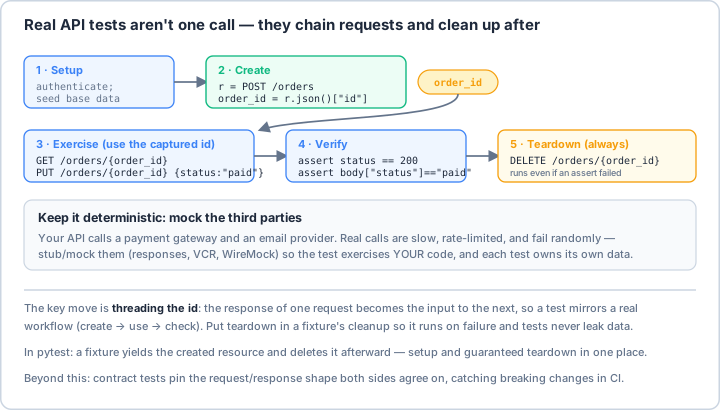
- Test stateful workflows by threading a created resource's ID through later requests
- Handle authentication schemes (bearer, basic, API key) and verify permission boundaries
- Generate realistic test data with factories and always tear it down for isolation
- Add GraphQL, load (Locust), and basic security checks, and mock flaky third parties
⏱️ Estimated Time: 45–60 minutes
🎯 Project: Write an API test for a full CRUD workflow — create a resource, capture its ID, read/update it, verify each response, and delete it in teardown.
API testing is the backbone of modern application quality assurance - it validates that your backend services work correctly, handle edge cases gracefully, and maintain contracts between systems. Like testing the engine of a car without needing the entire vehicle, API testing provides fast, reliable validation of business logic and data processing. Whether you're testing REST APIs, GraphQL endpoints, or microservices, mastering API testing is essential for delivering robust backend services. Let's explore the comprehensive world of API test automation! 🔧
The API Testing Architecture
Think of API testing as quality control for your application's nervous system - it verifies that data flows correctly between components, responses meet specifications, and services handle various scenarios appropriately. Using tools like requests, pytest, and specialized frameworks, you can create comprehensive test suites that validate functionality, performance, security, and reliability. Understanding request/response cycles, authentication, data validation, and contract testing is crucial for effective API testing!
Real-World Scenario: The Microservices API Testing Platform 🌍
You're building a comprehensive API testing platform for a microservices ecosystem that validates REST and GraphQL endpoints, tests authentication and authorization flows, ensures data consistency across services, validates API contracts between teams, performs load and stress testing, monitors API performance metrics, tests error handling and edge cases, and validates webhook deliveries. Your platform must support multiple authentication methods, handle various data formats, provide detailed test reports, and integrate with CI/CD pipelines. Let's build a professional API testing framework!
# Comprehensive API Testing Framework
# pip install requests pytest pytest-html pytest-benchmark
# pip install jsonschema pydantic faker factory-boy
# pip install locust aiohttp httpx grpcio graphql-core
import os
import json
import time
import asyncio
import logging
from typing import Dict, List, Any, Optional, Union, Callable, Type
from dataclasses import dataclass, field, asdict
from datetime import datetime, timedelta
from pathlib import Path
from enum import Enum
import hashlib
import hmac
import base64
import jwt
from urllib.parse import urljoin, urlparse, parse_qs
import requests
import httpx
import aiohttp
from requests.auth import HTTPBasicAuth, HTTPDigestAuth
from requests.adapters import HTTPAdapter
from urllib3.util.retry import Retry
import pytest
import allure
from jsonschema import validate, ValidationError
from pydantic import BaseModel, Field, field_validator
from faker import Faker
import yaml
# Performance testing
from locust import HttpUser, task, between
# GraphQL support
from graphql import build_schema, graphql_sync
# ==================== Configuration ====================
@dataclass
class APITestConfig:
"""Configuration for API testing."""
base_url: str = "http://localhost:8000"
timeout: float = 30.0
verify_ssl: bool = True
# Authentication
auth_type: str = "bearer" # none, basic, bearer, oauth2, api_key
auth_token: Optional[str] = None
api_key: Optional[str] = None
# Retry configuration
retry_count: int = 3
retry_backoff: float = 1.0
retry_status_codes: List[int] = field(default_factory=lambda: [500, 502, 503, 504])
# Headers
default_headers: Dict[str, str] = field(default_factory=lambda: {
"Content-Type": "application/json",
"Accept": "application/json"
})
# Logging
log_requests: bool = True
log_responses: bool = True
# Validation
validate_ssl: bool = True
validate_schema: bool = True
# Performance
connection_pool_size: int = 10
max_keepalive_connections: int = 5
# ==================== API Client ====================
class APIClient:
"""Enhanced API client for testing."""
def __init__(self, config: APITestConfig):
self.config = config
self.session = self._create_session()
self.logger = logging.getLogger(__name__)
self.request_history = []
def _create_session(self) -> requests.Session:
"""Create configured session with retry logic."""
session = requests.Session()
# Configure retry strategy
retry_strategy = Retry(
total=self.config.retry_count,
backoff_factor=self.config.retry_backoff,
status_forcelist=self.config.retry_status_codes,
allowed_methods=["GET", "POST", "PUT", "DELETE", "PATCH"]
)
adapter = HTTPAdapter(
pool_connections=self.config.connection_pool_size,
pool_maxsize=self.config.connection_pool_size,
max_retries=retry_strategy
)
session.mount("http://", adapter)
session.mount("https://", adapter)
# Set default headers
session.headers.update(self.config.default_headers)
# Configure authentication
self._setup_authentication(session)
return session
def _setup_authentication(self, session: requests.Session):
"""Setup authentication for session."""
if self.config.auth_type == "basic":
session.auth = HTTPBasicAuth(
self.config.auth_token.split(":")[0],
self.config.auth_token.split(":")[1]
)
elif self.config.auth_type == "bearer":
if self.config.auth_token:
session.headers["Authorization"] = f"Bearer {self.config.auth_token}"
elif self.config.auth_type == "api_key":
if self.config.api_key:
session.headers["X-API-Key"] = self.config.api_key
def request(
self,
method: str,
endpoint: str,
**kwargs
) -> requests.Response:
"""Make HTTP request with logging and validation."""
# Build full URL
url = urljoin(self.config.base_url, endpoint)
# Set timeout if not provided
kwargs.setdefault("timeout", self.config.timeout)
kwargs.setdefault("verify", self.config.verify_ssl)
# Log request
if self.config.log_requests:
self.logger.info(f"{method} {url}")
if "json" in kwargs:
self.logger.debug(f"Request body: {json.dumps(kwargs['json'], indent=2)}")
# Make request
start_time = time.time()
response = self.session.request(method, url, **kwargs)
duration = time.time() - start_time
# Store in history
self.request_history.append({
"method": method,
"url": url,
"status_code": response.status_code,
"duration": duration,
"timestamp": datetime.now()
})
# Log response
if self.config.log_responses:
self.logger.info(f"Response: {response.status_code} ({duration:.2f}s)")
if response.content:
try:
self.logger.debug(f"Response body: {response.json()}")
except:
self.logger.debug(f"Response body: {response.text[:200]}")
return response
def get(self, endpoint: str, **kwargs) -> requests.Response:
"""GET request."""
return self.request("GET", endpoint, **kwargs)
def post(self, endpoint: str, **kwargs) -> requests.Response:
"""POST request."""
return self.request("POST", endpoint, **kwargs)
def put(self, endpoint: str, **kwargs) -> requests.Response:
"""PUT request."""
return self.request("PUT", endpoint, **kwargs)
def patch(self, endpoint: str, **kwargs) -> requests.Response:
"""PATCH request."""
return self.request("PATCH", endpoint, **kwargs)
def delete(self, endpoint: str, **kwargs) -> requests.Response:
"""DELETE request."""
return self.request("DELETE", endpoint, **kwargs)
def get_metrics(self) -> Dict[str, Any]:
"""Get request metrics."""
if not self.request_history:
return {}
durations = [r["duration"] for r in self.request_history]
status_codes = [r["status_code"] for r in self.request_history]
return {
"total_requests": len(self.request_history),
"avg_duration": sum(durations) / len(durations),
"min_duration": min(durations),
"max_duration": max(durations),
"success_rate": len([s for s in status_codes if 200 <= s < 300]) / len(status_codes) * 100
}
# ==================== Async API Client ====================
class AsyncAPIClient:
"""Asynchronous API client for high-performance testing."""
def __init__(self, config: APITestConfig):
self.config = config
self.client = httpx.AsyncClient(
base_url=config.base_url,
timeout=config.timeout,
headers=config.default_headers,
verify=config.verify_ssl
)
async def request(
self,
method: str,
endpoint: str,
**kwargs
) -> httpx.Response:
"""Make async HTTP request."""
response = await self.client.request(method, endpoint, **kwargs)
return response
async def get(self, endpoint: str, **kwargs) -> httpx.Response:
"""Async GET request."""
return await self.request("GET", endpoint, **kwargs)
async def post(self, endpoint: str, **kwargs) -> httpx.Response:
"""Async POST request."""
return await self.request("POST", endpoint, **kwargs)
async def batch_requests(
self,
requests: List[Dict[str, Any]]
) -> List[httpx.Response]:
"""Execute multiple requests concurrently."""
tasks = []
for req in requests:
method = req.pop("method", "GET")
endpoint = req.pop("endpoint", "/")
tasks.append(self.request(method, endpoint, **req))
responses = await asyncio.gather(*tasks)
return responses
async def close(self):
"""Close client connection."""
await self.client.aclose()
# ==================== Response Validation ====================
class ResponseValidator:
"""Validate API responses."""
@staticmethod
def validate_status_code(
response: requests.Response,
expected: Union[int, List[int]]
):
"""Validate response status code."""
if isinstance(expected, int):
expected = [expected]
assert response.status_code in expected, \
f"Expected status {expected}, got {response.status_code}"
@staticmethod
def validate_json_schema(
response: requests.Response,
schema: Dict[str, Any]
):
"""Validate response against JSON schema."""
try:
validate(response.json(), schema)
except ValidationError as e:
pytest.fail(f"Schema validation failed: {e.message}")
@staticmethod
def validate_response_time(
response: requests.Response,
max_time: float
):
"""Validate response time."""
assert response.elapsed.total_seconds() < max_time, \
f"Response took {response.elapsed.total_seconds()}s, max allowed: {max_time}s"
@staticmethod
def validate_headers(
response: requests.Response,
expected_headers: Dict[str, str]
):
"""Validate response headers."""
for header, value in expected_headers.items():
assert header in response.headers, f"Missing header: {header}"
if value:
assert response.headers[header] == value, \
f"Header {header} = {response.headers[header]}, expected {value}"
@staticmethod
def validate_content_type(
response: requests.Response,
expected: str = "application/json"
):
"""Validate content type."""
content_type = response.headers.get("Content-Type", "")
assert expected in content_type, \
f"Expected content type {expected}, got {content_type}"
# ==================== Test Data Models ====================
class UserModel(BaseModel):
"""User data model for validation."""
id: Optional[int] = None
username: str = Field(..., min_length=3, max_length=50)
email: str = Field(..., pattern=r'^[\w\.-]+@[\w\.-]+\.\w+$')
first_name: str
last_name: str
age: Optional[int] = Field(None, ge=0, le=120)
created_at: Optional[datetime] = None
@field_validator('email')
@classmethod
def email_must_be_valid(cls, v):
"""Validate email format."""
if '@' not in v:
raise ValueError('Invalid email')
return v
class ProductModel(BaseModel):
"""Product data model."""
id: Optional[int] = None
name: str = Field(..., min_length=1, max_length=200)
description: Optional[str] = None
price: float = Field(..., gt=0)
stock: int = Field(..., ge=0)
category: str
tags: List[str] = []
# ==================== Test Data Factory ====================
class TestDataFactory:
"""Factory for generating test data."""
def __init__(self):
self.faker = Faker()
def create_user(self, **overrides) -> Dict[str, Any]:
"""Create user test data."""
user_data = {
"username": self.faker.user_name(),
"email": self.faker.email(),
"first_name": self.faker.first_name(),
"last_name": self.faker.last_name(),
"age": self.faker.random_int(min=18, max=80),
"password": self.faker.password()
}
user_data.update(overrides)
return user_data
def create_product(self, **overrides) -> Dict[str, Any]:
"""Create product test data."""
product_data = {
"name": self.faker.company() + " " + self.faker.word(),
"description": self.faker.text(),
"price": round(self.faker.random.uniform(1, 1000), 2),
"stock": self.faker.random_int(min=0, max=1000),
"category": self.faker.random_element(["Electronics", "Clothing", "Books", "Food"]),
"tags": [self.faker.word() for _ in range(3)]
}
product_data.update(overrides)
return product_data
def create_bulk(
self,
factory_method: Callable,
count: int,
**overrides
) -> List[Dict[str, Any]]:
"""Create multiple test data items."""
return [factory_method(**overrides) for _ in range(count)]
# ==================== API Test Base Class ====================
class APITestBase:
"""Base class for API tests."""
@pytest.fixture(autouse=True)
def setup(self):
"""Setup test environment."""
self.config = APITestConfig()
self.client = APIClient(self.config)
self.validator = ResponseValidator()
self.data_factory = TestDataFactory()
self.created_resources = []
yield
# Cleanup created resources
self.cleanup_resources()
def cleanup_resources(self):
"""Clean up resources created during tests."""
for resource_type, resource_id in reversed(self.created_resources):
try:
self.client.delete(f"/{resource_type}/{resource_id}")
except:
pass
def track_resource(self, resource_type: str, resource_id: Any):
"""Track resource for cleanup."""
self.created_resources.append((resource_type, resource_id))
# ==================== Example API Tests ====================
class TestUserAPI(APITestBase):
"""User API test cases."""
def test_create_user(self):
"""Test user creation."""
# Arrange
user_data = self.data_factory.create_user()
# Act
response = self.client.post("/users", json=user_data)
# Assert
self.validator.validate_status_code(response, 201)
self.validator.validate_content_type(response)
# Validate response data
created_user = response.json()
assert created_user["username"] == user_data["username"]
assert created_user["email"] == user_data["email"]
assert "id" in created_user
# Track for cleanup
self.track_resource("users", created_user["id"])
# Validate with Pydantic model
UserModel(**created_user)
def test_get_user(self):
"""Test getting user by ID."""
# Create user first
user_data = self.data_factory.create_user()
create_response = self.client.post("/users", json=user_data)
user_id = create_response.json()["id"]
self.track_resource("users", user_id)
# Get user
response = self.client.get(f"/users/{user_id}")
# Validate
self.validator.validate_status_code(response, 200)
user = response.json()
assert user["id"] == user_id
assert user["username"] == user_data["username"]
def test_update_user(self):
"""Test updating user."""
# Create user
user_data = self.data_factory.create_user()
create_response = self.client.post("/users", json=user_data)
user_id = create_response.json()["id"]
self.track_resource("users", user_id)
# Update user
update_data = {"email": "newemail@example.com"}
response = self.client.patch(f"/users/{user_id}", json=update_data)
# Validate
self.validator.validate_status_code(response, 200)
updated_user = response.json()
assert updated_user["email"] == update_data["email"]
def test_delete_user(self):
"""Test deleting user."""
# Create user
user_data = self.data_factory.create_user()
create_response = self.client.post("/users", json=user_data)
user_id = create_response.json()["id"]
# Delete user
response = self.client.delete(f"/users/{user_id}")
self.validator.validate_status_code(response, 204)
# Verify deletion
get_response = self.client.get(f"/users/{user_id}")
self.validator.validate_status_code(get_response, 404)
def test_list_users_pagination(self):
"""Test user list pagination."""
# Create multiple users
for _ in range(25):
user_data = self.data_factory.create_user()
response = self.client.post("/users", json=user_data)
self.track_resource("users", response.json()["id"])
# Test pagination
response = self.client.get("/users", params={"page": 1, "limit": 10})
self.validator.validate_status_code(response, 200)
data = response.json()
assert "users" in data
assert len(data["users"]) <= 10
assert data["page"] == 1
assert "total" in data
@pytest.mark.parametrize("invalid_data,expected_error", [
({"username": "ab"}, "username too short"),
({"email": "invalid"}, "invalid email"),
({"age": -1}, "age must be positive"),
({"age": 150}, "age too high"),
])
def test_create_user_validation(self, invalid_data, expected_error):
"""Test user creation with invalid data."""
user_data = self.data_factory.create_user()
user_data.update(invalid_data)
response = self.client.post("/users", json=user_data)
self.validator.validate_status_code(response, 400)
error = response.json()
assert "error" in error
# Check error message contains expected error
# ==================== Contract Testing ====================
class ContractTest:
"""API contract testing."""
def __init__(self, contract_file: str):
"""Load contract definition."""
with open(contract_file, 'r') as f:
self.contract = yaml.safe_load(f)
def validate_endpoint(
self,
endpoint: str,
method: str,
response: requests.Response
):
"""Validate response against contract."""
# Find contract for endpoint
endpoint_contract = self.find_contract(endpoint, method)
if not endpoint_contract:
raise ValueError(f"No contract found for {method} {endpoint}")
# Validate status code
expected_status = endpoint_contract.get("status", 200)
assert response.status_code == expected_status
# Validate response schema
if "response_schema" in endpoint_contract:
validate(response.json(), endpoint_contract["response_schema"])
# Validate headers
if "response_headers" in endpoint_contract:
for header, value in endpoint_contract["response_headers"].items():
assert header in response.headers
if value:
assert response.headers[header] == value
def find_contract(self, endpoint: str, method: str) -> Optional[Dict]:
"""Find contract for endpoint and method."""
for path, methods in self.contract.get("paths", {}).items():
if self.match_path(endpoint, path):
return methods.get(method.lower())
return None
def match_path(self, endpoint: str, pattern: str) -> bool:
"""Match endpoint against pattern with parameters."""
# Simple pattern matching (can be enhanced)
pattern_parts = pattern.split("/")
endpoint_parts = endpoint.split("/")
if len(pattern_parts) != len(endpoint_parts):
return False
for pattern_part, endpoint_part in zip(pattern_parts, endpoint_parts):
if pattern_part.startswith("{") and pattern_part.endswith("}"):
continue # Parameter placeholder
if pattern_part != endpoint_part:
return False
return True
# ==================== GraphQL Testing ====================
class GraphQLClient:
"""GraphQL API testing client."""
def __init__(self, endpoint: str, headers: Optional[Dict] = None):
self.endpoint = endpoint
self.headers = headers or {}
self.session = requests.Session()
self.session.headers.update(self.headers)
def query(
self,
query: str,
variables: Optional[Dict] = None,
operation_name: Optional[str] = None
) -> Dict[str, Any]:
"""Execute GraphQL query."""
payload = {
"query": query,
"variables": variables or {},
}
if operation_name:
payload["operationName"] = operation_name
response = self.session.post(
self.endpoint,
json=payload
)
response.raise_for_status()
return response.json()
def introspect(self) -> Dict[str, Any]:
"""Get GraphQL schema through introspection."""
introspection_query = """
query IntrospectionQuery {
__schema {
types {
name
kind
description
fields {
name
type {
name
kind
}
}
}
}
}
"""
return self.query(introspection_query)
class TestGraphQLAPI:
"""GraphQL API tests."""
@pytest.fixture
def graphql_client(self):
"""Create GraphQL client."""
return GraphQLClient("http://localhost:8000/graphql")
def test_query_users(self, graphql_client):
"""Test querying users."""
query = """
query GetUsers($limit: Int) {
users(limit: $limit) {
id
username
email
createdAt
}
}
"""
result = graphql_client.query(query, variables={"limit": 10})
assert "data" in result
assert "users" in result["data"]
assert len(result["data"]["users"]) <= 10
def test_mutation_create_user(self, graphql_client):
"""Test creating user with mutation."""
mutation = """
mutation CreateUser($input: UserInput!) {
createUser(input: $input) {
id
username
email
}
}
"""
variables = {
"input": {
"username": "testuser",
"email": "test@example.com",
"password": "secure123"
}
}
result = graphql_client.query(mutation, variables=variables)
assert "data" in result
assert "createUser" in result["data"]
assert result["data"]["createUser"]["username"] == "testuser"
# ==================== Performance Testing ====================
class APILoadTest(HttpUser):
"""Load testing with Locust."""
wait_time = between(1, 3)
def on_start(self):
"""Setup before testing."""
# Login and get token
response = self.client.post("/auth/login", json={
"username": "testuser",
"password": "testpass"
})
if response.status_code == 200:
self.token = response.json()["token"]
self.client.headers["Authorization"] = f"Bearer {self.token}"
@task(3)
def get_users(self):
"""Get users endpoint."""
self.client.get("/users")
@task(2)
def get_user_detail(self):
"""Get specific user."""
user_id = random.randint(1, 100)
self.client.get(f"/users/{user_id}")
@task(1)
def create_user(self):
"""Create new user."""
self.client.post("/users", json={
"username": f"user_{random.randint(1000, 9999)}",
"email": f"user{random.randint(1000, 9999)}@example.com",
"password": "testpass"
})
# ==================== Security Testing ====================
class SecurityTester:
"""API security testing."""
def __init__(self, client: APIClient):
self.client = client
def test_sql_injection(self, endpoint: str):
"""Test for SQL injection vulnerabilities."""
payloads = [
"' OR '1'='1",
"'; DROP TABLE users; --",
"1' UNION SELECT * FROM users--",
"admin'--"
]
results = []
for payload in payloads:
response = self.client.get(f"{endpoint}?id={payload}")
# Check for SQL errors in response
if response.status_code == 500:
response_text = response.text.lower()
if any(err in response_text for err in ["sql", "syntax", "query"]):
results.append({
"vulnerable": True,
"payload": payload,
"error": "Possible SQL injection"
})
return results
def test_authentication_bypass(self):
"""Test for authentication bypass."""
# Test without auth
response = self.client.get("/admin/users")
assert response.status_code == 401, "Endpoint accessible without auth"
# Test with invalid token
self.client.session.headers["Authorization"] = "Bearer invalid_token"
response = self.client.get("/admin/users")
assert response.status_code == 401, "Endpoint accessible with invalid token"
def test_rate_limiting(self, endpoint: str, limit: int = 100):
"""Test rate limiting."""
responses = []
for _ in range(limit + 10):
response = self.client.get(endpoint)
responses.append(response.status_code)
# Check if rate limiting kicked in
rate_limited = any(status == 429 for status in responses)
assert rate_limited, f"No rate limiting detected after {limit} requests"
def test_cors_headers(self):
"""Test CORS configuration."""
response = self.client.session.options(self.client.config.base_url)
# Check CORS headers
assert "Access-Control-Allow-Origin" in response.headers
assert "Access-Control-Allow-Methods" in response.headers
# Verify not too permissive
origin = response.headers.get("Access-Control-Allow-Origin")
assert origin != "*", "CORS allows all origins (security risk)"
# ==================== Test Report Generator ====================
class TestReporter:
"""Generate test reports."""
def __init__(self):
self.results = []
def add_result(self, test_name: str, status: str, duration: float, details: Dict = None):
"""Add test result."""
self.results.append({
"test_name": test_name,
"status": status,
"duration": duration,
"details": details or {},
"timestamp": datetime.now()
})
def generate_html_report(self, filename: str = "api_test_report.html"):
"""Generate HTML report."""
html = """
API Test Report
API Test Report
Summary
Total Tests: {total}
Passed: {passed}
Failed: {failed}
Success Rate: {success_rate:.1f}%
Test Name
Status
Duration
Timestamp
{rows}
Pro Tip: Think of API testing as validating the contract between your backend and its consumers - it should verify not just that endpoints work, but that they behave correctly under all conditions. Start with functional testing of happy paths, then add edge cases, error scenarios, and boundary conditions. Use schema validation (JSON Schema or Pydantic) to ensure response structures are correct - this catches breaking changes early. Implement proper test data management with factories that generate realistic data, and always clean up after tests to maintain isolation. Test authentication and authorization thoroughly - verify that protected endpoints are actually protected and permissions are enforced. Use parameterized tests for similar scenarios with different data. Implement retry logic for flaky network issues but investigate root causes. Test pagination, filtering, and sorting with various data sets. Monitor performance metrics - a functionally correct but slow API is still broken. Use contract testing to ensure API changes don't break consumers. Test rate limiting to ensure it works and document limits. Validate error responses are helpful and consistent. Use different environments (dev, staging) but be careful with production. Chain requests to test workflows, not just individual endpoints. Most importantly: API tests should be fast and reliable - they're your first line of defense against backend issues!