🌍 Environment Management: Master System Configurations
📚 What You'll Learn
By the end of this lesson, you will be able to:
- Explain why configuration belongs to the environment, not the code, so one build runs unchanged in dev, staging, and production
- Layer configuration by precedence (defaults, config file, environment variables, CLI flags) and predict the effective value of a setting
- Load secrets safely from environment variables or a secret manager instead of hard-coding them
- Keep
.envout of version control and commit a.env.examplewith keys but no values - Isolate each project's dependencies in a virtual environment so package versions never clash
⏱️ Estimated Time: 45–60 minutes
🎯 Project: Build a small app that reads its settings from layered sources and loads a secret from an environment variable rather than code.
Environments are like different stages in a theater - development is rehearsal, staging is dress rehearsal, and production is opening night. Each needs different settings, secrets, and configurations. Environment management ensures your code performs flawlessly on every stage. Let's become the stage managers of the digital world! 🎭
The Environment Management Landscape
Think of environment management as creating parallel universes for your applications. Each universe has its own laws (configurations), citizens (services), and secrets (API keys). Python helps you manage these universes, ensuring they never collide and always work in harmony!
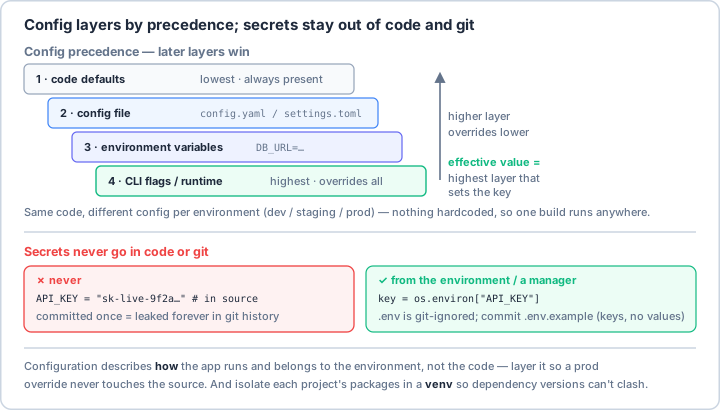
.env in .gitignore, and commit only a .env.example with keys and no values. (And isolate each project's packages in a venv so versions can't clash.)Real-World Scenario: The Multi-Environment Application Platform 🚀
You're managing a complex application that runs in development, staging, and production environments. Each environment has different database connections, API endpoints, feature flags, and secrets. Developers need isolated Python environments, operations needs containerized deployments, and security demands encrypted secrets. Let's build a comprehensive environment management system!
import os
import sys
import json
import yaml
import platform
import subprocess
import shutil
import hashlib
import base64
import tempfile
from pathlib import Path
from typing import Dict, List, Optional, Any, Tuple, Union
from dataclasses import dataclass, field, asdict
from enum import Enum
from datetime import datetime, timedelta
import logging
import re
import configparser
import venv
import pkg_resources
from cryptography.fernet import Fernet
from cryptography.hazmat.primitives import hashes
from cryptography.hazmat.primitives.kdf.pbkdf2 import PBKDF2HMAC
import docker
import requests
from dotenv import load_dotenv, dotenv_values
import toml
class EnvironmentType(Enum):
"""Types of environments."""
DEVELOPMENT = "development"
STAGING = "staging"
PRODUCTION = "production"
TESTING = "testing"
LOCAL = "local"
@dataclass
class Environment:
"""Environment configuration."""
name: str
type: EnvironmentType
variables: Dict[str, str] = field(default_factory=dict)
secrets: Dict[str, str] = field(default_factory=dict)
features: Dict[str, bool] = field(default_factory=dict)
services: Dict[str, str] = field(default_factory=dict)
dependencies: List[str] = field(default_factory=list)
created_at: datetime = field(default_factory=datetime.now)
updated_at: datetime = field(default_factory=datetime.now)
@dataclass
class ServiceConfig:
"""Service configuration."""
name: str
host: str
port: int
protocol: str = "http"
credentials: Dict[str, str] = field(default_factory=dict)
health_check: str = "/health"
timeout: int = 30
class EnvironmentManager:
"""
Comprehensive environment management system for configuration,
secrets, and deployment environments.
"""
def __init__(self, config_dir: str = None):
self.config_dir = Path(config_dir) if config_dir else Path.home() / '.envmanager'
self.config_dir.mkdir(parents=True, exist_ok=True)
self.environments = {}
self.current_env = None
self.secret_manager = SecretManager(self.config_dir / 'secrets')
self.config_manager = ConfigurationManager(self.config_dir / 'configs')
self.setup_logging()
self.load_environments()
def setup_logging(self):
"""Setup logging configuration."""
log_file = self.config_dir / 'environment.log'
logging.basicConfig(
level=logging.INFO,
format='%(asctime)s - %(name)s - %(levelname)s - %(message)s',
handlers=[
logging.FileHandler(log_file),
logging.StreamHandler()
]
)
self.logger = logging.getLogger(__name__)
def create_environment(self, env: Environment) -> bool:
"""Create a new environment."""
try:
# Store environment
self.environments[env.name] = env
# Create environment directory
env_dir = self.config_dir / 'environments' / env.name
env_dir.mkdir(parents=True, exist_ok=True)
# Save environment configuration
config_file = env_dir / 'environment.json'
with open(config_file, 'w') as f:
json.dump(asdict(env), f, indent=2, default=str)
# Create .env file
env_file = env_dir / '.env'
with open(env_file, 'w') as f:
for key, value in env.variables.items():
f.write(f"{key}={value}\n")
# Store secrets securely
for key, value in env.secrets.items():
self.secret_manager.store_secret(f"{env.name}_{key}", value)
self.logger.info(f"Created environment: {env.name}")
return True
except Exception as e:
self.logger.error(f"Failed to create environment: {e}")
return False
def load_environments(self):
"""Load all environments from disk."""
env_root = self.config_dir / 'environments'
if not env_root.exists():
return
for env_dir in env_root.iterdir():
if env_dir.is_dir():
config_file = env_dir / 'environment.json'
if config_file.exists():
with open(config_file, 'r') as f:
data = json.load(f)
env = Environment(
name=data['name'],
type=EnvironmentType(data['type']),
variables=data.get('variables', {}),
secrets=data.get('secrets', {}),
features=data.get('features', {}),
services=data.get('services', {}),
dependencies=data.get('dependencies', [])
)
self.environments[env.name] = env
def activate_environment(self, name: str) -> bool:
"""Activate an environment."""
if name not in self.environments:
self.logger.error(f"Environment not found: {name}")
return False
env = self.environments[name]
# Set environment variables
for key, value in env.variables.items():
os.environ[key] = value
# Load secrets into environment
for key in env.secrets:
secret_value = self.secret_manager.get_secret(f"{name}_{key}")
if secret_value:
os.environ[key] = secret_value
# Set current environment
self.current_env = env
os.environ['ENVIRONMENT'] = name
os.environ['ENVIRONMENT_TYPE'] = env.type.value
self.logger.info(f"Activated environment: {name}")
return True
def deactivate_environment(self):
"""Deactivate current environment."""
if not self.current_env:
return
# Remove environment variables
for key in self.current_env.variables:
os.environ.pop(key, None)
# Remove secrets from environment
for key in self.current_env.secrets:
os.environ.pop(key, None)
# Clear environment markers
os.environ.pop('ENVIRONMENT', None)
os.environ.pop('ENVIRONMENT_TYPE', None)
self.logger.info(f"Deactivated environment: {self.current_env.name}")
self.current_env = None
def get_config(self, key: str, default: Any = None) -> Any:
"""Get configuration value from current environment."""
if not self.current_env:
return default
# Check variables
if key in self.current_env.variables:
return self.current_env.variables[key]
# Check secrets
if key in self.current_env.secrets:
return self.secret_manager.get_secret(f"{self.current_env.name}_{key}")
# Check environment variables
return os.environ.get(key, default)
def is_feature_enabled(self, feature: str) -> bool:
"""Check if a feature is enabled in current environment."""
if not self.current_env:
return False
return self.current_env.features.get(feature, False)
def get_service_config(self, service: str) -> Optional[ServiceConfig]:
"""Get service configuration for current environment."""
if not self.current_env:
return None
if service not in self.current_env.services:
return None
# Parse service configuration
service_data = self.current_env.services[service]
if isinstance(service_data, str):
# Simple URL format
parts = service_data.split(':')
if len(parts) >= 2:
return ServiceConfig(
name=service,
host=parts[0],
port=int(parts[1]) if parts[1].isdigit() else 80
)
elif isinstance(service_data, dict):
return ServiceConfig(**service_data)
return None
def export_environment(self, name: str, format: str = 'env') -> str:
"""Export environment configuration."""
if name not in self.environments:
raise ValueError(f"Environment not found: {name}")
env = self.environments[name]
if format == 'env':
# .env format
lines = []
for key, value in env.variables.items():
lines.append(f"{key}={value}")
return '\n'.join(lines)
elif format == 'json':
# JSON format
return json.dumps(asdict(env), indent=2, default=str)
elif format == 'yaml':
# YAML format
return yaml.dump(asdict(env), default_flow_style=False)
elif format == 'docker':
# Docker environment format
lines = []
for key, value in env.variables.items():
lines.append(f"ENV {key}={value}")
return '\n'.join(lines)
else:
raise ValueError(f"Unknown export format: {format}")
def compare_environments(self, env1_name: str, env2_name: str) -> Dict:
"""Compare two environments."""
if env1_name not in self.environments:
raise ValueError(f"Environment not found: {env1_name}")
if env2_name not in self.environments:
raise ValueError(f"Environment not found: {env2_name}")
env1 = self.environments[env1_name]
env2 = self.environments[env2_name]
comparison = {
'variables': {
'only_in_env1': {},
'only_in_env2': {},
'different': {}
},
'secrets': {
'only_in_env1': set(),
'only_in_env2': set()
},
'features': {
'only_in_env1': {},
'only_in_env2': {},
'different': {}
}
}
# Compare variables
for key, value in env1.variables.items():
if key not in env2.variables:
comparison['variables']['only_in_env1'][key] = value
elif env2.variables[key] != value:
comparison['variables']['different'][key] = {
env1_name: value,
env2_name: env2.variables[key]
}
for key, value in env2.variables.items():
if key not in env1.variables:
comparison['variables']['only_in_env2'][key] = value
# Compare secrets (keys only, not values)
comparison['secrets']['only_in_env1'] = set(env1.secrets.keys()) - set(env2.secrets.keys())
comparison['secrets']['only_in_env2'] = set(env2.secrets.keys()) - set(env1.secrets.keys())
# Compare features
for key, value in env1.features.items():
if key not in env2.features:
comparison['features']['only_in_env1'][key] = value
elif env2.features[key] != value:
comparison['features']['different'][key] = {
env1_name: value,
env2_name: env2.features[key]
}
for key, value in env2.features.items():
if key not in env1.features:
comparison['features']['only_in_env2'][key] = value
return comparison
class SecretManager:
"""
Secure secret management with encryption.
"""
def __init__(self, secret_dir: Path):
self.secret_dir = secret_dir
self.secret_dir.mkdir(parents=True, exist_ok=True)
# Initialize encryption
self.master_key = self._get_or_create_master_key()
self.cipher = Fernet(self.master_key)
self.logger = logging.getLogger(__name__)
def _get_or_create_master_key(self) -> bytes:
"""Get or create master encryption key."""
key_file = self.secret_dir / '.master.key'
if key_file.exists():
with open(key_file, 'rb') as f:
return f.read()
else:
# Generate new key
key = Fernet.generate_key()
# Store securely (in production, use key management service)
with open(key_file, 'wb') as f:
f.write(key)
# Restrict permissions
os.chmod(key_file, 0o600)
return key
def store_secret(self, name: str, value: str) -> bool:
"""Store an encrypted secret."""
try:
# Encrypt value
encrypted = self.cipher.encrypt(value.encode())
# Store in file
secret_file = self.secret_dir / f"{name}.secret"
with open(secret_file, 'wb') as f:
f.write(encrypted)
# Restrict permissions
os.chmod(secret_file, 0o600)
self.logger.info(f"Stored secret: {name}")
return True
except Exception as e:
self.logger.error(f"Failed to store secret: {e}")
return False
def get_secret(self, name: str) -> Optional[str]:
"""Retrieve and decrypt a secret."""
try:
secret_file = self.secret_dir / f"{name}.secret"
if not secret_file.exists():
return None
# Read encrypted value
with open(secret_file, 'rb') as f:
encrypted = f.read()
# Decrypt
decrypted = self.cipher.decrypt(encrypted)
return decrypted.decode()
except Exception as e:
self.logger.error(f"Failed to get secret: {e}")
return None
def delete_secret(self, name: str) -> bool:
"""Delete a secret."""
try:
secret_file = self.secret_dir / f"{name}.secret"
if secret_file.exists():
# Overwrite with random data before deletion
with open(secret_file, 'wb') as f:
f.write(os.urandom(1024))
secret_file.unlink()
self.logger.info(f"Deleted secret: {name}")
return True
return False
except Exception as e:
self.logger.error(f"Failed to delete secret: {e}")
return False
def rotate_secret(self, name: str, new_value: str) -> bool:
"""Rotate a secret value."""
# Store old value with timestamp
old_value = self.get_secret(name)
if old_value:
timestamp = datetime.now().strftime("%Y%m%d_%H%M%S")
self.store_secret(f"{name}_backup_{timestamp}", old_value)
# Store new value
return self.store_secret(name, new_value)
class ConfigurationManager:
"""
Manage application configurations across environments.
"""
def __init__(self, config_dir: Path):
self.config_dir = config_dir
self.config_dir.mkdir(parents=True, exist_ok=True)
self.configs = {}
self.logger = logging.getLogger(__name__)
def load_config(self, file_path: str, format: str = None) -> Dict:
"""Load configuration from file."""
file_path = Path(file_path)
if not format:
# Detect format from extension
format = file_path.suffix[1:] if file_path.suffix else 'json'
try:
with open(file_path, 'r') as f:
if format == 'json':
return json.load(f)
elif format == 'yaml' or format == 'yml':
return yaml.safe_load(f)
elif format == 'toml':
return toml.load(f)
elif format == 'ini':
parser = configparser.ConfigParser()
parser.read_string(f.read())
return {s: dict(parser[s]) for s in parser.sections()}
elif format == 'env':
return dotenv_values(file_path)
else:
raise ValueError(f"Unknown format: {format}")
except Exception as e:
self.logger.error(f"Failed to load config: {e}")
return {}
def merge_configs(self, *configs: Dict) -> Dict:
"""Merge multiple configurations with precedence."""
result = {}
for config in configs:
result = self._deep_merge(result, config)
return result
def _deep_merge(self, dict1: Dict, dict2: Dict) -> Dict:
"""Deep merge two dictionaries."""
result = dict1.copy()
for key, value in dict2.items():
if key in result and isinstance(result[key], dict) and isinstance(value, dict):
result[key] = self._deep_merge(result[key], value)
else:
result[key] = value
return result
def validate_config(self, config: Dict, schema: Dict) -> Tuple[bool, List[str]]:
"""Validate configuration against schema."""
errors = []
def validate_item(data, schema, path=""):
if 'type' in schema:
expected_type = schema['type']
if expected_type == 'string' and not isinstance(data, str):
errors.append(f"{path}: Expected string, got {type(data).__name__}")
elif expected_type == 'number' and not isinstance(data, (int, float)):
errors.append(f"{path}: Expected number, got {type(data).__name__}")
elif expected_type == 'boolean' and not isinstance(data, bool):
errors.append(f"{path}: Expected boolean, got {type(data).__name__}")
elif expected_type == 'object' and not isinstance(data, dict):
errors.append(f"{path}: Expected object, got {type(data).__name__}")
elif expected_type == 'array' and not isinstance(data, list):
errors.append(f"{path}: Expected array, got {type(data).__name__}")
if 'required' in schema and isinstance(data, dict):
for required_key in schema['required']:
if required_key not in data:
errors.append(f"{path}: Missing required field '{required_key}'")
if 'properties' in schema and isinstance(data, dict):
for key, value in data.items():
if key in schema['properties']:
validate_item(value, schema['properties'][key], f"{path}.{key}")
validate_item(config, schema)
return len(errors) == 0, errors
def substitute_variables(self, config: Dict, variables: Dict) -> Dict:
"""Substitute variables in configuration."""
def substitute(obj):
if isinstance(obj, str):
# Replace ${VAR} patterns
pattern = r'\$\{([^}]+)\}'
def replacer(match):
var_name = match.group(1)
return str(variables.get(var_name, match.group(0)))
return re.sub(pattern, replacer, obj)
elif isinstance(obj, dict):
return {k: substitute(v) for k, v in obj.items()}
elif isinstance(obj, list):
return [substitute(item) for item in obj]
else:
return obj
return substitute(config)
class PythonEnvironmentManager:
"""
Manage Python virtual environments.
"""
def __init__(self, base_dir: str = None):
self.base_dir = Path(base_dir) if base_dir else Path.home() / '.pyenvs'
self.base_dir.mkdir(parents=True, exist_ok=True)
self.logger = logging.getLogger(__name__)
def create_venv(self, name: str, python_version: str = None) -> bool:
"""Create a Python virtual environment."""
try:
venv_path = self.base_dir / name
if venv_path.exists():
self.logger.warning(f"Virtual environment already exists: {name}")
return False
# Create virtual environment.
# NOTE: venv.create() always uses the CURRENTLY running
# interpreter -- it cannot build an environment for a
# different Python version. The `python_version` argument is
# therefore advisory here. To actually target another version
# you must shell out to that interpreter, e.g.:
# subprocess.run([f"python{python_version}", "-m", "venv",
# str(venv_path)], check=True)
if python_version:
venv.create(venv_path, with_pip=True,
system_site_packages=False,
symlinks=True)
else:
# Use current Python
venv.create(venv_path, with_pip=True)
self.logger.info(f"Created virtual environment: {name}")
return True
except Exception as e:
self.logger.error(f"Failed to create venv: {e}")
return False
def activate_venv(self, name: str) -> Optional[str]:
"""Get activation command for virtual environment."""
venv_path = self.base_dir / name
if not venv_path.exists():
self.logger.error(f"Virtual environment not found: {name}")
return None
if platform.system() == 'Windows':
activate_script = venv_path / 'Scripts' / 'activate.bat'
else:
activate_script = venv_path / 'bin' / 'activate'
return str(activate_script)
def install_requirements(self, name: str, requirements: Union[str, List[str]]) -> bool:
"""Install packages in virtual environment."""
venv_path = self.base_dir / name
if not venv_path.exists():
self.logger.error(f"Virtual environment not found: {name}")
return False
try:
# Get pip executable
if platform.system() == 'Windows':
pip_exe = venv_path / 'Scripts' / 'pip.exe'
else:
pip_exe = venv_path / 'bin' / 'pip'
# Install requirements
if isinstance(requirements, str):
# Requirements file
cmd = [str(pip_exe), 'install', '-r', requirements]
else:
# List of packages
cmd = [str(pip_exe), 'install'] + requirements
result = subprocess.run(cmd, capture_output=True, text=True)
if result.returncode == 0:
self.logger.info(f"Installed requirements in {name}")
return True
else:
self.logger.error(f"Failed to install requirements: {result.stderr}")
return False
except Exception as e:
self.logger.error(f"Failed to install requirements: {e}")
return False
def freeze_requirements(self, name: str) -> Optional[str]:
"""Get installed packages from virtual environment."""
venv_path = self.base_dir / name
if not venv_path.exists():
return None
try:
# Get pip executable
if platform.system() == 'Windows':
pip_exe = venv_path / 'Scripts' / 'pip.exe'
else:
pip_exe = venv_path / 'bin' / 'pip'
result = subprocess.run(
[str(pip_exe), 'freeze'],
capture_output=True,
text=True
)
if result.returncode == 0:
return result.stdout
return None
except Exception as e:
self.logger.error(f"Failed to freeze requirements: {e}")
return None
def delete_venv(self, name: str) -> bool:
"""Delete a virtual environment."""
venv_path = self.base_dir / name
if not venv_path.exists():
return False
try:
shutil.rmtree(venv_path)
self.logger.info(f"Deleted virtual environment: {name}")
return True
except Exception as e:
self.logger.error(f"Failed to delete venv: {e}")
return False
class ContainerEnvironmentManager:
"""
Manage containerized environments with Docker.
"""
def __init__(self):
self.client = docker.from_env()
self.logger = logging.getLogger(__name__)
def build_environment(self, name: str, dockerfile: str,
build_args: Dict = None) -> bool:
"""Build a Docker environment."""
try:
image, logs = self.client.images.build(
path=dockerfile,
tag=name,
buildargs=build_args or {},
rm=True
)
for log in logs:
if 'stream' in log:
self.logger.info(log['stream'].strip())
self.logger.info(f"Built Docker environment: {name}")
return True
except Exception as e:
self.logger.error(f"Failed to build environment: {e}")
return False
def run_in_environment(self, image: str, command: str,
environment: Dict = None,
volumes: Dict = None) -> Tuple[int, str]:
"""Run command in containerized environment."""
try:
container = self.client.containers.run(
image=image,
command=command,
environment=environment or {},
volumes=volumes or {},
detach=False,
remove=True,
stdout=True,
stderr=True
)
# Get output
output = container.decode() if isinstance(container, bytes) else str(container)
return 0, output
except docker.errors.ContainerError as e:
return e.exit_status, e.stderr.decode() if e.stderr else str(e)
except Exception as e:
self.logger.error(f"Failed to run in environment: {e}")
return 1, str(e)
def create_compose_file(self, services: Dict[str, Dict]) -> str:
"""Create Docker Compose configuration."""
compose = {
'version': '3.8',
'services': {}
}
for name, config in services.items():
service = {
'image': config.get('image', name),
'environment': config.get('environment', {}),
'ports': config.get('ports', []),
'volumes': config.get('volumes', []),
'depends_on': config.get('depends_on', [])
}
# Remove empty fields
service = {k: v for k, v in service.items() if v}
compose['services'][name] = service
return yaml.dump(compose, default_flow_style=False)
class SystemEnvironmentManager:
"""
Manage system-level environment configurations.
"""
def __init__(self):
self.logger = logging.getLogger(__name__)
self.system = platform.system()
def get_system_info(self) -> Dict:
"""Get system environment information."""
return {
'platform': platform.platform(),
'system': platform.system(),
'release': platform.release(),
'version': platform.version(),
'machine': platform.machine(),
'processor': platform.processor(),
'python_version': platform.python_version(),
'python_implementation': platform.python_implementation(),
'hostname': platform.node(),
'user': os.environ.get('USER') or os.environ.get('USERNAME'),
'home': str(Path.home()),
'cwd': os.getcwd(),
'path': os.environ.get('PATH', '').split(os.pathsep)
}
def set_system_variable(self, name: str, value: str,
persistent: bool = False) -> bool:
"""Set system environment variable."""
try:
# Set for current process
os.environ[name] = value
if persistent:
if self.system == 'Windows':
# Windows - use setx
subprocess.run(['setx', name, value], check=True)
elif self.system in ['Linux', 'Darwin']:
# Unix-like - add to shell profile
shell = os.environ.get('SHELL', '/bin/bash')
if 'bash' in shell:
profile = Path.home() / '.bashrc'
elif 'zsh' in shell:
profile = Path.home() / '.zshrc'
else:
profile = Path.home() / '.profile'
with open(profile, 'a') as f:
f.write(f'\nexport {name}="{value}"\n')
self.logger.info(f"Added {name} to {profile}")
return True
except Exception as e:
self.logger.error(f"Failed to set system variable: {e}")
return False
def update_path(self, directory: str, prepend: bool = True) -> bool:
"""Update system PATH variable."""
try:
current_path = os.environ.get('PATH', '')
path_list = current_path.split(os.pathsep)
# Check if already in PATH
if directory in path_list:
return True
# Add to PATH
if prepend:
path_list.insert(0, directory)
else:
path_list.append(directory)
new_path = os.pathsep.join(path_list)
os.environ['PATH'] = new_path
self.logger.info(f"Updated PATH with: {directory}")
return True
except Exception as e:
self.logger.error(f"Failed to update PATH: {e}")
return False
# Example usage
if __name__ == "__main__":
# Initialize environment manager
env_manager = EnvironmentManager()
# Example 1: Create development environment
dev_env = Environment(
name="development",
type=EnvironmentType.DEVELOPMENT,
variables={
"DEBUG": "true",
"LOG_LEVEL": "debug",
"DATABASE_HOST": "localhost",
"DATABASE_PORT": "5432",
"API_ENDPOINT": "http://localhost:8000"
},
secrets={
"DATABASE_PASSWORD": "dev_password",
"API_KEY": "dev_api_key_12345",
"JWT_SECRET": "dev_jwt_secret"
},
features={
"new_feature": True,
"experimental_api": True,
"debug_mode": True
},
services={
"database": "localhost:5432",
"redis": "localhost:6379",
"api": "http://localhost:8000"
}
)
env_manager.create_environment(dev_env)
# Example 2: Create production environment
prod_env = Environment(
name="production",
type=EnvironmentType.PRODUCTION,
variables={
"DEBUG": "false",
"LOG_LEVEL": "error",
"DATABASE_HOST": "db.production.com",
"DATABASE_PORT": "5432",
"API_ENDPOINT": "https://api.production.com"
},
secrets={
"DATABASE_PASSWORD": "prod_secure_password",
"API_KEY": "prod_api_key_67890",
"JWT_SECRET": "prod_jwt_secret",
"SSL_CERT": "-----BEGIN CERTIFICATE-----..."
},
features={
"new_feature": False,
"experimental_api": False,
"debug_mode": False
},
services={
"database": "db.production.com:5432",
"redis": "redis.production.com:6379",
"api": "https://api.production.com"
}
)
env_manager.create_environment(prod_env)
# Example 3: Activate and use environment
print("\n🌍 Activating Development Environment")
env_manager.activate_environment("development")
# Access configuration
print(f" DEBUG: {env_manager.get_config('DEBUG')}")
print(f" API Endpoint: {env_manager.get_config('API_ENDPOINT')}")
print(f" New Feature Enabled: {env_manager.is_feature_enabled('new_feature')}")
# Get service configuration
db_config = env_manager.get_service_config('database')
if db_config:
print(f" Database: {db_config.host}:{db_config.port}")
# Example 4: Compare environments
print("\n🔍 Comparing Environments")
comparison = env_manager.compare_environments("development", "production")
print(" Variable Differences:")
for key, values in comparison['variables']['different'].items():
print(f" {key}:")
print(f" Dev: {values['development']}")
print(f" Prod: {values['production']}")
print(" Feature Differences:")
for key, values in comparison['features']['different'].items():
print(f" {key}: Dev={values['development']}, Prod={values['production']}")
# Example 5: Export environment
print("\n📤 Exporting Environment")
env_export = env_manager.export_environment("development", format="env")
print(" .env format:")
print(" " + "\n ".join(env_export.split("\n")[:3]))
# Example 6: Configuration management
config_manager = ConfigurationManager(Path.home() / '.envmanager' / 'configs')
# Load and merge configurations
base_config = {
"app": {
"name": "MyApp",
"version": "1.0.0"
},
"database": {
"host": "${DATABASE_HOST}",
"port": "${DATABASE_PORT}"
}
}
# Substitute variables
substituted = config_manager.substitute_variables(
base_config,
{"DATABASE_HOST": "localhost", "DATABASE_PORT": "5432"}
)
print("\n⚙️ Configuration with substituted variables:")
print(f" Database: {substituted['database']['host']}:{substituted['database']['port']}")
# Example 7: Python virtual environments
print("\n🐍 Managing Python Virtual Environments")
py_env_manager = PythonEnvironmentManager()
# Create virtual environment
py_env_manager.create_venv("myproject")
# Install packages
py_env_manager.install_requirements("myproject", ["requests", "flask"])
# Get activation script
activate_script = py_env_manager.activate_venv("myproject")
if activate_script:
print(f" Activate with: source {activate_script}")
# Example 8: Container environments
print("\n🐳 Container Environment Management")
container_manager = ContainerEnvironmentManager()
# Create Docker Compose configuration
services = {
"web": {
"image": "myapp:latest",
"environment": {
"DEBUG": "false",
"DATABASE_URL": "postgresql://db:5432/myapp"
},
"ports": ["80:8000"],
"depends_on": ["db"]
},
"db": {
"image": "postgres:13",
"environment": {
"POSTGRES_DB": "myapp",
"POSTGRES_PASSWORD": "secret"
},
"volumes": ["pgdata:/var/lib/postgresql/data"]
}
}
compose_yaml = container_manager.create_compose_file(services)
print(" Docker Compose Configuration:")
print(" " + "\n ".join(compose_yaml.split("\n")[:10]))
# Example 9: System environment
print("\n💻 System Environment Information")
sys_env_manager = SystemEnvironmentManager()
sys_info = sys_env_manager.get_system_info()
print(f" Platform: {sys_info['platform']}")
print(f" Python: {sys_info['python_version']}")
print(f" User: {sys_info['user']}")
print(f" Home: {sys_info['home']}")
# Example 10: Secret rotation
print("\n🔐 Secret Management")
secret_manager = env_manager.secret_manager
# Store a secret
secret_manager.store_secret("api_token", "secret_token_12345")
# Rotate secret
secret_manager.rotate_secret("api_token", "new_secret_token_67890")
# Retrieve secret
current_secret = secret_manager.get_secret("api_token")
print(f" Current API Token: {'*' * 10 + current_secret[-5:] if current_secret else 'None'}")
# Deactivate environment
env_manager.deactivate_environment()
print("\n✅ Environment management demonstration complete!")
Key Takeaways and Best Practices 🎯
- Never Hardcode Secrets: Always use environment variables or secret management systems.
- Separate Environments: Keep development, staging, and production completely isolated.
- Use Version Control Wisely: Store configurations in version control, but never secrets.
- Encrypt Sensitive Data: Always encrypt secrets at rest and in transit.
- Implement Feature Flags: Control feature rollout across environments.
- Validate Configurations: Always validate configurations before deployment.
- Audit Environment Changes: Keep logs of all environment modifications.
Environment Management Best Practices 📋
Environment management mastery transforms you from a configuration juggler to an infrastructure conductor. You can seamlessly deploy applications across multiple environments, manage secrets securely, and ensure consistency from development to production. Whether you're managing a single application or a microservices architecture, these environment management skills are essential for modern DevOps! 🚀
Pro Tip: Environment management is like being a stage director - you ensure every actor (service) has the right props (configurations) for their scene (environment). Always follow the principle of least privilege for secrets, use immutable infrastructure where possible, and implement proper secret rotation. Remember the 12-factor app methodology: treat configuration as code, but secrets as runtime concerns. Use tools like HashiCorp Vault for production secret management, implement proper RBAC (Role-Based Access Control), and always have a rollback plan. Most importantly: test your disaster recovery procedures - the worst time to discover your backup secrets don't work is during an outage!