🧠 Natural Language Processing: Make Bots Understand Human Language
📚 What You'll Learn
By the end of this lesson, you will be able to:
- Apply core text-processing steps — tokenization, normalization, and POS tagging — with libraries like NLTK and spaCy
- Recognize a user's intent (what they want) and extract the entities (the values it needs)
- Implement slot-filling so the bot asks follow-up questions until every required value is collected
- Explain why intent-plus-entities generalizes where brittle keyword matching fails
- Use a confidence threshold with a fallback so low-confidence input triggers a clarifying question instead of a wrong guess
- Add a confirmation step before costly or irreversible actions, and analyze sentiment to shape responses
⏱️ Estimated Time: 45–60 minutes
🎯 Project: Build a mini natural-language handler that classifies an intent, extracts its entities, slot-fills any missing value, and falls back to a clarifying question when confidence is low.
Natural Language Processing (NLP) is the bridge between human communication and machine understanding - it transforms the messy, ambiguous world of human language into structured data that bots can process and respond to intelligently. Like teaching a computer to truly understand conversation, mastering NLP allows you to build bots that comprehend intent, extract information, analyze sentiment, and engage in natural dialogue. Let's explore the fascinating world of NLP for chatbot development! 🤖
The NLP Architecture for Chatbots
Think of NLP as giving your bot a brain that can decode human language - it processes text through multiple layers of analysis, from basic tokenization to complex semantic understanding. Using libraries like NLTK, spaCy, and Transformers, combined with AI services like Dialogflow and LUIS, you can create bots that understand context, handle multiple languages, and provide intelligent responses. Understanding these NLP techniques is essential for building truly conversational bots!
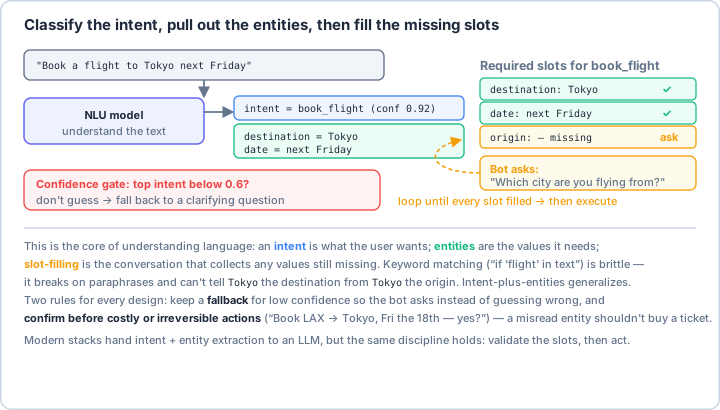
Tokyo-the-destination from Tokyo-the-origin; intent-plus-entities generalizes. Two rules for every design: keep a fallback for low-confidence input so the bot asks instead of guessing wrong, and confirm before costly or irreversible actions — a misread entity shouldn't buy a ticket.Real-World Scenario: The Intelligent Virtual Assistant 🎯
You're building an intelligent virtual assistant that understands natural language queries, extracts key information from conversations, handles multiple intents in a single message, maintains context across interactions, supports multiple languages, analyzes user sentiment, generates human-like responses, learns from interactions, and integrates with various services. Your bot must handle ambiguous inputs, understand slang and typos, and provide helpful responses even when uncertain. Let's build a comprehensive NLP framework for chatbots!
# First, install required packages:
# pip install nltk spacy transformers torch tensorflow dialogflow google-cloud-language textblob rasa
import re
import json
import logging
from typing import List, Dict, Optional, Any, Tuple, Union
from dataclasses import dataclass, field
from enum import Enum
from datetime import datetime, timedelta
import numpy as np
# NLP Libraries
import nltk
import spacy
from textblob import TextBlob
from transformers import pipeline, AutoTokenizer, AutoModelForSequenceClassification
import torch
# Download required NLTK data
nltk.download('punkt')
nltk.download('wordnet')
nltk.download('averaged_perceptron_tagger')
nltk.download('stopwords')
nltk.download('vader_lexicon')
# Load spaCy model (install with: python -m spacy download en_core_web_sm)
nlp = spacy.load("en_core_web_sm")
# ==================== NLP Configuration ====================
@dataclass
class NLPConfig:
"""NLP configuration for chatbot."""
# Models
language_model: str = "en_core_web_sm"
sentiment_model: str = "distilbert-base-uncased-finetuned-sst-2-english"
# Thresholds
intent_confidence_threshold: float = 0.7
entity_confidence_threshold: float = 0.8
# Features
enable_sentiment_analysis: bool = True
enable_entity_extraction: bool = True
enable_spell_correction: bool = True
enable_translation: bool = False
# Context
context_window_size: int = 5
session_timeout: int = 1800 # 30 minutes
# Languages
supported_languages: List[str] = field(default_factory=lambda: ["en", "es", "fr", "de"])
default_language: str = "en"
# ==================== Intent and Entity Classes ====================
class Intent(Enum):
"""Common chatbot intents."""
GREETING = "greeting"
GOODBYE = "goodbye"
HELP = "help"
QUESTION = "question"
COMMAND = "command"
FEEDBACK = "feedback"
SMALL_TALK = "small_talk"
COMPLAINT = "complaint"
APPRECIATION = "appreciation"
UNKNOWN = "unknown"
@dataclass
class Entity:
"""Extracted entity from text."""
text: str
type: str # PERSON, LOCATION, DATE, etc.
value: Any
confidence: float
start: int
end: int
@dataclass
class NLPResult:
"""Result of NLP processing."""
original_text: str
processed_text: str
language: str
# Core NLP
tokens: List[str]
lemmas: List[str]
pos_tags: List[Tuple[str, str]]
# Understanding
intent: Intent
intent_confidence: float
entities: List[Entity]
# Sentiment
sentiment: str # positive, negative, neutral
sentiment_score: float
emotion: Optional[str] = None
# Additional
keywords: List[str] = field(default_factory=list)
topics: List[str] = field(default_factory=list)
# Response hints
requires_clarification: bool = False
suggested_responses: List[str] = field(default_factory=list)
# ==================== Text Preprocessor ====================
class TextPreprocessor:
"""Preprocess text for NLP."""
def __init__(self, config: NLPConfig):
self.config = config
self.stopwords = set(nltk.corpus.stopwords.words('english'))
def process(self, text: str) -> str:
"""Full preprocessing pipeline."""
# Clean text
text = self.clean_text(text)
# Spell correction
if self.config.enable_spell_correction:
text = self.correct_spelling(text)
# Normalize
text = self.normalize_text(text)
return text
def clean_text(self, text: str) -> str:
"""Clean and standardize text."""
# Remove extra whitespace
text = ' '.join(text.split())
# Convert to lowercase for processing
text = text.lower()
# Remove special characters but keep punctuation for intent
text = re.sub(r'[^\w\s\?\!\.\,\']', '', text)
# Expand contractions
contractions = {
"don't": "do not",
"won't": "will not",
"can't": "cannot",
"n't": " not",
"'re": " are",
"'ve": " have",
"'ll": " will",
"'d": " would",
"'m": " am"
}
for contraction, expanded in contractions.items():
text = text.replace(contraction, expanded)
return text
def correct_spelling(self, text: str) -> str:
"""Correct spelling mistakes."""
blob = TextBlob(text)
return str(blob.correct())
def normalize_text(self, text: str) -> str:
"""Normalize text (numbers, dates, etc.)."""
# Normalize numbers
text = re.sub(r'\b\d+\b', '', text)
# Normalize URLs
text = re.sub(r'http\S+|www\S+', '', text)
# Normalize emails
text = re.sub(r'\S+@\S+', '', text)
return text
def tokenize(self, text: str) -> List[str]:
"""Tokenize text into words."""
return nltk.word_tokenize(text)
def remove_stopwords(self, tokens: List[str]) -> List[str]:
"""Remove stopwords from tokens."""
return [t for t in tokens if t.lower() not in self.stopwords]
def lemmatize(self, tokens: List[str]) -> List[str]:
"""Lemmatize tokens."""
lemmatizer = nltk.WordNetLemmatizer()
return [lemmatizer.lemmatize(token) for token in tokens]
# ==================== Intent Classifier ====================
class IntentClassifier:
"""Classify user intent from text."""
def __init__(self):
self.patterns = self._load_intent_patterns()
self.ml_classifier = None # Can load trained model
def _load_intent_patterns(self) -> Dict[Intent, List[str]]:
"""Load regex patterns for intent matching."""
return {
Intent.GREETING: [
r'\b(hi|hello|hey|greetings|good morning|good afternoon|good evening)\b',
r'\b(howdy|sup|what\'s up)\b'
],
Intent.GOODBYE: [
r'\b(bye|goodbye|see you|farewell|quit|exit)\b',
r'\b(talk to you later|ttyl|cya)\b'
],
Intent.HELP: [
r'\b(help|assist|support|guide|how to)\b',
r'\b(what can you do|how does this work)\b'
],
Intent.QUESTION: [
r'^(what|when|where|who|why|how|can|could|would|should|is|are|do|does)',
r'\?$'
],
Intent.APPRECIATION: [
r'\b(thank|thanks|appreciate|grateful|awesome|great|good job)\b',
r'\b(well done|nice|excellent|perfect)\b'
],
Intent.COMPLAINT: [
r'\b(problem|issue|wrong|broken|not working|error|bug)\b',
r'\b(terrible|awful|horrible|bad|worst)\b'
]
}
def classify(self, text: str) -> Tuple[Intent, float]:
"""Classify intent from text."""
text_lower = text.lower()
# Pattern-based classification
for intent, patterns in self.patterns.items():
for pattern in patterns:
if re.search(pattern, text_lower):
return intent, 0.9
# ML-based classification (if available)
if self.ml_classifier:
return self._ml_classify(text)
# Default to unknown
return Intent.UNKNOWN, 0.5
def _ml_classify(self, text: str) -> Tuple[Intent, float]:
"""Use ML model for classification."""
# Placeholder for ML classification
# In production, use trained model
return Intent.UNKNOWN, 0.5
def train(self, training_data: List[Tuple[str, Intent]]):
"""Train intent classifier on data."""
# Placeholder for training logic
# Could use sklearn, TensorFlow, or PyTorch
pass
# ==================== Entity Extractor ====================
class EntityExtractor:
"""Extract entities from text."""
def __init__(self, config: NLPConfig):
self.config = config
self.nlp = nlp # spaCy model
def extract(self, text: str) -> List[Entity]:
"""Extract entities from text."""
doc = self.nlp(text)
entities = []
# Extract named entities
for ent in doc.ents:
entities.append(Entity(
text=ent.text,
type=ent.label_,
value=ent.text,
confidence=0.9, # spaCy doesn't provide confidence
start=ent.start_char,
end=ent.end_char
))
# Extract custom entities
entities.extend(self._extract_custom_entities(text))
return entities
def _extract_custom_entities(self, text: str) -> List[Entity]:
"""Extract custom entities like email, phone, etc."""
entities = []
# Email extraction
email_pattern = r'\b[A-Za-z0-9._%+-]+@[A-Za-z0-9.-]+\.[A-Z|a-z]{2,}\b'
for match in re.finditer(email_pattern, text):
entities.append(Entity(
text=match.group(),
type="EMAIL",
value=match.group(),
confidence=1.0,
start=match.start(),
end=match.end()
))
# Phone number extraction
phone_pattern = r'\b\d{3}[-.]?\d{3}[-.]?\d{4}\b'
for match in re.finditer(phone_pattern, text):
entities.append(Entity(
text=match.group(),
type="PHONE",
value=match.group(),
confidence=0.95,
start=match.start(),
end=match.end()
))
# Date extraction (simple)
date_pattern = r'\b(today|tomorrow|yesterday|\d{1,2}/\d{1,2}/\d{2,4})\b'
for match in re.finditer(date_pattern, text, re.IGNORECASE):
entities.append(Entity(
text=match.group(),
type="DATE",
value=self._parse_date(match.group()),
confidence=0.9,
start=match.start(),
end=match.end()
))
return entities
def _parse_date(self, date_text: str) -> str:
"""Parse date text to standard format."""
date_lower = date_text.lower()
if date_lower == "today":
return datetime.now().strftime("%Y-%m-%d")
elif date_lower == "tomorrow":
return (datetime.now() + timedelta(days=1)).strftime("%Y-%m-%d")
elif date_lower == "yesterday":
return (datetime.now() - timedelta(days=1)).strftime("%Y-%m-%d")
else:
return date_text
# ==================== Sentiment Analyzer ====================
class SentimentAnalyzer:
"""Analyze sentiment and emotion from text."""
def __init__(self, config: NLPConfig):
self.config = config
# Load transformer model for sentiment
if config.enable_sentiment_analysis:
self.sentiment_pipeline = pipeline(
"sentiment-analysis",
model=config.sentiment_model
)
# VADER for additional sentiment analysis
from nltk.sentiment.vader import SentimentIntensityAnalyzer
self.vader = SentimentIntensityAnalyzer()
def analyze(self, text: str) -> Tuple[str, float, Optional[str]]:
"""
Analyze sentiment of text.
Returns:
Tuple of (sentiment, score, emotion)
"""
if not self.config.enable_sentiment_analysis:
return "neutral", 0.0, None
# Transformer-based sentiment
try:
result = self.sentiment_pipeline(text[:512])[0] # Limit text length
sentiment = result['label'].lower()
if sentiment == 'positive':
sentiment = 'positive'
elif sentiment == 'negative':
sentiment = 'negative'
else:
sentiment = 'neutral'
score = result['score']
except Exception:
# Fallback to VADER
vader_scores = self.vader.polarity_scores(text)
if vader_scores['compound'] >= 0.05:
sentiment = 'positive'
elif vader_scores['compound'] <= -0.05:
sentiment = 'negative'
else:
sentiment = 'neutral'
score = abs(vader_scores['compound'])
# Detect emotion
emotion = self._detect_emotion(text, sentiment)
return sentiment, score, emotion
def _detect_emotion(self, text: str, sentiment: str) -> Optional[str]:
"""Detect specific emotion from text."""
text_lower = text.lower()
emotions = {
'joy': ['happy', 'joy', 'excited', 'delighted', 'thrilled'],
'sadness': ['sad', 'depressed', 'unhappy', 'disappointed'],
'anger': ['angry', 'mad', 'furious', 'annoyed', 'frustrated'],
'fear': ['scared', 'afraid', 'worried', 'anxious', 'nervous'],
'surprise': ['surprised', 'amazed', 'shocked', 'astonished'],
'disgust': ['disgusted', 'revolted', 'repulsed']
}
for emotion, keywords in emotions.items():
if any(keyword in text_lower for keyword in keywords):
return emotion
return None
# ==================== Context Manager ====================
class ContextManager:
"""Manage conversation context."""
def __init__(self, config: NLPConfig):
self.config = config
self.sessions = {} # user_id -> session data
def get_session(self, user_id: str) -> Dict[str, Any]:
"""Get or create user session."""
if user_id not in self.sessions:
self.sessions[user_id] = {
'user_id': user_id,
'messages': [],
'entities': {},
'intent_history': [],
'created_at': datetime.now(),
'last_activity': datetime.now()
}
session = self.sessions[user_id]
# Check session timeout
if (datetime.now() - session['last_activity']).seconds > self.config.session_timeout:
# Reset session
self.sessions[user_id] = {
'user_id': user_id,
'messages': [],
'entities': {},
'intent_history': [],
'created_at': datetime.now(),
'last_activity': datetime.now()
}
return self.sessions[user_id]
def update_context(self, user_id: str, message: str,
nlp_result: NLPResult):
"""Update session context with new information."""
session = self.get_session(user_id)
# Add message to history
session['messages'].append({
'text': message,
'timestamp': datetime.now(),
'intent': nlp_result.intent.value,
'sentiment': nlp_result.sentiment
})
# Keep only recent messages
if len(session['messages']) > self.config.context_window_size:
session['messages'] = session['messages'][-self.config.context_window_size:]
# Update entities
for entity in nlp_result.entities:
session['entities'][entity.type] = entity.value
# Update intent history
session['intent_history'].append(nlp_result.intent)
if len(session['intent_history']) > 10:
session['intent_history'] = session['intent_history'][-10:]
# Update last activity
session['last_activity'] = datetime.now()
def get_context_summary(self, user_id: str) -> str:
"""Get summary of conversation context."""
session = self.get_session(user_id)
summary = []
# Recent intents
if session['intent_history']:
recent_intents = [i.value for i in session['intent_history'][-3:]]
summary.append(f"Recent intents: {', '.join(recent_intents)}")
# Known entities
if session['entities']:
entity_list = [f"{k}: {v}" for k, v in session['entities'].items()]
summary.append(f"Known info: {', '.join(entity_list)}")
return ' | '.join(summary) if summary else "No context"
# ==================== Response Generator ====================
class ResponseGenerator:
"""Generate intelligent responses."""
def __init__(self):
self.templates = self._load_response_templates()
def _load_response_templates(self) -> Dict[Intent, List[str]]:
"""Load response templates for each intent."""
return {
Intent.GREETING: [
"Hello! How can I help you today?",
"Hi there! What can I do for you?",
"Welcome! How may I assist you?"
],
Intent.GOODBYE: [
"Goodbye! Have a great day!",
"See you later! Take care!",
"Bye! Feel free to come back anytime!"
],
Intent.HELP: [
"I'm here to help! You can ask me questions, request information, or tell me what you need.",
"I can assist with various tasks. What would you like help with?",
"Here are some things I can help with: answering questions, providing information, and general assistance."
],
Intent.APPRECIATION: [
"You're welcome! Happy to help!",
"Glad I could assist you!",
"My pleasure! Let me know if you need anything else."
],
Intent.UNKNOWN: [
"I'm not sure I understand. Could you please rephrase that?",
"Could you provide more details?",
"I didn't quite catch that. Can you tell me more?"
]
}
def generate(self, nlp_result: NLPResult, context: Dict[str, Any]) -> str:
"""Generate response based on NLP result and context."""
# Get base response from template
templates = self.templates.get(nlp_result.intent, self.templates[Intent.UNKNOWN])
response = templates[0] # Simple selection, could be random
# Personalize response
response = self._personalize(response, nlp_result, context)
# Add sentiment acknowledgment
if nlp_result.sentiment == 'negative':
response = "I understand your concern. " + response
elif nlp_result.sentiment == 'positive':
response = "Great to hear that! " + response
# Add clarification if needed
if nlp_result.requires_clarification:
response += " Could you provide more details?"
return response
def _personalize(self, response: str, nlp_result: NLPResult,
context: Dict[str, Any]) -> str:
"""Personalize response based on context."""
# Add user name if known
if 'PERSON' in context.get('entities', {}):
name = context['entities']['PERSON']
response = response.replace("!", f", {name}!")
# Reference previous context if relevant
if len(context.get('messages', [])) > 1:
# Could add references to previous conversation
pass
return response
# ==================== Main NLP Processor ====================
class NLPProcessor:
"""Main NLP processing pipeline for chatbot."""
def __init__(self, config: NLPConfig):
self.config = config
self.preprocessor = TextPreprocessor(config)
self.intent_classifier = IntentClassifier()
self.entity_extractor = EntityExtractor(config)
self.sentiment_analyzer = SentimentAnalyzer(config)
self.context_manager = ContextManager(config)
self.response_generator = ResponseGenerator()
self.logger = logging.getLogger(__name__)
def process(self, text: str, user_id: str = "default") -> Tuple[NLPResult, str]:
"""
Process text and generate response.
Returns:
Tuple of (NLP result, generated response)
"""
# Preprocess text
processed_text = self.preprocessor.process(text)
# Tokenize
tokens = self.preprocessor.tokenize(processed_text)
lemmas = self.preprocessor.lemmatize(tokens)
# POS tagging
pos_tags = nltk.pos_tag(tokens)
# Intent classification
intent, intent_confidence = self.intent_classifier.classify(text)
# Entity extraction
entities = self.entity_extractor.extract(text) if self.config.enable_entity_extraction else []
# Sentiment analysis
sentiment, sentiment_score, emotion = self.sentiment_analyzer.analyze(text)
# Extract keywords
keywords = self._extract_keywords(tokens, pos_tags)
# Create NLP result
nlp_result = NLPResult(
original_text=text,
processed_text=processed_text,
language="en", # Could use language detection
tokens=tokens,
lemmas=lemmas,
pos_tags=pos_tags,
intent=intent,
intent_confidence=intent_confidence,
entities=entities,
sentiment=sentiment,
sentiment_score=sentiment_score,
emotion=emotion,
keywords=keywords,
requires_clarification=(intent_confidence < self.config.intent_confidence_threshold)
)
# Get context
context = self.context_manager.get_session(user_id)
# Update context
self.context_manager.update_context(user_id, text, nlp_result)
# Generate response
response = self.response_generator.generate(nlp_result, context)
return nlp_result, response
def _extract_keywords(self, tokens: List[str],
pos_tags: List[Tuple[str, str]]) -> List[str]:
"""Extract keywords from tokens."""
# Extract nouns and verbs as keywords
keywords = []
important_pos = ['NN', 'NNS', 'NNP', 'NNPS', 'VB', 'VBD', 'VBG', 'VBN', 'VBP', 'VBZ']
for token, pos in pos_tags:
if pos in important_pos and len(token) > 2:
keywords.append(token.lower())
# Remove duplicates while preserving order
seen = set()
keywords = [x for x in keywords if not (x in seen or seen.add(x))]
return keywords[:5] # Limit to top 5 keywords
# ==================== Chatbot Interface ====================
class NLPChatbot:
"""High-level chatbot interface with NLP."""
def __init__(self, config: Optional[NLPConfig] = None):
self.config = config or NLPConfig()
self.processor = NLPProcessor(self.config)
self.logger = logging.getLogger(__name__)
def chat(self, message: str, user_id: str = "default") -> Dict[str, Any]:
"""
Process a chat message and return response.
Returns:
Dictionary containing response and metadata
"""
try:
# Process message
nlp_result, response = self.processor.process(message, user_id)
# Log interaction
self.logger.info(f"User ({user_id}): {message}")
self.logger.info(f"Bot: {response}")
self.logger.debug(f"Intent: {nlp_result.intent.value} ({nlp_result.intent_confidence:.2f})")
self.logger.debug(f"Sentiment: {nlp_result.sentiment} ({nlp_result.sentiment_score:.2f})")
# Return structured response
return {
'response': response,
'intent': nlp_result.intent.value,
'confidence': nlp_result.intent_confidence,
'sentiment': nlp_result.sentiment,
'entities': [
{'type': e.type, 'value': e.value}
for e in nlp_result.entities
],
'keywords': nlp_result.keywords,
'requires_clarification': nlp_result.requires_clarification
}
except Exception as e:
self.logger.error(f"Error processing message: {e}")
return {
'response': "I encountered an error processing your message. Please try again.",
'error': str(e)
}
def train_intent(self, training_data: List[Tuple[str, str]]):
"""Train intent classifier with examples."""
# Convert string intents to Intent enum
converted_data = []
for text, intent_str in training_data:
try:
intent = Intent[intent_str.upper()]
converted_data.append((text, intent))
except KeyError:
self.logger.warning(f"Unknown intent: {intent_str}")
self.processor.intent_classifier.train(converted_data)
def get_context(self, user_id: str) -> str:
"""Get conversation context summary."""
return self.processor.context_manager.get_context_summary(user_id)
def reset_context(self, user_id: str):
"""Reset user's conversation context."""
if user_id in self.processor.context_manager.sessions:
del self.processor.context_manager.sessions[user_id]
# Example usage
if __name__ == "__main__":
print("🧠 Natural Language Processing Examples\n")
# Example 1: Initialize chatbot
print("1️⃣ Initializing NLP Chatbot:")
config = NLPConfig(
enable_sentiment_analysis=True,
enable_entity_extraction=True,
intent_confidence_threshold=0.7
)
chatbot = NLPChatbot(config)
print(" ✓ NLP models loaded")
print(" ✓ Intent classifier ready")
print(" ✓ Entity extractor initialized")
print(" ✓ Sentiment analyzer configured")
# Example 2: Process messages
print("\n2️⃣ Processing Sample Messages:")
test_messages = [
"Hello, how are you today?",
"I need help with my order #12345",
"This product is terrible! I want a refund!",
"Can you schedule a meeting for tomorrow at 3pm?",
"Thank you so much for your help!",
"What's the weather like?"
]
for message in test_messages:
result = chatbot.chat(message, "user123")
print(f"\n User: {message}")
print(f" Bot: {result['response']}")
print(f" Intent: {result['intent']} ({result['confidence']:.2f})")
print(f" Sentiment: {result['sentiment']}")
if result['entities']:
print(f" Entities: {result['entities']}")
# Example 3: NLP components
print("\n3️⃣ NLP Components:")
components = [
("Tokenization", "Breaking text into words/tokens"),
("Lemmatization", "Reducing words to base form"),
("POS Tagging", "Identifying parts of speech"),
("NER", "Named Entity Recognition"),
("Intent Classification", "Understanding user goal"),
("Sentiment Analysis", "Detecting emotion/opinion")
]
for component, description in components:
print(f" {component}: {description}")
# Example 4: Intent types
print("\n4️⃣ Common Chatbot Intents:")
for intent in Intent:
print(f" • {intent.value}")
# Example 5: Entity types
print("\n5️⃣ Entity Types (spaCy NER):")
entity_types = [
("PERSON", "People, including fictional"),
("ORG", "Organizations, companies"),
("GPE", "Countries, cities, states"),
("DATE", "Dates or periods"),
("TIME", "Times of day"),
("MONEY", "Monetary values"),
("LOC", "Locations"),
("PRODUCT", "Products")
]
for entity_type, description in entity_types:
print(f" {entity_type}: {description}")
# Example 6: Sentiment analysis
print("\n6️⃣ Sentiment Analysis Examples:")
sentiment_examples = [
("I love this product!", "Positive"),
("This is terrible", "Negative"),
("It's okay I guess", "Neutral"),
("Best experience ever!!!", "Positive"),
("Worst service imaginable", "Negative")
]
for text, expected in sentiment_examples:
nlp_result, _ = chatbot.processor.process(text)
print(f" '{text}' → {nlp_result.sentiment} ({nlp_result.sentiment_score:.2f})")
# Example 7: Context management
print("\n7️⃣ Context Management:")
# Simulate conversation
conversation = [
"My name is John",
"I need help with my order",
"The order number is 12345",
"It hasn't arrived yet"
]
print(" Conversation flow:")
for msg in conversation:
chatbot.chat(msg, "user456")
print(f" User: {msg}")
context = chatbot.get_context("user456")
print(f"\n Context summary: {context}")
# Example 8: Training data format
print("\n8️⃣ Training Data Format:")
training_examples = [
("Hi there", "greeting"),
("How do I reset my password?", "help"),
("Thanks for your help", "appreciation"),
("This isn't working", "complaint"),
("Goodbye", "goodbye")
]
print(" Training examples:")
for text, intent in training_examples[:3]:
print(f" '{text}' → {intent}")
# Example 9: Best practices
print("\n9️⃣ NLP Best Practices:")
practices = [
"📊 Collect diverse training data",
"🧹 Clean and normalize text",
"🎯 Define clear intents",
"🏷️ Use consistent entity types",
"📈 Monitor confidence scores",
"🔄 Implement feedback loops",
"🌍 Support multiple languages",
"💾 Maintain conversation context",
"⚡ Cache processed results",
"📝 Log for improvement"
]
for practice in practices:
print(f" {practice}")
print("\n✅ NLP demonstration complete!")
Key Takeaways and Best Practices 🎯
- Preprocess Text: Clean and normalize input for better understanding.
- Use Multiple Techniques: Combine rule-based and ML approaches.
- Extract Entities: Identify key information from user input.
- Analyze Sentiment: Understand user emotions and respond appropriately.
- Maintain Context: Track conversation history for coherent responses.
- Handle Uncertainty: Ask for clarification when confidence is low.
- Train Continuously: Improve models with user interactions.
- Support Languages: Consider multilingual support for wider reach.
NLP for Chatbots Best Practices 📋
Mastering NLP for chatbots enables you to create truly intelligent conversational agents that understand and respond to users naturally. You can now build bots that comprehend intent, extract information, analyze sentiment, maintain context, and engage in meaningful dialogue. Whether you're building customer service bots, virtual assistants, or conversational AI, these NLP skills make your bots genuinely intelligent! 🚀
Pro Tip: Think of NLP as teaching your bot to truly understand humans - it's not just about keywords, but comprehending intent, context, and emotion. Start with robust text preprocessing: clean, normalize, and tokenize text properly. Use both rule-based patterns and machine learning models - rules handle common cases reliably while ML handles complexity. Always extract entities (names, dates, numbers) as they often contain critical information. Implement sentiment analysis to gauge user mood and adjust responses accordingly. Maintain conversation context across messages - humans expect you to remember what was just discussed. Set confidence thresholds and ask for clarification when uncertain rather than guessing wrong. Use frameworks like spaCy or NLTK for core NLP tasks, but consider cloud services like Dialogflow for production. Train your models continuously with real user data, but always validate before deploying updates. Support multiple languages if you have international users. Most importantly: NLP is about understanding humans, not just processing text - design your bot to be helpful, empathetic, and genuinely conversational!