⚡ Command Handling: Structure Bot Interactions
📚 What You'll Learn
By the end of this lesson, you will be able to:
- Parse raw chat text into a command name plus typed arguments, options, and subcommands
- Build a command pipeline — parse, validate, authorize, cooldown, handle — where any gate can reject early with a clear error
- Register commands cleanly using handlers, decorators, and aliases
- Validate and type-check arguments, treating every input as untrusted data (and never
eval()-ing it) - Enforce permissions before execution and apply cooldowns or rate limits to prevent abuse
- Provide a helpful experience with a built-in help system and specific error feedback
⏱️ Estimated Time: 45–60 minutes
🎯 Project: Build a small command handler that parses a command with arguments, checks the caller's permission, applies a per-user cooldown, and returns a targeted error message when any check fails.
Command handling is the backbone of structured bot interactions - it transforms user input into actionable operations through a well-organized system of commands, arguments, permissions, and workflows. Like building a control panel for your bot, mastering command handling allows you to create intuitive, powerful interfaces that users can navigate easily while maintaining security and scalability. Let's explore the comprehensive world of command handling for chatbots! 🎮
The Command Handling Architecture
Think of command handling as creating a sophisticated remote control for your bot - each button (command) triggers specific actions, with validation, permissions, and error handling built in. Using patterns like command parsers, decorators, middleware, and command chains, you can build bots that handle everything from simple single-word commands to complex multi-step workflows with arguments and options. Understanding these patterns is essential for building professional-grade bots!
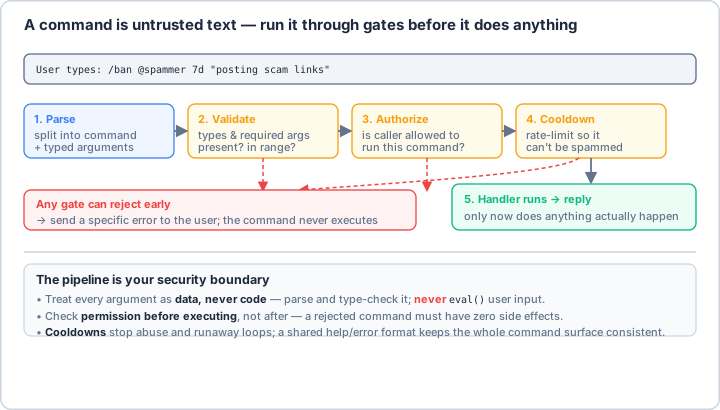
eval() it), check permission before executing, and use cooldowns to stop abuse and runaway loops.Real-World Scenario: The Multi-Platform Command System 🚀
You're building a universal command system that works across Discord, Slack, Telegram, and web interfaces, handling admin commands, user interactions, game mechanics, moderation tools, data queries, system management, workflow automation, and integrations with external services. Your system must parse complex commands, validate arguments, check permissions, handle errors gracefully, support command chaining, provide helpful feedback, and scale to thousands of concurrent users. Let's build a production-ready command handling framework!
# First, install required packages:
# pip install click argparse shlex typing-extensions dataclasses asyncio
import re
import shlex
import asyncio
import logging
from typing import (
List, Dict, Optional, Any, Callable, Union,
TypeVar, Generic, Awaitable, Tuple
)
from dataclasses import dataclass, field
from enum import Enum, auto
from datetime import datetime, timedelta
from functools import wraps
from collections import defaultdict, deque
import inspect
import json
# ==================== Command Configuration ====================
class CommandCategory(Enum):
"""Command categories for organization."""
GENERAL = "general"
ADMIN = "admin"
MODERATION = "moderation"
FUN = "fun"
UTILITY = "utility"
MUSIC = "music"
GAMES = "games"
SETTINGS = "settings"
HELP = "help"
class PermissionLevel(Enum):
"""Permission levels for commands."""
EVERYONE = 0
MEMBER = 1
MODERATOR = 2
ADMIN = 3
OWNER = 4
DEVELOPER = 5
@dataclass
class CommandConfig:
"""Command configuration."""
prefix: str = "!"
case_sensitive: bool = False
# Features
enable_aliases: bool = True
enable_cooldowns: bool = True
enable_permissions: bool = True
enable_help: bool = True
# Limits
max_args: int = 10
max_command_length: int = 100
cooldown_message: str = "Command on cooldown. Try again in {remaining}s"
# Error handling
show_errors: bool = True
error_color: str = "#FF0000"
success_color: str = "#00FF00"
# ==================== Command Arguments ====================
@dataclass
class Argument:
"""Command argument definition."""
name: str
type: type
description: str
required: bool = True
default: Any = None
choices: Optional[List[Any]] = None
min_value: Optional[Union[int, float]] = None
max_value: Optional[Union[int, float]] = None
validator: Optional[Callable] = None
@dataclass
class ParsedArgument:
"""Parsed argument with value."""
name: str
value: Any
raw: str
valid: bool = True
error: Optional[str] = None
# ==================== Command Context ====================
@dataclass
class CommandContext:
"""Context for command execution."""
# Source info
platform: str # discord, slack, telegram, etc.
guild_id: Optional[str] = None
channel_id: str = None
user_id: str = None
message_id: str = None
# User info
username: str = "Unknown"
display_name: str = "Unknown"
permission_level: PermissionLevel = PermissionLevel.EVERYONE
# Message info
content: str = ""
raw_content: str = ""
timestamp: datetime = field(default_factory=datetime.now)
# Command info
command: Optional['Command'] = None
args: List[ParsedArgument] = field(default_factory=list)
kwargs: Dict[str, Any] = field(default_factory=dict)
# Bot reference
bot: Any = None
# Response methods
reply: Optional[Callable] = None
send: Optional[Callable] = None
def get_arg(self, name: str, default: Any = None) -> Any:
"""Get argument value by name."""
for arg in self.args:
if arg.name == name:
return arg.value
return default
# ==================== Command Base Class ====================
class Command:
"""Base command class."""
def __init__(
self,
name: str,
description: str = "No description",
category: CommandCategory = CommandCategory.GENERAL,
aliases: List[str] = None,
usage: str = None,
examples: List[str] = None,
permission_level: PermissionLevel = PermissionLevel.EVERYONE,
cooldown: Optional[int] = None, # seconds
hidden: bool = False,
enabled: bool = True
):
self.name = name
self.description = description
self.category = category
self.aliases = aliases or []
self.usage = usage or name
self.examples = examples or []
self.permission_level = permission_level
self.cooldown = cooldown
self.hidden = hidden
self.enabled = enabled
# Arguments
self.arguments: List[Argument] = []
# Subcommands
self.subcommands: Dict[str, 'Command'] = {}
# Cooldown tracking
self.cooldowns: Dict[str, datetime] = {}
# Statistics
self.usage_count = 0
self.error_count = 0
def add_argument(
self,
name: str,
arg_type: type = str,
description: str = "",
required: bool = True,
**kwargs
):
"""Add argument to command."""
self.arguments.append(Argument(
name=name,
type=arg_type,
description=description,
required=required,
**kwargs
))
return self
def add_subcommand(self, command: 'Command'):
"""Add subcommand."""
self.subcommands[command.name] = command
for alias in command.aliases:
self.subcommands[alias] = command
return self
async def can_execute(self, ctx: CommandContext) -> Tuple[bool, Optional[str]]:
"""Check if command can be executed."""
# Check if enabled
if not self.enabled:
return False, "Command is disabled"
# Check permissions
if ctx.permission_level.value < self.permission_level.value:
return False, f"Insufficient permissions. Required: {self.permission_level.name}"
# Check cooldown
if self.cooldown and ctx.user_id in self.cooldowns:
time_passed = (datetime.now() - self.cooldowns[ctx.user_id]).seconds
if time_passed < self.cooldown:
remaining = self.cooldown - time_passed
return False, f"Command on cooldown. Try again in {remaining}s"
return True, None
async def execute(self, ctx: CommandContext) -> Any:
"""Execute command - override in subclasses."""
raise NotImplementedError("Command execution not implemented")
async def handle(self, ctx: CommandContext) -> Any:
"""Handle command execution with checks."""
# Check if can execute
can_exec, error = await self.can_execute(ctx)
if not can_exec:
if ctx.reply:
await ctx.reply(f"❌ {error}")
return None
# Update cooldown
if self.cooldown:
self.cooldowns[ctx.user_id] = datetime.now()
# Update statistics
self.usage_count += 1
try:
# Execute command
result = await self.execute(ctx)
return result
except Exception as e:
self.error_count += 1
logging.error(f"Command {self.name} error: {e}")
if ctx.reply:
await ctx.reply(f"❌ Error executing command: {str(e)}")
raise
# ==================== Command Decorators ====================
def command(
name: str = None,
**kwargs
):
"""Decorator to create commands from functions."""
def decorator(func):
cmd_name = name or func.__name__
# Create command class from function
class FunctionCommand(Command):
def __init__(self):
super().__init__(cmd_name, **kwargs)
self.func = func
# Extract arguments from function signature
sig = inspect.signature(func)
for param_name, param in sig.parameters.items():
if param_name in ['self', 'ctx']:
continue
param_type = str if param.annotation == param.empty else param.annotation
required = param.default == param.empty
default = None if required else param.default
self.add_argument(
param_name,
param_type,
f"Argument {param_name}",
required,
default=default
)
async def execute(self, ctx: CommandContext):
# Prepare arguments for function
kwargs = {}
for arg in self.arguments:
value = ctx.get_arg(arg.name, arg.default)
kwargs[arg.name] = value
# Call function
if asyncio.iscoroutinefunction(self.func):
return await self.func(ctx, **kwargs)
else:
return self.func(ctx, **kwargs)
return FunctionCommand()
return decorator
def cooldown(seconds: int):
"""Decorator to add cooldown to command."""
def decorator(command_obj):
command_obj.cooldown = seconds
return command_obj
return decorator
def require_permission(level: PermissionLevel):
"""Decorator to set permission requirement."""
def decorator(command_obj):
command_obj.permission_level = level
return command_obj
return decorator
# ==================== Command Parser ====================
class CommandParser:
"""Parse command strings into structured data."""
def __init__(self, config: CommandConfig):
self.config = config
def parse(self, message: str) -> Optional[Tuple[str, List[str], Dict[str, str]]]:
"""
Parse message into command, args, and flags.
Returns:
Tuple of (command_name, arguments, flags) or None
"""
if not message.startswith(self.config.prefix):
return None
# Remove prefix
content = message[len(self.config.prefix):].strip()
if not content:
return None
# Use shlex for proper parsing of quoted strings
try:
parts = shlex.split(content)
except ValueError:
# Fallback to simple split on parsing error
parts = content.split()
if not parts:
return None
# Extract command
command_name = parts[0]
if not self.config.case_sensitive:
command_name = command_name.lower()
# Parse arguments and flags
args = []
flags = {}
i = 1
while i < len(parts):
part = parts[i]
if part.startswith('--'):
# Long flag
flag_name = part[2:]
if '=' in flag_name:
key, value = flag_name.split('=', 1)
flags[key] = value
elif i + 1 < len(parts) and not parts[i + 1].startswith('-'):
flags[flag_name] = parts[i + 1]
i += 1
else:
flags[flag_name] = True
elif part.startswith('-') and len(part) > 1:
# Short flag(s)
for char in part[1:]:
flags[char] = True
else:
# Regular argument
args.append(part)
i += 1
return command_name, args, flags
def parse_arguments(
self,
args: List[str],
argument_defs: List[Argument]
) -> List[ParsedArgument]:
"""Parse arguments according to definitions."""
parsed = []
for i, arg_def in enumerate(argument_defs):
if i < len(args):
raw_value = args[i]
# Try to convert to correct type
try:
if arg_def.type == bool:
value = raw_value.lower() in ['true', 'yes', '1']
elif arg_def.type == int:
value = int(raw_value)
elif arg_def.type == float:
value = float(raw_value)
else:
value = raw_value
# Validate value
error = self._validate_argument(value, arg_def)
parsed.append(ParsedArgument(
name=arg_def.name,
value=value,
raw=raw_value,
valid=error is None,
error=error
))
except (ValueError, TypeError) as e:
parsed.append(ParsedArgument(
name=arg_def.name,
value=None,
raw=raw_value,
valid=False,
error=f"Invalid type for {arg_def.name}: expected {arg_def.type.__name__}"
))
elif arg_def.required:
parsed.append(ParsedArgument(
name=arg_def.name,
value=None,
raw="",
valid=False,
error=f"Missing required argument: {arg_def.name}"
))
else:
parsed.append(ParsedArgument(
name=arg_def.name,
value=arg_def.default,
raw="",
valid=True
))
return parsed
def _validate_argument(self, value: Any, arg_def: Argument) -> Optional[str]:
"""Validate argument value."""
# Check choices
if arg_def.choices and value not in arg_def.choices:
return f"Invalid choice. Must be one of: {', '.join(map(str, arg_def.choices))}"
# Check min/max
if arg_def.min_value is not None and value < arg_def.min_value:
return f"Value must be at least {arg_def.min_value}"
if arg_def.max_value is not None and value > arg_def.max_value:
return f"Value must be at most {arg_def.max_value}"
# Custom validator
if arg_def.validator:
try:
if not arg_def.validator(value):
return "Validation failed"
except Exception as e:
return str(e)
return None
# ==================== Command Registry ====================
class CommandRegistry:
"""Registry for managing commands."""
def __init__(self, config: CommandConfig):
self.config = config
self.commands: Dict[str, Command] = {}
self.aliases: Dict[str, str] = {}
self.categories: Dict[CommandCategory, List[Command]] = defaultdict(list)
self.parser = CommandParser(config)
self.logger = logging.getLogger(__name__)
# Middleware
self.pre_execute: List[Callable] = []
self.post_execute: List[Callable] = []
# Command history
self.history: deque = deque(maxlen=100)
def register(self, command: Command):
"""Register a command."""
# Register main command
self.commands[command.name] = command
# Register aliases
for alias in command.aliases:
self.aliases[alias] = command.name
# Add to category
self.categories[command.category].append(command)
self.logger.info(f"Registered command: {command.name}")
def unregister(self, command_name: str):
"""Unregister a command."""
if command_name in self.commands:
command = self.commands[command_name]
# Remove from registry
del self.commands[command_name]
# Remove aliases
for alias in command.aliases:
if alias in self.aliases:
del self.aliases[alias]
# Remove from category
if command in self.categories[command.category]:
self.categories[command.category].remove(command)
self.logger.info(f"Unregistered command: {command_name}")
def get_command(self, name: str) -> Optional[Command]:
"""Get command by name or alias."""
# Check direct command
if name in self.commands:
return self.commands[name]
# Check aliases
if name in self.aliases:
return self.commands[self.aliases[name]]
return None
def add_middleware(self, func: Callable, post: bool = False):
"""Add middleware function."""
if post:
self.post_execute.append(func)
else:
self.pre_execute.append(func)
async def execute(self, message: str, ctx: CommandContext) -> Any:
"""Execute command from message."""
# Parse command
parsed = self.parser.parse(message)
if not parsed:
return None
command_name, args, flags = parsed
# Get command
command = self.get_command(command_name)
if not command:
if ctx.reply:
await ctx.reply(f"❌ Unknown command: {command_name}")
return None
# Check for subcommands
if args and args[0] in command.subcommands:
subcommand = command.subcommands[args[0]]
args = args[1:]
command = subcommand
# Parse arguments
parsed_args = self.parser.parse_arguments(args, command.arguments)
# Check for argument errors
for arg in parsed_args:
if not arg.valid:
if ctx.reply:
await ctx.reply(f"❌ {arg.error}")
return None
# Update context
ctx.command = command
ctx.args = parsed_args
ctx.kwargs = flags
# Add to history
self.history.append({
'timestamp': datetime.now(),
'user': ctx.user_id,
'command': command_name,
'args': args,
'flags': flags
})
# Run pre-execute middleware
for middleware in self.pre_execute:
result = await self._run_middleware(middleware, ctx)
if result is False:
return None
# Execute command
result = await command.handle(ctx)
# Run post-execute middleware
for middleware in self.post_execute:
await self._run_middleware(middleware, ctx, result)
return result
async def _run_middleware(self, middleware: Callable, ctx: CommandContext,
result: Any = None) -> Any:
"""Run middleware function."""
if asyncio.iscoroutinefunction(middleware):
return await middleware(ctx, result) if result is not None else await middleware(ctx)
else:
return middleware(ctx, result) if result is not None else middleware(ctx)
# ==================== Built-in Commands ====================
class HelpCommand(Command):
"""Built-in help command."""
def __init__(self, registry: CommandRegistry):
super().__init__(
"help",
"Show help information",
CommandCategory.HELP,
aliases=["h", "?"]
)
self.registry = registry
self.add_argument("command", str, "Command to get help for", required=False)
async def execute(self, ctx: CommandContext) -> str:
"""Execute help command."""
command_name = ctx.get_arg("command")
if command_name:
# Show help for specific command
command = self.registry.get_command(command_name)
if not command:
return f"❌ Unknown command: {command_name}"
# Build help message
help_text = f"**{command.name}**\n"
help_text += f"{command.description}\n\n"
if command.aliases:
help_text += f"**Aliases:** {', '.join(command.aliases)}\n"
help_text += f"**Usage:** {self.registry.config.prefix}{command.usage}\n"
if command.arguments:
help_text += "\n**Arguments:**\n"
for arg in command.arguments:
required = "required" if arg.required else "optional"
help_text += f" • {arg.name} ({arg.type.__name__}, {required})"
if arg.description:
help_text += f" - {arg.description}"
help_text += "\n"
if command.examples:
help_text += "\n**Examples:**\n"
for example in command.examples:
help_text += f" {self.registry.config.prefix}{example}\n"
if command.subcommands:
help_text += "\n**Subcommands:**\n"
for sub_name in command.subcommands:
help_text += f" • {sub_name}\n"
if ctx.reply:
await ctx.reply(help_text)
return help_text
else:
# Show general help
help_text = "**Available Commands:**\n\n"
for category in CommandCategory:
commands_in_category = [
cmd for cmd in self.registry.categories[category]
if not cmd.hidden
]
if commands_in_category:
help_text += f"**{category.value.title()}:**\n"
for cmd in commands_in_category:
help_text += f" • {self.registry.config.prefix}{cmd.name}"
if cmd.description:
help_text += f" - {cmd.description}"
help_text += "\n"
help_text += "\n"
help_text += f"\nUse `{self.registry.config.prefix}help <command>` for more info"
if ctx.reply:
await ctx.reply(help_text)
return help_text
# ==================== Command Manager ====================
class CommandManager:
"""High-level command management system."""
def __init__(self, config: Optional[CommandConfig] = None):
self.config = config or CommandConfig()
self.registry = CommandRegistry(self.config)
self.logger = logging.getLogger(__name__)
# Register built-in commands
self.registry.register(HelpCommand(self.registry))
def command(self, **kwargs):
"""Decorator for registering commands."""
def decorator(func):
cmd = command(**kwargs)(func)
self.registry.register(cmd)
return cmd
return decorator
def group(self, name: str, **kwargs):
"""Create command group."""
group_cmd = Command(name, **kwargs)
self.registry.register(group_cmd)
def decorator(func):
sub_cmd = command()(func)
group_cmd.add_subcommand(sub_cmd)
return sub_cmd
return decorator
async def process_message(
self,
message: str,
platform: str = "unknown",
user_id: str = "unknown",
**kwargs
) -> Any:
"""Process a message as potential command."""
# Create context
ctx = CommandContext(
platform=platform,
user_id=user_id,
content=message,
raw_content=message,
**kwargs
)
# Execute command
return await self.registry.execute(message, ctx)
# ==================== Example Commands ====================
# Create command manager
manager = CommandManager()
# Example: Simple command
@manager.command(
description="Ping the bot",
category=CommandCategory.GENERAL,
aliases=["p"]
)
async def ping(ctx: CommandContext):
"""Simple ping command."""
if ctx.reply:
await ctx.reply("🏓 Pong!")
return "Pong!"
# Example: Command with arguments
@manager.command(
description="Perform calculation",
category=CommandCategory.UTILITY
)
async def calc(ctx: CommandContext, expression: str):
"""Calculator command."""
try:
# Evaluate a simple arithmetic expression SAFELY with an AST allow-list.
# Never use eval() on untrusted chat input: even eval(expr, {"__builtins__": {}})
# is escapable and is a remote-code-execution risk.
import ast, operator
_OPS = {ast.Add: operator.add, ast.Sub: operator.sub, ast.Mult: operator.mul,
ast.Div: operator.truediv, ast.Pow: operator.pow,
ast.Mod: operator.mod, ast.USub: operator.neg}
def _safe_eval(node):
if isinstance(node, ast.Constant) and isinstance(node.value, (int, float)):
return node.value
if isinstance(node, ast.BinOp) and type(node.op) in _OPS:
return _OPS[type(node.op)](_safe_eval(node.left), _safe_eval(node.right))
if isinstance(node, ast.UnaryOp) and type(node.op) in _OPS:
return _OPS[type(node.op)](_safe_eval(node.operand))
raise ValueError("Unsupported expression")
result = _safe_eval(ast.parse(expression, mode='eval').body)
response = f"Result: {result}"
except Exception as e:
response = f"Error: {str(e)}"
if ctx.reply:
await ctx.reply(response)
return response
# Example: Admin command
@manager.command(
description="Kick a user",
category=CommandCategory.MODERATION
)
@require_permission(PermissionLevel.MODERATOR)
async def kick(ctx: CommandContext, user: str, reason: str = "No reason"):
"""Kick command."""
response = f"Kicked {user} for: {reason}"
if ctx.reply:
await ctx.reply(response)
return response
# Example: Command with cooldown
@manager.command(
description="Roll dice",
category=CommandCategory.FUN
)
@cooldown(5) # 5 second cooldown
async def roll(ctx: CommandContext, sides: int = 6):
"""Dice roll command."""
import random
result = random.randint(1, sides)
response = f"🎲 You rolled: {result}"
if ctx.reply:
await ctx.reply(response)
return response
# ==================== Command Chain Builder ====================
class CommandChain:
"""Build and execute command chains."""
def __init__(self, manager: CommandManager):
self.manager = manager
self.chain = []
def add(self, command_str: str) -> 'CommandChain':
"""Add command to chain."""
self.chain.append(command_str)
return self
def pipe(self, command_str: str) -> 'CommandChain':
"""Pipe output to next command."""
self.chain.append(('pipe', command_str))
return self
async def execute(self, ctx: CommandContext) -> List[Any]:
"""Execute command chain."""
results = []
last_result = None
for item in self.chain:
if isinstance(item, tuple) and item[0] == 'pipe':
# Pipe last result to next command
command_str = item[1]
if last_result:
command_str += f" {last_result}"
last_result = await self.manager.process_message(
command_str,
platform=ctx.platform,
user_id=ctx.user_id
)
else:
# Regular command
last_result = await self.manager.process_message(
item,
platform=ctx.platform,
user_id=ctx.user_id
)
results.append(last_result)
return results
# Example usage
if __name__ == "__main__":
print("⚡ Command Handling Examples\n")
# Example 1: Command structure
print("1️⃣ Command Structure:")
print(" Basic: !command")
print(" With args: !command arg1 arg2")
print(" With flags: !command --flag value")
print(" Subcommand: !group subcommand")
print(" Chain: !cmd1 && !cmd2")
# Example 2: Command registration
print("\n2️⃣ Registering Commands:")
print(" Using decorator:")
print(" @manager.command()")
print(" async def mycommand(ctx):")
print(" return 'Result'")
# Example 3: Permission levels
print("\n3️⃣ Permission Levels:")
for level in PermissionLevel:
print(f" {level.value}: {level.name}")
# Example 4: Command categories
print("\n4️⃣ Command Categories:")
for category in CommandCategory:
print(f" • {category.value}")
# Example 5: Argument types
print("\n5️⃣ Argument Types:")
arg_types = [
("str", "Text string", "!say Hello World"),
("int", "Integer number", "!roll 20"),
("float", "Decimal number", "!volume 0.5"),
("bool", "True/False", "!toggle true"),
("choice", "From list", "!color red|blue|green")
]
for arg_type, description, example in arg_types:
print(f" {arg_type}: {description}")
print(f" Example: {example}")
# Example 6: Test command execution
print("\n6️⃣ Testing Commands:")
async def test_commands():
# Test ping
result = await manager.process_message("!ping", "test", "user123")
print(f" !ping → {result}")
# Test with arguments
result = await manager.process_message("!calc 2+2", "test", "user123")
print(f" !calc 2+2 → {result}")
# Test help
result = await manager.process_message("!help", "test", "user123")
print(f" !help → (help text)")
# Run async test
asyncio.run(test_commands())
# Example 7: Cooldown example
print("\n7️⃣ Cooldown System:")
print(" Command used → Start cooldown")
print(" User tries again → 'On cooldown (3s remaining)'")
print(" After cooldown → Command works again")
# Example 8: Command middleware
print("\n8️⃣ Middleware Pipeline:")
pipeline = [
"1. Parse command",
"2. Check permissions",
"3. Validate arguments",
"4. Check cooldown",
"5. Pre-execute middleware",
"6. Execute command",
"7. Post-execute middleware",
"8. Return result"
]
for step in pipeline:
print(f" {step}")
# Example 9: Error handling
print("\n9️⃣ Error Handling:")
errors = [
("Unknown command", "!invalid", "Command not found"),
("Missing argument", "!kick", "Missing required argument: user"),
("Wrong type", "!roll abc", "Invalid type: expected int"),
("Permission denied", "!admin", "Insufficient permissions"),
("On cooldown", "!roll (repeated)", "Command on cooldown")
]
for error_type, command, message in errors:
print(f" {error_type}:")
print(f" Command: {command}")
print(f" Error: {message}")
# Example 10: Best practices
print("\n🔟 Command Handling Best Practices:")
practices = [
"📝 Use clear, consistent command names",
"🎯 Implement proper argument validation",
"🔒 Check permissions before execution",
"⏱️ Add cooldowns to prevent spam",
"📚 Provide helpful error messages",
"💡 Include usage examples",
"🔄 Support command aliases",
"📊 Track command usage",
"🛡️ Handle errors gracefully",
"📖 Auto-generate help docs"
]
for practice in practices:
print(f" {practice}")
print("\n✅ Command handling demonstration complete!")
Key Takeaways and Best Practices 🎯
- Structure Commands Well: Use clear names and consistent patterns.
- Validate Arguments: Check types, ranges, and requirements.
- Implement Permissions: Secure sensitive commands properly.
- Add Cooldowns: Prevent spam and abuse.
- Provide Help: Auto-generate documentation from commands.
- Handle Errors Gracefully: Give users helpful feedback.
- Use Middleware: Add cross-cutting concerns cleanly.
- Track Usage: Monitor command statistics for insights.
Command Handling Best Practices 📋
Mastering command handling enables you to create powerful, intuitive bot interfaces that users can navigate easily. You can now build bots with complex command structures, argument validation, permissions, cooldowns, and comprehensive help systems. Whether you're building admin tools, game bots, or automation systems, these command handling skills create professional, user-friendly bot experiences! 🚀
Pro Tip: Think of command handling as creating a user interface through text - it should be intuitive, consistent, and helpful. Start with a clear command structure: use consistent prefixes (!command) and follow conventions users expect. Implement robust argument parsing that handles quoted strings, flags, and various data types. Always validate input thoroughly - check types, ranges, and permissions before executing. Add cooldowns to prevent spam and protect your bot from abuse. Build a comprehensive help system that auto-generates from your command definitions. Use decorators to keep command code clean and reusable. Implement command categories to organize features logically. Support aliases for commonly used commands. Add middleware for logging, metrics, and other cross-cutting concerns. Handle errors gracefully with clear, actionable error messages. Track command usage to understand how users interact with your bot. Most importantly: design commands that feel natural to use - good command design makes complex features accessible!