🚀 Data Pipelines: Process and Store Data at Scale
📚 What You'll Learn
By the end of this lesson, you will be able to:
- Describe the stages of a data pipeline (ingest → validate → transform → enrich → store) and what separates a pipeline from a one-off script
- Validate scraped records against a schema with Pydantic and quarantine bad rows instead of dropping them silently or crashing a later stage
- Build reusable transformers for cleaning text, normalizing prices/currencies, and enriching records with computed features
- Choose an appropriate storage backend (PostgreSQL, MongoDB, Elasticsearch, Redis) for your data's shape and access pattern
- Make loads idempotent with upserts keyed on a natural key so re-runs are safe, and track throughput and error-rate metrics
⏱️ Estimated Time: 45–60 minutes
🎯 Project: Build an ETL pipeline that validates, transforms, and idempotently upserts scraped product records into a database.
Data pipelines are the highways of information - transforming raw scraped data into valuable insights. Like a sophisticated factory assembly line, they take messy input, clean it, enrich it, validate it, and deliver it exactly where it needs to go. Whether you're handling gigabytes or terabytes, streaming or batch processing, a well-designed pipeline is the difference between data chaos and data mastery. Let's build industrial-strength data pipelines! 🏭
The Data Pipeline Architecture
Think of a data pipeline as a river system where data flows from multiple sources, gets filtered through various processing stages, and eventually reaches its destination lakes and oceans (databases, warehouses, APIs). Each component must handle failures gracefully, scale elastically, and maintain data quality throughout the journey!
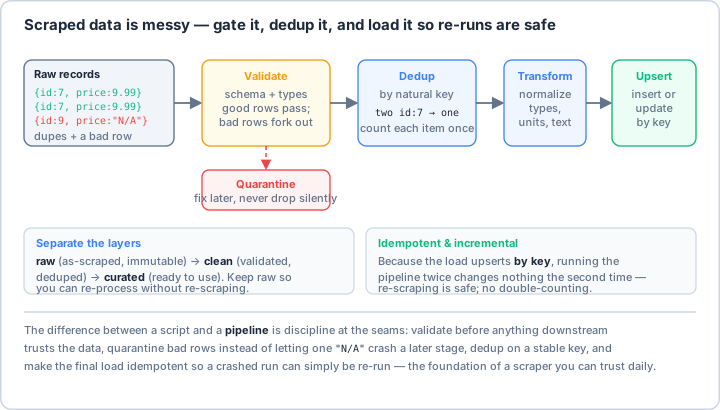
"N/A" crash a later stage or vanish silently), dedup on a stable natural key, and make the final load an idempotent upsert so a crashed or repeated run is safe — re-scraping updates in place instead of double-counting. Keep raw → clean → curated as separate layers so you can re-process without re-scraping.Real-World Scenario: The Market Intelligence Platform 📈
You're building a market intelligence platform that processes millions of product listings, reviews, and price changes daily from hundreds of sources. The system must handle different data formats, validate quality, enrich with ML predictions, detect anomalies, and serve real-time analytics to thousands of users. Your pipeline must be bulletproof, scalable, and maintainable!
# First, install required packages:
# pip install apache-beam pandas sqlalchemy psycopg2 redis kafka-python elasticsearch pymongo pydantic luigi airflow
import json
import logging
import time
from typing import List, Dict, Optional, Any, Iterator, Tuple, Union, Generator
from dataclasses import dataclass, field, asdict
from datetime import datetime, timedelta
from enum import Enum
from pathlib import Path
import hashlib
import uuid
from concurrent.futures import ThreadPoolExecutor, ProcessPoolExecutor
import multiprocessing as mp
from queue import Queue, Empty
import threading
import pandas as pd
import numpy as np
from pydantic import BaseModel, validator, Field
from sqlalchemy import create_engine, Column, String, Float, Integer, DateTime, Boolean, Text
from sqlalchemy.orm import declarative_base
from sqlalchemy.orm import sessionmaker
import redis
import pymongo
from elasticsearch import Elasticsearch
from kafka import KafkaProducer, KafkaConsumer
import luigi
# ==================== Data Models ====================
class DataQuality(Enum):
"""Data quality levels."""
HIGH = "high"
MEDIUM = "medium"
LOW = "low"
INVALID = "invalid"
class ProcessingStatus(Enum):
"""Processing status."""
PENDING = "pending"
PROCESSING = "processing"
COMPLETED = "completed"
FAILED = "failed"
RETRY = "retry"
# Pydantic models for validation
class ProductData(BaseModel):
"""Product data model with validation."""
id: str
name: str
price: float = Field(gt=0, le=1000000)
currency: str = Field(pattern="^[A-Z]{3}$")
description: Optional[str] = None
category: Optional[str] = None
brand: Optional[str] = None
in_stock: bool = True
rating: Optional[float] = Field(None, ge=0, le=5)
review_count: int = Field(default=0, ge=0)
image_urls: List[str] = []
scraped_at: datetime
source_url: str
@validator('price')
def price_must_be_positive(cls, v):
if v <= 0:
raise ValueError('Price must be positive')
return round(v, 2)
@validator('name')
def name_not_empty(cls, v):
if not v or not v.strip():
raise ValueError('Name cannot be empty')
return v.strip()
class Config:
json_encoders = {
datetime: lambda v: v.isoformat()
}
@dataclass
class PipelineMetrics:
"""Pipeline performance metrics."""
items_processed: int = 0
items_failed: int = 0
processing_time: float = 0
throughput: float = 0
error_rate: float = 0
last_updated: datetime = field(default_factory=datetime.now)
# ==================== Data Pipeline Base ====================
class DataPipeline:
"""
Base class for data pipelines.
"""
def __init__(self, name: str, config: Dict[str, Any] = None):
self.name = name
self.config = config or {}
self.metrics = PipelineMetrics()
self.logger = self._setup_logging()
def _setup_logging(self) -> logging.Logger:
"""Setup pipeline logging."""
logger = logging.getLogger(f"pipeline.{self.name}")
logger.setLevel(logging.INFO)
if not logger.handlers:
handler = logging.StreamHandler()
formatter = logging.Formatter(
'%(asctime)s - %(name)s - %(levelname)s - %(message)s'
)
handler.setFormatter(formatter)
logger.addHandler(handler)
return logger
def process(self, data: Any) -> Any:
"""Process data through pipeline."""
raise NotImplementedError
def validate(self, data: Any) -> bool:
"""Validate data."""
raise NotImplementedError
def transform(self, data: Any) -> Any:
"""Transform data."""
raise NotImplementedError
def store(self, data: Any) -> bool:
"""Store processed data."""
raise NotImplementedError
# ==================== ETL Pipeline ====================
class ETLPipeline(DataPipeline):
"""
Extract, Transform, Load pipeline.
"""
def __init__(self, name: str,
extractors: List[Any] = None,
transformers: List[Any] = None,
loaders: List[Any] = None):
super().__init__(name)
self.extractors = extractors or []
self.transformers = transformers or []
self.loaders = loaders or []
def extract(self, source: str) -> Generator[Dict, None, None]:
"""Extract data from source."""
for extractor in self.extractors:
try:
for item in extractor.extract(source):
yield item
except Exception as e:
self.logger.error(f"Extraction failed: {e}")
def transform(self, data: Iterator[Dict]) -> Generator[Dict, None, None]:
"""Transform extracted data."""
for item in data:
try:
# Apply transformations in sequence
transformed = item
for transformer in self.transformers:
transformed = transformer.transform(transformed)
if transformed:
yield transformed
except Exception as e:
self.logger.error(f"Transformation failed for item: {e}")
self.metrics.items_failed += 1
def load(self, data: Iterator[Dict]) -> int:
"""Load transformed data."""
loaded_count = 0
for item in data:
try:
# Load to all configured destinations
for loader in self.loaders:
if loader.load(item):
loaded_count += 1
except Exception as e:
self.logger.error(f"Loading failed: {e}")
return loaded_count
def run(self, source: str) -> PipelineMetrics:
"""Run complete ETL pipeline."""
start_time = time.time()
try:
# Extract
extracted = self.extract(source)
# Transform
transformed = self.transform(extracted)
# Load
loaded = self.load(transformed)
# Update metrics
self.metrics.items_processed = loaded
self.metrics.processing_time = time.time() - start_time
self.metrics.throughput = loaded / self.metrics.processing_time if self.metrics.processing_time > 0 else 0
except Exception as e:
self.logger.error(f"Pipeline failed: {e}")
return self.metrics
# ==================== Stream Processing ====================
class StreamProcessor:
"""
Real-time stream processing.
"""
def __init__(self, name: str,
batch_size: int = 100,
flush_interval: int = 10):
self.name = name
self.batch_size = batch_size
self.flush_interval = flush_interval
self.buffer = []
self.last_flush = time.time()
self.running = False
self.logger = logging.getLogger(f"stream.{name}")
# Threading
self.lock = threading.Lock()
self.flush_thread = None
def start(self):
"""Start stream processor."""
self.running = True
# Start flush thread
self.flush_thread = threading.Thread(target=self._flush_worker)
self.flush_thread.daemon = True
self.flush_thread.start()
self.logger.info("Stream processor started")
def stop(self):
"""Stop stream processor."""
self.running = False
# Final flush
self.flush()
if self.flush_thread:
self.flush_thread.join(timeout=5)
self.logger.info("Stream processor stopped")
def process(self, item: Dict) -> bool:
"""Process single item."""
with self.lock:
# Validate item
if not self.validate(item):
return False
# Add to buffer
self.buffer.append(item)
# Check if batch is full
if len(self.buffer) >= self.batch_size:
self.flush()
return True
def validate(self, item: Dict) -> bool:
"""Validate stream item."""
# Override in subclass
return True
def flush(self):
"""Flush buffer to storage."""
with self.lock:
if not self.buffer:
return
try:
# Process batch
self.process_batch(self.buffer)
# Clear buffer
self.buffer.clear()
self.last_flush = time.time()
except Exception as e:
self.logger.error(f"Flush failed: {e}")
def process_batch(self, batch: List[Dict]):
"""Process a batch of items."""
# Override in subclass
pass
def _flush_worker(self):
"""Background worker for periodic flushing."""
while self.running:
time.sleep(1)
# Check if flush interval reached
if time.time() - self.last_flush >= self.flush_interval:
self.flush()
# ==================== Data Validators ====================
class DataValidator:
"""
Validate and clean data.
"""
def __init__(self, schema: BaseModel = None):
self.schema = schema
self.logger = logging.getLogger(__name__)
self.stats = {
'total': 0,
'valid': 0,
'invalid': 0,
'cleaned': 0
}
def validate(self, data: Dict) -> Tuple[bool, Optional[Dict]]:
"""
Validate data against schema.
Returns:
(is_valid, cleaned_data)
"""
self.stats['total'] += 1
try:
if self.schema:
# Validate with Pydantic
validated = self.schema(**data)
self.stats['valid'] += 1
return True, validated.dict()
else:
# Basic validation
cleaned = self.clean_data(data)
if cleaned:
self.stats['valid'] += 1
return True, cleaned
except Exception as e:
self.logger.warning(f"Validation failed: {e}")
self.stats['invalid'] += 1
return False, None
def clean_data(self, data: Dict) -> Optional[Dict]:
"""Clean and normalize data."""
cleaned = {}
for key, value in data.items():
# Remove None values
if value is None:
continue
# Clean strings
if isinstance(value, str):
value = value.strip()
if not value:
continue
# Validate numbers
if isinstance(value, (int, float)):
if np.isnan(value) or np.isinf(value):
continue
cleaned[key] = value
self.stats['cleaned'] += 1
return cleaned if cleaned else None
def check_quality(self, data: Dict) -> DataQuality:
"""Assess data quality."""
if not data:
return DataQuality.INVALID
# Calculate completeness
required_fields = ['id', 'name', 'price']
missing = sum(1 for field in required_fields if field not in data)
if missing == 0:
return DataQuality.HIGH
elif missing == 1:
return DataQuality.MEDIUM
elif missing == 2:
return DataQuality.LOW
else:
return DataQuality.INVALID
# ==================== Data Transformers ====================
class DataTransformer:
"""
Transform and enrich data.
"""
def __init__(self):
self.logger = logging.getLogger(__name__)
def transform(self, data: Dict) -> Dict:
"""Apply transformations to data."""
# Override in subclass
return data
class PriceNormalizer(DataTransformer):
"""Normalize prices to common currency."""
def __init__(self, target_currency: str = "USD"):
super().__init__()
self.target_currency = target_currency
self.exchange_rates = self._load_exchange_rates()
def _load_exchange_rates(self) -> Dict[str, float]:
"""Load exchange rates (simplified)."""
return {
"USD": 1.0,
"EUR": 0.85,
"GBP": 0.73,
"JPY": 110.0,
"CNY": 6.45
}
def transform(self, data: Dict) -> Dict:
"""Normalize price to target currency."""
if 'price' in data and 'currency' in data:
currency = data['currency']
if currency != self.target_currency:
rate = self.exchange_rates.get(currency, 1.0)
target_rate = self.exchange_rates.get(self.target_currency, 1.0)
# Convert price
data['original_price'] = data['price']
data['original_currency'] = currency
data['price'] = round(data['price'] * (target_rate / rate), 2)
data['currency'] = self.target_currency
return data
class TextCleaner(DataTransformer):
"""Clean and normalize text fields."""
def transform(self, data: Dict) -> Dict:
"""Clean text fields."""
text_fields = ['name', 'description', 'category', 'brand']
for field in text_fields:
if field in data and data[field]:
# Remove extra whitespace
data[field] = ' '.join(data[field].split())
# Remove HTML tags if present
import re
data[field] = re.sub(r'<[^>]+>', '', data[field])
# Normalize unicode
data[field] = data[field].encode('ascii', 'ignore').decode('ascii')
return data
class FeatureEnricher(DataTransformer):
"""Enrich data with additional features."""
def transform(self, data: Dict) -> Dict:
"""Add computed features."""
# Price tier
if 'price' in data:
price = data['price']
if price < 10:
data['price_tier'] = 'budget'
elif price < 50:
data['price_tier'] = 'mid-range'
elif price < 200:
data['price_tier'] = 'premium'
else:
data['price_tier'] = 'luxury'
# Availability score
if 'in_stock' in data:
data['availability_score'] = 1.0 if data['in_stock'] else 0.0
# Quality score
if 'rating' in data and 'review_count' in data:
rating = data.get('rating', 0)
reviews = data.get('review_count', 0)
# Weighted by review count
if reviews > 0:
weight = min(1.0, reviews / 100)
data['quality_score'] = rating * weight
else:
data['quality_score'] = 0
# Add processing timestamp
data['processed_at'] = datetime.now().isoformat()
return data
# ==================== Data Storage ====================
class StorageBackend:
"""Base class for storage backends."""
def store(self, data: Dict) -> bool:
"""Store data."""
raise NotImplementedError
def retrieve(self, query: Dict) -> List[Dict]:
"""Retrieve data."""
raise NotImplementedError
class PostgreSQLStorage(StorageBackend):
"""PostgreSQL storage backend."""
def __init__(self, connection_string: str):
self.engine = create_engine(connection_string)
self.Session = sessionmaker(bind=self.engine)
# Create tables
Base = declarative_base()
class Product(Base):
__tablename__ = 'products'
id = Column(String, primary_key=True)
name = Column(String, nullable=False)
price = Column(Float)
currency = Column(String(3))
description = Column(Text)
category = Column(String)
brand = Column(String)
in_stock = Column(Boolean)
rating = Column(Float)
review_count = Column(Integer)
scraped_at = Column(DateTime)
processed_at = Column(DateTime, default=datetime.now)
Base.metadata.create_all(self.engine)
self.Product = Product
def store(self, data: Dict) -> bool:
"""Store data in PostgreSQL."""
session = self.Session()
try:
product = self.Product(**data)
session.add(product)
session.commit()
return True
except Exception as e:
session.rollback()
logging.error(f"PostgreSQL storage failed: {e}")
return False
finally:
session.close()
class MongoDBStorage(StorageBackend):
"""MongoDB storage backend."""
def __init__(self, connection_string: str, database: str, collection: str):
self.client = pymongo.MongoClient(connection_string)
self.db = self.client[database]
self.collection = self.db[collection]
# Create indexes
self.collection.create_index([("id", 1)], unique=True)
self.collection.create_index([("scraped_at", -1)])
def store(self, data: Dict) -> bool:
"""Store data in MongoDB."""
try:
# Upsert document
self.collection.update_one(
{"id": data["id"]},
{"$set": data},
upsert=True
)
return True
except Exception as e:
logging.error(f"MongoDB storage failed: {e}")
return False
class ElasticsearchStorage(StorageBackend):
"""Elasticsearch storage backend."""
def __init__(self, hosts: List[str], index: str):
self.es = Elasticsearch(hosts)
self.index = index
# Create index if not exists
if not self.es.indices.exists(index=self.index):
self.es.indices.create(index=self.index)
def store(self, data: Dict) -> bool:
"""Store data in Elasticsearch."""
try:
# Index document
self.es.index(
index=self.index,
id=data.get("id"),
body=data
)
return True
except Exception as e:
logging.error(f"Elasticsearch storage failed: {e}")
return False
class RedisCache(StorageBackend):
"""Redis cache backend."""
def __init__(self, host: str = "localhost", port: int = 6379):
self.redis = redis.Redis(host=host, port=port, decode_responses=True)
def store(self, data: Dict, ttl: int = 3600) -> bool:
"""Store data in Redis with TTL."""
try:
key = f"product:{data.get('id')}"
self.redis.setex(
key,
ttl,
json.dumps(data, default=str)
)
return True
except Exception as e:
logging.error(f"Redis storage failed: {e}")
return False
def retrieve(self, product_id: str) -> Optional[Dict]:
"""Retrieve data from Redis."""
try:
key = f"product:{product_id}"
data = self.redis.get(key)
if data:
return json.loads(data)
except Exception as e:
logging.error(f"Redis retrieval failed: {e}")
return None
# ==================== Batch Processing ====================
class BatchProcessor:
"""
Process data in batches for efficiency.
"""
def __init__(self, batch_size: int = 1000,
num_workers: int = 4):
self.batch_size = batch_size
self.num_workers = num_workers
self.logger = logging.getLogger(__name__)
def process_parallel(self, data: List[Dict],
processor: callable) -> List[Dict]:
"""Process data in parallel."""
results = []
with ProcessPoolExecutor(max_workers=self.num_workers) as executor:
# Split into batches
batches = [
data[i:i + self.batch_size]
for i in range(0, len(data), self.batch_size)
]
# Process batches in parallel
futures = [
executor.submit(self._process_batch, batch, processor)
for batch in batches
]
# Collect results
for future in futures:
try:
batch_results = future.result(timeout=300)
results.extend(batch_results)
except Exception as e:
self.logger.error(f"Batch processing failed: {e}")
return results
def _process_batch(self, batch: List[Dict],
processor: callable) -> List[Dict]:
"""Process single batch."""
results = []
for item in batch:
try:
processed = processor(item)
if processed:
results.append(processed)
except Exception as e:
self.logger.error(f"Item processing failed: {e}")
return results
# ==================== Pipeline Orchestration ====================
class PipelineOrchestrator:
"""
Orchestrate multiple pipelines.
"""
def __init__(self):
self.pipelines = {}
self.schedules = {}
self.logger = logging.getLogger(__name__)
def register_pipeline(self, name: str, pipeline: DataPipeline,
schedule: Optional[str] = None):
"""Register a pipeline."""
self.pipelines[name] = pipeline
if schedule:
self.schedules[name] = schedule
self.logger.info(f"Registered pipeline: {name}")
def run_pipeline(self, name: str, **kwargs) -> PipelineMetrics:
"""Run a specific pipeline."""
if name not in self.pipelines:
raise ValueError(f"Pipeline not found: {name}")
pipeline = self.pipelines[name]
self.logger.info(f"Running pipeline: {name}")
start_time = time.time()
try:
metrics = pipeline.run(**kwargs)
self.logger.info(
f"Pipeline completed: {name} - "
f"Items: {metrics.items_processed}, "
f"Time: {metrics.processing_time:.2f}s"
)
return metrics
except Exception as e:
self.logger.error(f"Pipeline failed: {name} - {e}")
raise
def run_all(self) -> Dict[str, PipelineMetrics]:
"""Run all registered pipelines."""
results = {}
for name in self.pipelines:
try:
results[name] = self.run_pipeline(name)
except Exception as e:
self.logger.error(f"Failed to run pipeline {name}: {e}")
return results
# ==================== Luigi Task Example ====================
class ScrapingTask(luigi.Task):
"""Luigi task for web scraping."""
date = luigi.DateParameter(default=datetime.today().date())
source = luigi.Parameter()
def output(self):
"""Task output."""
return luigi.LocalTarget(
f"data/raw/{self.source}_{self.date}.json"
)
def run(self):
"""Run scraping task."""
# Scraping logic here
data = [] # Scraped data
with self.output().open('w') as f:
json.dump(data, f)
class ProcessingTask(luigi.Task):
"""Luigi task for data processing."""
date = luigi.DateParameter(default=datetime.today().date())
source = luigi.Parameter()
def requires(self):
"""Task dependencies."""
return ScrapingTask(date=self.date, source=self.source)
def output(self):
"""Task output."""
return luigi.LocalTarget(
f"data/processed/{self.source}_{self.date}.json"
)
def run(self):
"""Run processing task."""
# Load scraped data
with self.input().open('r') as f:
data = json.load(f)
# Process data
processor = DataTransformer()
processed = [processor.transform(item) for item in data]
# Save processed data
with self.output().open('w') as f:
json.dump(processed, f)
# Example usage
if __name__ == "__main__":
print("🚀 Data Pipeline Examples\n")
# Example 1: Create ETL pipeline
print("1️⃣ ETL Pipeline Setup:")
etl_pipeline = ETLPipeline(
name="product_pipeline",
extractors=[], # Add extractors
transformers=[
PriceNormalizer("USD"),
TextCleaner(),
FeatureEnricher()
],
loaders=[] # Add loaders
)
print(f" Pipeline created: {etl_pipeline.name}")
print(f" Transformers: {len(etl_pipeline.transformers)}")
# Example 2: Data validation
print("\n2️⃣ Data Validation:")
validator = DataValidator(schema=ProductData)
test_data = {
"id": "123",
"name": "Test Product",
"price": 99.99,
"currency": "USD",
"scraped_at": datetime.now(),
"source_url": "https://example.com/product/123"
}
is_valid, cleaned = validator.validate(test_data)
print(f" Validation result: {is_valid}")
print(f" Data quality: {validator.check_quality(cleaned)}")
# Example 3: Stream processing
print("\n3️⃣ Stream Processing:")
stream = StreamProcessor(
name="product_stream",
batch_size=10,
flush_interval=5
)
print(f" Stream processor: {stream.name}")
print(f" Batch size: {stream.batch_size}")
print(f" Flush interval: {stream.flush_interval}s")
# Example 4: Data transformation
print("\n4️⃣ Data Transformation:")
# Price normalization
price_normalizer = PriceNormalizer("USD")
product = {
"price": 85.50,
"currency": "EUR"
}
normalized = price_normalizer.transform(product.copy())
print(f" Original: {product['price']} {product['currency']}")
print(f" Normalized: {normalized['price']} {normalized['currency']}")
# Feature enrichment
enricher = FeatureEnricher()
product_data = {
"price": 150,
"rating": 4.5,
"review_count": 250,
"in_stock": True
}
enriched = enricher.transform(product_data.copy())
print(f" Price tier: {enriched.get('price_tier')}")
print(f" Quality score: {enriched.get('quality_score'):.2f}")
# Example 5: Storage backends
print("\n5️⃣ Storage Backends:")
storage_options = [
("PostgreSQL", "Relational database for structured data"),
("MongoDB", "Document store for flexible schemas"),
("Elasticsearch", "Full-text search and analytics"),
("Redis", "In-memory cache for fast access"),
("S3/GCS", "Object storage for raw data"),
("Kafka", "Message queue for streaming")
]
for storage, description in storage_options:
print(f" {storage}: {description}")
# Example 6: Batch processing
print("\n6️⃣ Batch Processing:")
batch_processor = BatchProcessor(batch_size=100, num_workers=4)
print(f" Batch size: {batch_processor.batch_size}")
print(f" Workers: {batch_processor.num_workers}")
print(" Processing modes:")
print(" • Parallel processing with multiprocessing")
print(" • Chunked processing for memory efficiency")
print(" • Fault tolerance with retry logic")
# Example 7: Pipeline metrics
print("\n7️⃣ Pipeline Metrics:")
metrics = PipelineMetrics(
items_processed=10000,
items_failed=50,
processing_time=120.5
)
metrics.throughput = metrics.items_processed / metrics.processing_time
metrics.error_rate = metrics.items_failed / metrics.items_processed
print(f" Items processed: {metrics.items_processed:,}")
print(f" Throughput: {metrics.throughput:.1f} items/sec")
print(f" Error rate: {metrics.error_rate:.2%}")
# Example 8: Data quality levels
print("\n8️⃣ Data Quality Assessment:")
quality_checks = [
("Completeness", "All required fields present"),
("Accuracy", "Values within expected ranges"),
("Consistency", "Format and structure uniform"),
("Timeliness", "Data is recent and relevant"),
("Uniqueness", "No duplicate records"),
("Validity", "Conforms to business rules")
]
for check, description in quality_checks:
print(f" {check}: {description}")
# Example 9: Pipeline patterns
print("\n9️⃣ Common Pipeline Patterns:")
patterns = [
("Lambda Architecture", "Batch + Stream processing"),
("Kappa Architecture", "Stream-only processing"),
("Medallion Architecture", "Bronze → Silver → Gold layers"),
("Event Sourcing", "Store all state changes"),
("CQRS", "Separate read and write models"),
("Microservices", "Distributed pipeline components")
]
for pattern, description in patterns:
print(f" {pattern}: {description}")
# Example 10: Best practices
print("\n🔟 Pipeline Best Practices:")
best_practices = [
"🔍 Validate data early and often",
"📊 Monitor pipeline metrics continuously",
"🔄 Implement idempotent operations",
"💾 Use checkpointing for recovery",
"⚡ Optimize for throughput vs latency",
"🛡️ Handle failures gracefully",
"📈 Scale horizontally when possible",
"🏷️ Version your data schemas",
"🔐 Secure sensitive data in transit/rest",
"📝 Log everything for debugging"
]
for practice in best_practices:
print(f" {practice}")
print("\n✅ Data pipeline demonstration complete!")
Key Takeaways and Best Practices 🎯
- Validate Early: Catch data quality issues at the source.
- Transform Incrementally: Apply transformations in logical stages.
- Handle Failures Gracefully: Implement retry logic and dead letter queues.
- Monitor Everything: Track metrics, throughput, and error rates.
- Scale Horizontally: Design for distributed processing from the start.
- Use Appropriate Storage: Match storage backend to data characteristics.
- Implement Checkpointing: Enable recovery from failures.
- Version Schemas: Handle schema evolution gracefully.
Data Pipeline Best Practices 📋
Mastering data pipelines transforms you from a data collector to a data engineer. You can now build robust, scalable systems that process millions of records reliably. Whether you're building ETL pipelines, real-time streams, or complex data workflows, these pipeline skills ensure your data flows smoothly from source to insight! 🌊
📓 Learning Journal
Keep a learning journal — digital or physical. After this lesson, take a few minutes to write down:
- Key concepts you learned
- Techniques that clicked for you
- Questions or confusion points to revisit
- Ideas you want to try
- Your progress and feelings about learning this
✍️ This lesson's prompt: Idempotency means a pipeline can be re-run safely without double-counting or corrupting data. Where in your past projects would an idempotent, restartable design have saved you from a painful cleanup — and what would you change now?
📝 Lesson Summary
🎓 Key Takeaways
- A pipeline is discipline at the seams: validate before anything downstream trusts the data, and quarantine bad rows instead of dropping or crashing on them.
- Separate raw → clean → curated layers so you can re-process data without having to re-scrape it.
- Make the final load an idempotent upsert keyed on a stable natural key, so a crashed or repeated run updates in place rather than double-counting.
- Match the storage backend to the job — SQL for structured queries, document stores for flexible schemas, search engines for full-text, caches for speed — and monitor throughput and error rates throughout.
🎉 What You've Accomplished
You've moved from collecting data to engineering it. You can now build an ETL flow that validates against a schema, transforms and enriches records in clear stages, and lands them reliably in a store — a system that keeps running correctly even when individual records or runs go wrong.
❓ Common Questions at This Stage
What actually makes a "pipeline" different from just a script?
A script does the work once and hopes nothing goes wrong. A pipeline builds in guarantees at each seam: schema validation, quarantine for bad rows, idempotent loads, and metrics — so it can be re-run, scaled, and debugged with confidence.
Why upsert instead of a plain insert?
Inserts create duplicates every time you re-run. An upsert keyed on a natural key (e.g. product id) inserts new records and updates existing ones, which makes the whole load idempotent — re-scraping the same page changes nothing or refreshes in place.
When should I use batch processing vs stream processing?
Use batch for historical or periodic loads where latency doesn't matter and throughput does. Use streams when you need results in near real time. Many mature systems combine both (a Lambda-style architecture).
🔭 Looking Ahead
With reliable pipelines in hand, you'll move beyond scraping into robotic process automation (RPA) — coordinating whole workflows across applications, not just data.
✅ Before the Next Lesson
- Add a Pydantic schema to a small dataset and route rejected rows to a separate "quarantine" list or file.
- Rewrite an insert-based load as an upsert and prove to yourself that running it twice produces no duplicates.
- Write your Learning Journal entry for this lesson.
🌟 Encouragement for the Journey
Reliable data pipelines are what turn a clever scraper into a system people can depend on. Every guard you add — validation, quarantine, idempotency — is a future 3 a.m. incident you'll never have to debug. You're building like an engineer now. Keep going.
Pro Tip: Think of data pipelines as assembly lines in a factory - each station has a specific job, quality checks happen throughout, and the whole system should handle hiccups without stopping production. Start with validation - bad data is worse than no data. Use schemas (Pydantic, JSON Schema) to enforce structure. Transform data incrementally with clear, testable functions. Choose storage based on your needs: SQL for structured queries, NoSQL for flexibility, object storage for raw data, and caches for speed. Implement both batch and stream processing - batch for historical data, streams for real-time. Monitor everything: throughput, latency, error rates, data quality scores. Use orchestrators like Airflow or Luigi for complex workflows. Always design for failure - implement retries, dead letter queues, and circuit breakers. Most importantly: make your pipelines idempotent so they can be safely re-run without duplicating data!