📄 Document Processing: Extract Intelligence from Documents
📚 What You'll Learn
By the end of this lesson, you will be able to:
- Describe the document-processing pipeline: ingest, classify, extract, validate, and integrate
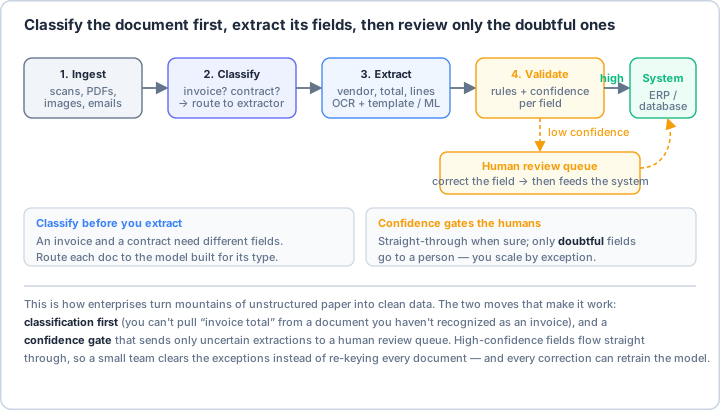
- Explain why classification must come before extraction so each document is routed to the right extractor
- Use OCR together with templates or ML to pull structured fields (vendor, total, line items) from unstructured documents
- Apply a confidence gate so high-confidence fields flow straight through while doubtful ones go to a human review queue
- Validate extracted data against business rules and integrate the results with downstream systems
⏱️ Estimated Time: 45–60 minutes
🎯 Project: Build a mini pipeline that classifies a sample document, extracts its key fields, and flags low-confidence fields for review.
Document processing automation transforms mountains of unstructured documents into actionable structured data - it's the bridge between paper-based processes and digital transformation. Like having an army of skilled data entry clerks who never tire and never make mistakes, automated document processing extracts, validates, and integrates information from invoices, contracts, forms, and reports at unprecedented speed and accuracy. Whether you're processing financial documents, legal contracts, medical records, or government forms, mastering document processing is essential for enterprise automation. Let's explore the comprehensive world of intelligent document processing! 📚
The Document Processing Architecture
Think of document processing as creating a digital assembly line for information extraction - documents flow through stages of classification, extraction, validation, and integration, with each stage adding value and structure to raw data. Using OCR, NLP, machine learning, and template matching, modern document processing handles everything from simple forms to complex unstructured documents. Understanding document types, extraction techniques, and validation strategies is crucial for successful implementation!
Real-World Scenario: The Intelligent Document Hub 🏛️
You're building an intelligent document processing hub for a multinational corporation that processes 50,000+ documents daily including invoices from 1,000+ vendors in multiple formats, contracts requiring clause extraction and risk assessment, customer forms needing validation and data entry, regulatory reports demanding accuracy and compliance, handles documents in 15 languages with varying quality, integrates extracted data with SAP, Salesforce, and custom systems, provides real-time processing status and exception handling, and maintains audit trails for compliance. Your solution must achieve 95%+ accuracy, process documents in under 30 seconds, handle peak loads gracefully, and adapt to new document types. Let's build a comprehensive document processing framework!
# Comprehensive Document Processing Framework
# pip install pytesseract pdf2image PyPDF2 pdfplumber
# pip install opencv-python pillow numpy pandas
# pip install transformers torch spacy textract
# pip install python-docx openpyxl xlrd
# pip install fuzzywuzzy python-Levenshtein
# pip install layoutparser detectron2
import os
import io
import json
import re
import hashlib
from typing import Dict, List, Any, Optional, Tuple, Union
from dataclasses import dataclass, field, asdict
from datetime import datetime, date
from pathlib import Path
from enum import Enum, auto
import logging
import tempfile
# OCR and Image Processing
import cv2
import numpy as np
from PIL import Image, ImageEnhance, ImageFilter
import pytesseract
from pdf2image import convert_from_path
# PDF Processing
import PyPDF2
import pdfplumber
import fitz # PyMuPDF
# Document parsing
from docx import Document as DocxDocument
import openpyxl
import pandas as pd
# NLP and ML
import spacy
from transformers import pipeline, AutoTokenizer, AutoModelForTokenClassification
import torch
# Pattern matching and validation
import re
from fuzzywuzzy import fuzz, process
from dateutil import parser as date_parser
# Layout analysis
try:
import layoutparser as lp
except ImportError:
lp = None
# ==================== Document Models ====================
class DocumentType(Enum):
"""Document type classification."""
INVOICE = auto()
CONTRACT = auto()
FORM = auto()
REPORT = auto()
RECEIPT = auto()
STATEMENT = auto()
LETTER = auto()
UNKNOWN = auto()
class ProcessingStatus(Enum):
"""Document processing status."""
PENDING = auto()
PROCESSING = auto()
COMPLETED = auto()
FAILED = auto()
VALIDATION_REQUIRED = auto()
@dataclass
class DocumentMetadata:
"""Document metadata."""
id: str
filename: str
file_type: str
file_size: int
page_count: int
language: str = "en"
created_at: datetime = field(default_factory=datetime.now)
processing_time: Optional[float] = None
confidence_score: Optional[float] = None
def to_dict(self) -> Dict[str, Any]:
"""Convert to dictionary."""
data = asdict(self)
data['created_at'] = self.created_at.isoformat()
return data
@dataclass
class ExtractedData:
"""Extracted data from document."""
document_id: str
document_type: DocumentType
fields: Dict[str, Any]
tables: List[pd.DataFrame] = field(default_factory=list)
confidence_scores: Dict[str, float] = field(default_factory=dict)
validation_errors: List[str] = field(default_factory=list)
def to_dict(self) -> Dict[str, Any]:
"""Convert to dictionary."""
return {
'document_id': self.document_id,
'document_type': self.document_type.name,
'fields': self.fields,
'tables': [df.to_dict() for df in self.tables],
'confidence_scores': self.confidence_scores,
'validation_errors': self.validation_errors
}
# ==================== Image Preprocessing ====================
class ImagePreprocessor:
"""Preprocess images for better OCR accuracy."""
@staticmethod
def enhance_image(image: Image.Image) -> Image.Image:
"""Enhance image quality for OCR."""
# Convert to grayscale
if image.mode != 'L':
image = image.convert('L')
# Enhance contrast
enhancer = ImageEnhance.Contrast(image)
image = enhancer.enhance(2.0)
# Enhance sharpness
enhancer = ImageEnhance.Sharpness(image)
image = enhancer.enhance(2.0)
# Apply median filter to remove noise
image = image.filter(ImageFilter.MedianFilter(size=3))
return image
@staticmethod
def deskew_image(image: np.ndarray) -> np.ndarray:
"""Deskew tilted image."""
# Convert to grayscale if needed
if len(image.shape) == 3:
gray = cv2.cvtColor(image, cv2.COLOR_BGR2GRAY)
else:
gray = image
# Threshold the image
_, thresh = cv2.threshold(gray, 0, 255, cv2.THRESH_BINARY_INV + cv2.THRESH_OTSU)
# Find contours
contours, _ = cv2.findContours(thresh, cv2.RETR_EXTERNAL, cv2.CHAIN_APPROX_SIMPLE)
if contours:
# Find the largest contour
largest_contour = max(contours, key=cv2.contourArea)
# Get the angle
rect = cv2.minAreaRect(largest_contour)
angle = rect[-1]
if angle < -45:
angle = -(90 + angle)
else:
angle = -angle
# Rotate the image
(h, w) = image.shape[:2]
center = (w // 2, h // 2)
M = cv2.getRotationMatrix2D(center, angle, 1.0)
rotated = cv2.warpAffine(image, M, (w, h), flags=cv2.INTER_CUBIC,
borderMode=cv2.BORDER_REPLICATE)
return rotated
return image
@staticmethod
def remove_noise(image: np.ndarray) -> np.ndarray:
"""Remove noise from image."""
# Apply morphological operations
kernel = np.ones((1, 1), np.uint8)
image = cv2.dilate(image, kernel, iterations=1)
image = cv2.erode(image, kernel, iterations=1)
# Apply Gaussian blur
image = cv2.GaussianBlur(image, (5, 5), 0)
return image
@staticmethod
def binarize_image(image: np.ndarray) -> np.ndarray:
"""Convert image to binary."""
# Apply adaptive thresholding
binary = cv2.adaptiveThreshold(
image, 255, cv2.ADAPTIVE_THRESH_GAUSSIAN_C,
cv2.THRESH_BINARY, 11, 2
)
return binary
# ==================== OCR Engine ====================
class OCREngine:
"""OCR engine for text extraction."""
def __init__(self, language: str = 'eng'):
self.language = language
self.logger = logging.getLogger(__name__)
# Configure Tesseract
self.tesseract_config = r'--oem 3 --psm 6'
def extract_text_from_image(self, image: Union[str, Image.Image, np.ndarray]) -> Tuple[str, float]:
"""Extract text from image with confidence score."""
# Convert to PIL Image if needed
if isinstance(image, str):
image = Image.open(image)
elif isinstance(image, np.ndarray):
image = Image.fromarray(image)
# Preprocess image
preprocessor = ImagePreprocessor()
image = preprocessor.enhance_image(image)
# Convert to numpy array
img_array = np.array(image)
# Get OCR data
ocr_data = pytesseract.image_to_data(
img_array,
lang=self.language,
config=self.tesseract_config,
output_type=pytesseract.Output.DICT
)
# Extract text and calculate confidence
text_parts = []
confidences = []
for i, conf in enumerate(ocr_data['conf']):
if conf > 0: # Filter out non-text
text = ocr_data['text'][i].strip()
if text:
text_parts.append(text)
confidences.append(conf)
full_text = ' '.join(text_parts)
avg_confidence = np.mean(confidences) if confidences else 0
return full_text, avg_confidence / 100
def extract_text_from_pdf(self, pdf_path: str) -> List[Tuple[str, float]]:
"""Extract text from PDF pages."""
results = []
# Try to extract text directly first
try:
with pdfplumber.open(pdf_path) as pdf:
for page in pdf.pages:
text = page.extract_text()
if text and text.strip():
results.append((text, 1.0)) # High confidence for direct extraction
else:
# Fall back to OCR
results.append(self._ocr_pdf_page(pdf_path, page.page_number - 1))
except Exception as e:
self.logger.warning(f"Direct PDF extraction failed: {e}, using OCR")
# Convert PDF to images and OCR
images = convert_from_path(pdf_path)
for img in images:
results.append(self.extract_text_from_image(img))
return results
def _ocr_pdf_page(self, pdf_path: str, page_num: int) -> Tuple[str, float]:
"""OCR a specific PDF page."""
images = convert_from_path(pdf_path, first_page=page_num+1, last_page=page_num+1)
if images:
return self.extract_text_from_image(images[0])
return "", 0.0
# ==================== Document Classifier ====================
class DocumentClassifier:
"""Classify document types using ML."""
def __init__(self):
self.logger = logging.getLogger(__name__)
# Keywords for rule-based classification
self.keywords = {
DocumentType.INVOICE: [
'invoice', 'bill', 'amount due', 'invoice number', 'billing',
'payment due', 'subtotal', 'total amount', 'tax', 'invoice date'
],
DocumentType.CONTRACT: [
'agreement', 'contract', 'terms and conditions', 'parties',
'whereas', 'hereby', 'covenant', 'obligations', 'governing law'
],
DocumentType.FORM: [
'form', 'application', 'please fill', 'required fields',
'signature', 'date of birth', 'social security', 'checkbox'
],
DocumentType.REPORT: [
'report', 'summary', 'analysis', 'findings', 'conclusion',
'executive summary', 'recommendations', 'methodology'
],
DocumentType.RECEIPT: [
'receipt', 'purchase', 'transaction', 'payment received',
'thank you for your purchase', 'order number', 'paid'
],
DocumentType.STATEMENT: [
'statement', 'account', 'balance', 'transactions', 'credit',
'debit', 'opening balance', 'closing balance', 'period'
]
}
def classify(self, text: str, use_ml: bool = False) -> Tuple[DocumentType, float]:
"""Classify document type."""
if use_ml:
return self._ml_classify(text)
else:
return self._rule_based_classify(text)
def _rule_based_classify(self, text: str) -> Tuple[DocumentType, float]:
"""Rule-based document classification."""
text_lower = text.lower()
scores = {}
for doc_type, keywords in self.keywords.items():
score = 0
for keyword in keywords:
if keyword in text_lower:
score += text_lower.count(keyword)
scores[doc_type] = score
if scores:
best_match = max(scores.items(), key=lambda x: x[1])
if best_match[1] > 0:
# Calculate confidence based on keyword matches
total_keywords = len(self.keywords[best_match[0]])
matched_keywords = sum(1 for k in self.keywords[best_match[0]] if k in text_lower)
confidence = matched_keywords / total_keywords
return best_match[0], confidence
return DocumentType.UNKNOWN, 0.0
def _ml_classify(self, text: str) -> Tuple[DocumentType, float]:
"""ML-based document classification."""
# This would use a trained model in production
# For now, fall back to rule-based
return self._rule_based_classify(text)
# ==================== Data Extractors ====================
class InvoiceExtractor:
"""Extract data from invoices."""
def __init__(self):
self.patterns = {
'invoice_number': [
r'Invoice\s*#?\s*:?\s*([A-Z0-9\-]+)',
r'Invoice\s+Number\s*:?\s*([A-Z0-9\-]+)',
r'INV\s*-?\s*([A-Z0-9\-]+)'
],
'date': [
r'Date\s*:?\s*([0-9]{1,2}[/-][0-9]{1,2}[/-][0-9]{2,4})',
r'Invoice\s+Date\s*:?\s*([0-9]{1,2}[/-][0-9]{1,2}[/-][0-9]{2,4})',
],
'amount': [
r'Total\s*:?\s*\$?\s*([0-9,]+\.?[0-9]*)',
r'Amount\s+Due\s*:?\s*\$?\s*([0-9,]+\.?[0-9]*)',
r'Grand\s+Total\s*:?\s*\$?\s*([0-9,]+\.?[0-9]*)'
],
'vendor': [
r'From\s*:?\s*([^\n]+)',
r'Vendor\s*:?\s*([^\n]+)',
r'Supplier\s*:?\s*([^\n]+)'
],
'customer': [
r'To\s*:?\s*([^\n]+)',
r'Bill\s+To\s*:?\s*([^\n]+)',
r'Customer\s*:?\s*([^\n]+)'
]
}
def extract(self, text: str) -> Dict[str, Any]:
"""Extract invoice data."""
extracted = {}
confidence_scores = {}
for field, patterns in self.patterns.items():
for pattern in patterns:
match = re.search(pattern, text, re.IGNORECASE | re.MULTILINE)
if match:
value = match.group(1).strip()
extracted[field] = self._clean_value(field, value)
confidence_scores[field] = self._calculate_confidence(match)
break
# Extract line items
extracted['line_items'] = self._extract_line_items(text)
# Calculate derived fields
if 'amount' in extracted:
extracted['amount'] = self._parse_amount(extracted['amount'])
if 'date' in extracted:
extracted['date'] = self._parse_date(extracted['date'])
return {
'fields': extracted,
'confidence': confidence_scores
}
def _extract_line_items(self, text: str) -> List[Dict[str, Any]]:
"""Extract line items from invoice."""
line_items = []
# Pattern for line items (simplified)
pattern = r'([A-Za-z\s]+)\s+(\d+)\s+\$?([0-9,]+\.?[0-9]*)\s+\$?([0-9,]+\.?[0-9]*)'
matches = re.findall(pattern, text)
for match in matches:
item = {
'description': match[0].strip(),
'quantity': int(match[1]),
'unit_price': float(match[2].replace(',', '')),
'total': float(match[3].replace(',', ''))
}
line_items.append(item)
return line_items
def _clean_value(self, field: str, value: str) -> str:
"""Clean extracted value."""
value = value.strip()
# Remove extra whitespace
value = ' '.join(value.split())
return value
def _parse_amount(self, amount_str: str) -> float:
"""Parse amount string to float."""
# Remove currency symbols and commas
amount_str = re.sub(r'[,$]', '', amount_str)
try:
return float(amount_str)
except ValueError:
return 0.0
def _parse_date(self, date_str: str) -> Optional[date]:
"""Parse date string."""
try:
return date_parser.parse(date_str).date()
except:
return None
def _calculate_confidence(self, match) -> float:
"""Calculate confidence score for extraction."""
# Simple confidence based on match quality
# In production, this would be more sophisticated
return 0.85
class ContractExtractor:
"""Extract data from contracts."""
def __init__(self):
# Load NLP model for entity recognition
try:
self.nlp = spacy.load("en_core_web_sm")
except:
self.nlp = None
def extract(self, text: str) -> Dict[str, Any]:
"""Extract contract data."""
extracted = {}
# Extract parties
extracted['parties'] = self._extract_parties(text)
# Extract dates
extracted['effective_date'] = self._extract_effective_date(text)
extracted['expiration_date'] = self._extract_expiration_date(text)
# Extract clauses
extracted['clauses'] = self._extract_clauses(text)
# Extract obligations
extracted['obligations'] = self._extract_obligations(text)
# Extract payment terms
extracted['payment_terms'] = self._extract_payment_terms(text)
return extracted
def _extract_parties(self, text: str) -> List[str]:
"""Extract contracting parties."""
parties = []
# Patterns for party extraction
patterns = [
r'between\s+([A-Z][^,]+),',
r'Party\s+[A-B]\s*:\s*([^\n]+)',
r'"([^"]+)"\s+\(?(Company|Party|Vendor|Client)',
]
for pattern in patterns:
matches = re.findall(pattern, text, re.MULTILINE)
for match in matches:
party = match[0] if isinstance(match, tuple) else match
party = party.strip()
if party and party not in parties:
parties.append(party)
# Use NER if available
if self.nlp and not parties:
doc = self.nlp(text[:5000]) # Process first 5000 chars
for ent in doc.ents:
if ent.label_ == "ORG":
if ent.text not in parties:
parties.append(ent.text)
return parties
def _extract_effective_date(self, text: str) -> Optional[date]:
"""Extract contract effective date."""
patterns = [
r'Effective\s+Date\s*:?\s*([^\n]+)',
r'commencing\s+on\s+([^\n,]+)',
r'effective\s+as\s+of\s+([^\n,]+)'
]
for pattern in patterns:
match = re.search(pattern, text, re.IGNORECASE)
if match:
try:
return date_parser.parse(match.group(1)).date()
except:
continue
return None
def _extract_expiration_date(self, text: str) -> Optional[date]:
"""Extract contract expiration date."""
patterns = [
r'Expir[ey]\s+Date\s*:?\s*([^\n]+)',
r'terminat[ei]\s+on\s+([^\n,]+)',
r'valid\s+until\s+([^\n,]+)'
]
for pattern in patterns:
match = re.search(pattern, text, re.IGNORECASE)
if match:
try:
return date_parser.parse(match.group(1)).date()
except:
continue
return None
def _extract_clauses(self, text: str) -> List[str]:
"""Extract contract clauses."""
clauses = []
# Pattern for numbered clauses
pattern = r'^\s*\d+\.?\s+([A-Z][^.]+\.)'
matches = re.findall(pattern, text, re.MULTILINE)
for match in matches[:20]: # Limit to first 20 clauses
clauses.append(match.strip())
return clauses
def _extract_obligations(self, text: str) -> List[str]:
"""Extract contractual obligations."""
obligations = []
# Keywords indicating obligations
obligation_keywords = ['shall', 'must', 'will', 'agrees to', 'undertakes']
sentences = text.split('.')
for sentence in sentences:
if any(keyword in sentence.lower() for keyword in obligation_keywords):
obligations.append(sentence.strip() + '.')
return obligations[:10] # Limit to 10 most important
def _extract_payment_terms(self, text: str) -> Dict[str, Any]:
"""Extract payment terms."""
terms = {}
# Extract payment amount
amount_pattern = r'payment\s+of\s+\$?([0-9,]+\.?[0-9]*)'
match = re.search(amount_pattern, text, re.IGNORECASE)
if match:
terms['amount'] = match.group(1)
# Extract payment schedule
schedule_pattern = r'(monthly|quarterly|annually|weekly)'
match = re.search(schedule_pattern, text, re.IGNORECASE)
if match:
terms['schedule'] = match.group(1)
# Extract payment due date
due_pattern = r'due\s+(within)?\s*(\d+)\s+days'
match = re.search(due_pattern, text, re.IGNORECASE)
if match:
terms['due_days'] = int(match.group(2))
return terms
# ==================== Table Extractor ====================
class TableExtractor:
"""Extract tables from documents."""
def extract_from_pdf(self, pdf_path: str) -> List[pd.DataFrame]:
"""Extract tables from PDF."""
tables = []
try:
with pdfplumber.open(pdf_path) as pdf:
for page in pdf.pages:
page_tables = page.extract_tables()
for table in page_tables:
if table and len(table) > 1:
# Convert to DataFrame
df = pd.DataFrame(table[1:], columns=table[0])
# Clean empty cells
df = df.replace('', np.nan)
df = df.dropna(how='all')
tables.append(df)
except Exception as e:
logging.error(f"Error extracting tables: {e}")
return tables
def extract_from_image(self, image_path: str) -> List[pd.DataFrame]:
"""Extract tables from image using computer vision."""
tables = []
# Read image
img = cv2.imread(image_path)
gray = cv2.cvtColor(img, cv2.COLOR_BGR2GRAY)
# Detect table structure using lines
edges = cv2.Canny(gray, 50, 150)
# Find contours
contours, _ = cv2.findContours(edges, cv2.RETR_EXTERNAL, cv2.CHAIN_APPROX_SIMPLE)
# Filter table-like contours
for contour in contours:
area = cv2.contourArea(contour)
if area > 10000: # Minimum area for table
# Extract region
x, y, w, h = cv2.boundingRect(contour)
table_region = img[y:y+h, x:x+w]
# OCR the table region
table_text = pytesseract.image_to_string(table_region)
# Parse into DataFrame
lines = table_text.split('\n')
if len(lines) > 1:
data = [line.split() for line in lines if line.strip()]
if data:
df = pd.DataFrame(data[1:], columns=data[0])
tables.append(df)
return tables
# ==================== Document Processor ====================
class DocumentProcessor:
"""Main document processing engine."""
def __init__(self):
self.ocr_engine = OCREngine()
self.classifier = DocumentClassifier()
self.extractors = {
DocumentType.INVOICE: InvoiceExtractor(),
DocumentType.CONTRACT: ContractExtractor()
}
self.table_extractor = TableExtractor()
self.logger = logging.getLogger(__name__)
def process_document(self, file_path: str) -> ExtractedData:
"""Process a document and extract data."""
start_time = datetime.now()
# Generate document ID
doc_id = self._generate_doc_id(file_path)
# Get file metadata
metadata = self._get_metadata(file_path, doc_id)
# Extract text
text, confidence = self._extract_text(file_path)
# Classify document
doc_type, classification_confidence = self.classifier.classify(text)
# Extract structured data
extracted_fields = {}
if doc_type in self.extractors:
extractor = self.extractors[doc_type]
extraction_result = extractor.extract(text)
if isinstance(extraction_result, dict):
extracted_fields = extraction_result.get('fields', {})
# Extract tables
tables = []
if file_path.endswith('.pdf'):
tables = self.table_extractor.extract_from_pdf(file_path)
# Validate extracted data
validation_errors = self._validate_data(doc_type, extracted_fields)
# Calculate processing time
processing_time = (datetime.now() - start_time).total_seconds()
metadata.processing_time = processing_time
metadata.confidence_score = confidence
# Create result
result = ExtractedData(
document_id=doc_id,
document_type=doc_type,
fields=extracted_fields,
tables=tables,
confidence_scores={'overall': confidence},
validation_errors=validation_errors
)
self.logger.info(f"Processed document {doc_id} in {processing_time:.2f}s")
return result
def _generate_doc_id(self, file_path: str) -> str:
"""Generate unique document ID."""
content = f"{file_path}_{datetime.now().isoformat()}"
return hashlib.sha256(content.encode()).hexdigest()[:16]
def _get_metadata(self, file_path: str, doc_id: str) -> DocumentMetadata:
"""Get document metadata."""
file_stat = os.stat(file_path)
# Count pages
page_count = 1
if file_path.endswith('.pdf'):
with open(file_path, 'rb') as f:
pdf = PyPDF2.PdfReader(f)
page_count = len(pdf.pages)
return DocumentMetadata(
id=doc_id,
filename=os.path.basename(file_path),
file_type=os.path.splitext(file_path)[1],
file_size=file_stat.st_size,
page_count=page_count
)
def _extract_text(self, file_path: str) -> Tuple[str, float]:
"""Extract text from document."""
if file_path.endswith('.pdf'):
pages = self.ocr_engine.extract_text_from_pdf(file_path)
if pages:
texts = [p[0] for p in pages]
confidences = [p[1] for p in pages]
return '\n'.join(texts), np.mean(confidences)
elif file_path.endswith(('.png', '.jpg', '.jpeg', '.tiff')):
return self.ocr_engine.extract_text_from_image(file_path)
elif file_path.endswith('.docx'):
doc = DocxDocument(file_path)
text = '\n'.join([p.text for p in doc.paragraphs])
return text, 1.0
return "", 0.0
def _validate_data(self, doc_type: DocumentType, fields: Dict[str, Any]) -> List[str]:
"""Validate extracted data."""
errors = []
if doc_type == DocumentType.INVOICE:
# Validate invoice fields
required_fields = ['invoice_number', 'amount', 'date']
for field in required_fields:
if field not in fields or not fields[field]:
errors.append(f"Missing required field: {field}")
# Validate amount
if 'amount' in fields:
if not isinstance(fields['amount'], (int, float)) or fields['amount'] <= 0:
errors.append("Invalid amount value")
elif doc_type == DocumentType.CONTRACT:
# Validate contract fields
if 'parties' in fields and len(fields['parties']) < 2:
errors.append("Contract must have at least two parties")
return errors
# ==================== Batch Processing ====================
class BatchProcessor:
"""Process multiple documents in batch."""
def __init__(self, processor: DocumentProcessor):
self.processor = processor
self.logger = logging.getLogger(__name__)
def process_batch(self, file_paths: List[str], parallel: bool = False) -> List[ExtractedData]:
"""Process batch of documents."""
results = []
if parallel:
import concurrent.futures
with concurrent.futures.ThreadPoolExecutor(max_workers=4) as executor:
futures = {executor.submit(self.processor.process_document, fp): fp
for fp in file_paths}
for future in concurrent.futures.as_completed(futures):
try:
result = future.result()
results.append(result)
except Exception as e:
self.logger.error(f"Error processing {futures[future]}: {e}")
else:
for file_path in file_paths:
try:
result = self.processor.process_document(file_path)
results.append(result)
except Exception as e:
self.logger.error(f"Error processing {file_path}: {e}")
return results
def process_folder(self, folder_path: str, pattern: str = "*") -> List[ExtractedData]:
"""Process all documents in folder."""
from pathlib import Path
folder = Path(folder_path)
file_paths = list(folder.glob(pattern))
self.logger.info(f"Processing {len(file_paths)} files from {folder_path}")
return self.process_batch([str(fp) for fp in file_paths])
# Example usage
if __name__ == "__main__":
print("📄 Document Processing Examples\n")
# Example 1: Document types
print("1️⃣ Supported Document Types:")
for doc_type in DocumentType:
if doc_type != DocumentType.UNKNOWN:
print(f" • {doc_type.name}")
# Example 2: Processing stages
print("\n2️⃣ Document Processing Stages:")
stages = [
"1. Image Preprocessing - Enhance, deskew, denoise",
"2. OCR - Extract text from images",
"3. Classification - Identify document type",
"4. Extraction - Extract structured data",
"5. Validation - Verify extracted data",
"6. Integration - Send to downstream systems"
]
for stage in stages:
print(f" {stage}")
# Example 3: OCR technologies
print("\n3️⃣ OCR Technologies:")
technologies = [
"Tesseract - Open source OCR engine",
"Google Cloud Vision - Cloud-based OCR",
"Amazon Textract - AWS OCR service",
"Azure Form Recognizer - Microsoft OCR",
"ABBYY FineReader - Commercial OCR"
]
for tech in technologies:
print(f" • {tech}")
# Example 4: Data extraction techniques
print("\n4️⃣ Data Extraction Techniques:")
techniques = [
"Regular Expressions - Pattern matching",
"NLP/NER - Named entity recognition",
"Template Matching - Fixed format documents",
"Machine Learning - Trained models",
"Rule-based - Business logic"
]
for technique in techniques:
print(f" • {technique}")
# Example 5: Create sample processor
print("\n5️⃣ Initialize Document Processor:")
processor = DocumentProcessor()
print(" ✓ OCR Engine initialized")
print(" ✓ Document Classifier ready")
print(" ✓ Data Extractors loaded")
print(" ✓ Table Extractor configured")
# Example 6: Sample invoice extraction
print("\n6️⃣ Sample Invoice Data Extraction:")
sample_invoice_text = """
INVOICE
Invoice Number: INV-2024-001
Date: January 15, 2024
Bill To:
Acme Corporation
123 Main Street
New York, NY 10001
Description Quantity Unit Price Total
Widget A 10 $50.00 $500.00
Widget B 5 $75.00 $375.00
Subtotal: $875.00
Tax (10%): $87.50
Total: $962.50
Payment Due: February 15, 2024
"""
invoice_extractor = InvoiceExtractor()
extracted = invoice_extractor.extract(sample_invoice_text)
print(" Extracted Fields:")
for field, value in extracted['fields'].items():
if field != 'line_items':
print(f" • {field}: {value}")
if 'line_items' in extracted['fields']:
print(f" • Line Items: {len(extracted['fields']['line_items'])} items")
# Example 7: Validation rules
print("\n7️⃣ Common Validation Rules:")
rules = [
"Required fields present",
"Data type validation",
"Format validation (dates, amounts)",
"Business rule validation",
"Cross-field validation",
"Duplicate detection"
]
for rule in rules:
print(f" • {rule}")
# Example 8: Performance metrics
print("\n8️⃣ Performance Metrics:")
metrics = [
"Processing Speed: < 30 seconds per document",
"Accuracy: > 95% field extraction",
"Straight-through Processing: > 80%",
"Error Rate: < 5%",
"Throughput: 1000+ documents/hour"
]
for metric in metrics:
print(f" • {metric}")
# Example 9: Best practices
print("\n9️⃣ Document Processing Best Practices:")
practices = [
"🎯 Preprocess images for better OCR accuracy",
"📊 Use confidence scores for quality control",
"🔄 Implement retry logic for failed extractions",
"✅ Validate data against business rules",
"📝 Maintain audit logs for compliance",
"🔒 Secure sensitive data (PII, financial)",
"📈 Monitor and optimize performance",
"🧪 Test with various document formats",
"💾 Cache processed results",
"🚀 Scale horizontally for high volume"
]
for practice in practices:
print(f" {practice}")
# Example 10: Integration examples
print("\n🔟 Integration Points:")
integrations = [
"ERP Systems - SAP, Oracle, Microsoft Dynamics",
"Document Management - SharePoint, Box, Dropbox",
"Workflow Systems - ServiceNow, Jira",
"Databases - SQL Server, PostgreSQL, MongoDB",
"Cloud Storage - AWS S3, Azure Blob, Google Cloud Storage",
"APIs - REST, SOAP, GraphQL",
"Message Queues - RabbitMQ, Kafka, SQS"
]
for integration in integrations:
print(f" • {integration}")
print("\n✅ Document processing demonstration complete!")
Key Takeaways and Best Practices 🎯
- Image Preprocessing: Enhance, deskew, and denoise images for better OCR accuracy.
- Multiple Extraction Methods: Combine OCR, regex, NLP, and ML for robust extraction.
- Confidence Scoring: Track confidence levels for quality assurance.
- Validation: Implement comprehensive validation rules for data quality.
- Error Handling: Gracefully handle various document formats and quality issues.
- Performance: Optimize for speed with parallel processing and caching.
- Security: Protect sensitive data throughout the processing pipeline.
- Scalability: Design for high-volume processing with batch capabilities.
Document Processing Best Practices 📋
Mastering document processing enables you to unlock valuable data trapped in unstructured documents. You can now preprocess images for optimal OCR, classify documents automatically, extract structured data with high accuracy, validate against business rules, and integrate with enterprise systems. Whether you're processing invoices, contracts, forms, or reports, these document processing skills are essential for digital transformation! 🚀
Pro Tip: Think of document processing as creating a digital assembly line that transforms unstructured documents into structured, actionable data - each stage adds value and increases data quality. Start with robust image preprocessing - even small improvements in image quality can dramatically increase OCR accuracy. Use multiple extraction techniques in combination: regex for structured patterns, NLP for understanding context, and ML for complex documents. Always track confidence scores - they help identify documents needing human review. Implement tiered validation: format validation (is it a valid date?), business validation (is the amount reasonable?), and cross-validation (do the line items sum to the total?). Design for variety - documents come in many formats, qualities, and structures. Handle tables separately - they require specialized extraction techniques. Use template matching for standardized forms but be flexible for variations. Cache OCR results to avoid reprocessing. Implement security measures for sensitive documents - encryption, access controls, and audit logging. Monitor performance metrics continuously - processing speed, accuracy rates, and error patterns. Plan for exception handling - some documents will always require human intervention. Test with real-world documents including poor quality scans, handwritten notes, and non-standard formats. Most importantly: document processing is iterative - start with basic extraction and continuously improve based on results!