🚗 WebDriver Setup: Your Gateway to Browser Automation
📚 What You'll Learn
By the end of this lesson, you will be able to:
- Describe the WebDriver stack — your script, the Selenium binding, the driver executable, and the real browser — and how they communicate over the W3C protocol
- Install Selenium and launch Chrome, Firefox, or Edge from Python
- Let Selenium Manager (Selenium 4.6+) resolve and download the matching driver automatically, and understand the version-match rule it solves
- Configure the browser with
Options: headless mode, window size, download directory, and useful flags - Diagnose common setup errors such as
SessionNotCreatedand driver/browser version mismatches - Cleanly start and quit a driver so no orphaned browser processes are left behind
⏱️ Estimated Time: 45–60 minutes
🎯 Project: Set up a working WebDriver from scratch that launches a browser (headed and headless), navigates to a page, prints its title, and shuts down cleanly with no leftover processes.
WebDriver is the bridge between your code and web browsers - it's like having a remote control for Chrome, Firefox, or any modern browser. Setting it up properly is the foundation of all browser automation. Like preparing a race car before hitting the track, proper WebDriver configuration determines whether your automation runs smoothly or crashes at the first turn. Let's master the art of WebDriver setup! 🏁
The WebDriver Ecosystem
Think of WebDriver as a universal translator between your Python code and various browsers. Each browser speaks its own language, but WebDriver provides a common interface to control them all. It's not just about launching a browser - it's about configuring it for optimal performance, reliability, and compatibility with your automation needs!
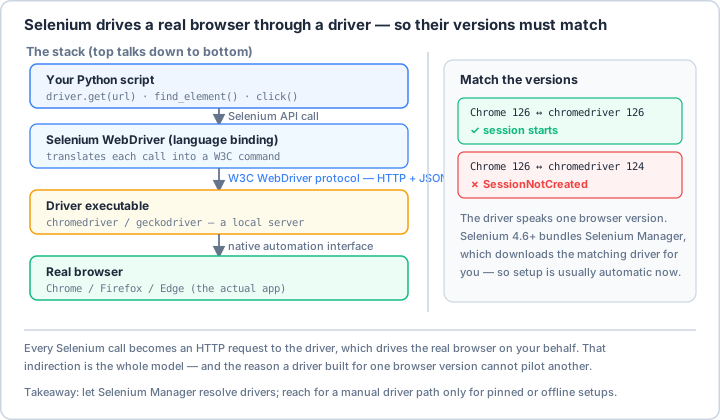
Selenium Manager resolves and downloads the right driver for you, so you can usually just create the browser and go.Real-World Scenario: The Multi-Browser Testing Platform 🌐
You're building an automated testing platform that needs to run tests across multiple browsers, handle different versions, work in headless mode for CI/CD, manage browser profiles, handle downloads and uploads, and scale across multiple machines. Your WebDriver setup must be bulletproof, flexible, and maintainable. Let's build a comprehensive WebDriver management system!
# First, install required packages:
# pip install selenium webdriver-manager python-dotenv pyvirtualdisplay
import os
import sys
import json
import logging
import platform
import subprocess
import zipfile
import tarfile
import shutil
from pathlib import Path
from typing import Dict, List, Optional, Any, Union, Tuple
from dataclasses import dataclass, field
from enum import Enum
import tempfile
import requests
from datetime import datetime
# Selenium imports
import selenium
from selenium import webdriver
from selenium.webdriver.common.desired_capabilities import DesiredCapabilities
from selenium.webdriver.common.proxy import Proxy, ProxyType
from selenium.webdriver.chrome.service import Service as ChromeService
from selenium.webdriver.chrome.options import Options as ChromeOptions
from selenium.webdriver.firefox.service import Service as FirefoxService
from selenium.webdriver.firefox.options import Options as FirefoxOptions
from selenium.webdriver.edge.service import Service as EdgeService
from selenium.webdriver.edge.options import Options as EdgeOptions
from selenium.webdriver.safari.options import Options as SafariOptions
from selenium.common.exceptions import WebDriverException, SessionNotCreatedException
# WebDriver Manager for automatic driver management
from webdriver_manager.chrome import ChromeDriverManager
from webdriver_manager.firefox import GeckoDriverManager
from webdriver_manager.microsoft import EdgeChromiumDriverManager
from webdriver_manager.opera import OperaDriverManager
# ==================== Configuration Classes ====================
class BrowserType(Enum):
"""Supported browser types."""
CHROME = "chrome"
FIREFOX = "firefox"
EDGE = "edge"
SAFARI = "safari"
OPERA = "opera"
CHROMIUM = "chromium"
BRAVE = "brave"
class DriverMode(Enum):
"""Driver execution modes."""
NORMAL = "normal"
HEADLESS = "headless"
INCOGNITO = "incognito"
MOBILE = "mobile"
@dataclass
class BrowserConfig:
"""Browser configuration settings."""
browser_type: BrowserType = BrowserType.CHROME
driver_mode: DriverMode = DriverMode.NORMAL
headless: bool = False
window_size: Tuple[int, int] = (1920, 1080)
start_maximized: bool = False
incognito: bool = False
disable_gpu: bool = True
no_sandbox: bool = True
disable_dev_shm: bool = True
disable_notifications: bool = True
accept_insecure_certs: bool = True
page_load_strategy: str = "normal" # normal, eager, none
implicit_wait: int = 10
page_load_timeout: int = 30
script_timeout: int = 30
# Advanced options
user_agent: Optional[str] = None
language: str = "en-US"
download_directory: Optional[str] = None
profile_directory: Optional[str] = None
binary_location: Optional[str] = None
extensions: List[str] = field(default_factory=list)
experimental_options: Dict[str, Any] = field(default_factory=dict)
# Proxy settings
proxy_enabled: bool = False
proxy_server: Optional[str] = None
proxy_type: str = "http" # http, socks5, etc.
proxy_auth: Optional[Tuple[str, str]] = None
# Performance options
disable_images: bool = False
disable_javascript: bool = False
disable_css: bool = False
# Mobile emulation
mobile_emulation: bool = False
device_name: Optional[str] = None
# Logging
log_level: str = "INFO"
enable_browser_logs: bool = False
log_path: Optional[str] = None
# ==================== WebDriver Manager ====================
class WebDriverManager:
"""
Comprehensive WebDriver management system.
"""
def __init__(self, config: BrowserConfig = None):
self.config = config or BrowserConfig()
self.driver = None
self.service = None
self.logger = self._setup_logging()
self._setup_directories()
def _setup_logging(self) -> logging.Logger:
"""Setup logging configuration."""
logger = logging.getLogger("WebDriverManager")
logger.setLevel(getattr(logging, self.config.log_level))
if not logger.handlers:
# Console handler
console_handler = logging.StreamHandler()
console_formatter = logging.Formatter(
'%(asctime)s - %(name)s - %(levelname)s - %(message)s'
)
console_handler.setFormatter(console_formatter)
logger.addHandler(console_handler)
# File handler if log path specified
if self.config.log_path:
file_handler = logging.FileHandler(self.config.log_path)
file_handler.setFormatter(console_formatter)
logger.addHandler(file_handler)
return logger
def _setup_directories(self):
"""Setup necessary directories."""
# Create download directory if specified
if self.config.download_directory:
Path(self.config.download_directory).mkdir(parents=True, exist_ok=True)
# Create profile directory if specified
if self.config.profile_directory:
Path(self.config.profile_directory).mkdir(parents=True, exist_ok=True)
def create_driver(self) -> webdriver.Remote:
"""
Create and configure WebDriver based on browser type.
"""
self.logger.info(f"Creating {self.config.browser_type.value} driver")
try:
if self.config.browser_type == BrowserType.CHROME:
return self._create_chrome_driver()
elif self.config.browser_type == BrowserType.FIREFOX:
return self._create_firefox_driver()
elif self.config.browser_type == BrowserType.EDGE:
return self._create_edge_driver()
elif self.config.browser_type == BrowserType.SAFARI:
return self._create_safari_driver()
elif self.config.browser_type == BrowserType.BRAVE:
return self._create_brave_driver()
else:
raise ValueError(f"Unsupported browser: {self.config.browser_type}")
except Exception as e:
self.logger.error(f"Failed to create driver: {e}")
raise
def _create_chrome_driver(self) -> webdriver.Chrome:
"""Create Chrome WebDriver with options."""
options = self._get_chrome_options()
# Set up service
try:
# Try to use webdriver-manager for automatic driver management
service = ChromeService(ChromeDriverManager().install())
self.logger.info("Using ChromeDriver from webdriver-manager")
except Exception as e:
self.logger.warning(f"webdriver-manager failed: {e}")
# Fallback to system ChromeDriver
service = ChromeService()
self.logger.info("Using system ChromeDriver")
# Add capabilities (Selenium 4 sets these on options, not a separate kwarg)
capabilities = self._get_chrome_capabilities()
for cap_name, cap_value in capabilities.items():
options.set_capability(cap_name, cap_value)
# Create driver
driver = webdriver.Chrome(
service=service,
options=options
)
self._configure_timeouts(driver)
self._setup_window(driver)
self.driver = driver
self.service = service
self.logger.info("Chrome driver created successfully")
return driver
def _get_chrome_options(self) -> ChromeOptions:
"""Configure Chrome options."""
options = ChromeOptions()
# Basic options
if self.config.headless:
options.add_argument("--headless")
options.add_argument("--disable-gpu")
if self.config.incognito:
options.add_argument("--incognito")
if self.config.start_maximized:
options.add_argument("--start-maximized")
else:
options.add_argument(f"--window-size={self.config.window_size[0]},{self.config.window_size[1]}")
# System options
if self.config.no_sandbox:
options.add_argument("--no-sandbox")
if self.config.disable_dev_shm:
options.add_argument("--disable-dev-shm-usage")
# Build ONE merged preferences dict. Each add_experimental_option("prefs", ...)
# call replaces the entire "prefs" value, so every pref must live in a single
# dict that is added exactly once (otherwise earlier prefs are silently lost).
prefs = {
"credentials_enable_service": False,
"profile.password_manager_enabled": False,
"profile.default_content_setting_values.notifications": 2 if self.config.disable_notifications else 1,
}
# Performance options
if self.config.disable_images:
prefs["profile.managed_default_content_settings.images"] = 2
if self.config.disable_javascript:
prefs["profile.managed_default_content_settings.javascript"] = 2
# Download settings
if self.config.download_directory:
prefs.update({
"download.default_directory": os.path.abspath(self.config.download_directory),
"download.prompt_for_download": False,
"download.directory_upgrade": True,
"safebrowsing.enabled": False,
"safebrowsing.disable_download_protection": True
})
options.add_experimental_option("prefs", prefs)
# Disable automation flags
options.add_experimental_option("excludeSwitches", ["enable-automation"])
options.add_experimental_option("useAutomationExtension", False)
# User agent
if self.config.user_agent:
options.add_argument(f"user-agent={self.config.user_agent}")
# Language
options.add_argument(f"--lang={self.config.language}")
# Binary location
if self.config.binary_location:
options.binary_location = self.config.binary_location
# Profile
if self.config.profile_directory:
options.add_argument(f"--user-data-dir={self.config.profile_directory}")
# Extensions
for extension_path in self.config.extensions:
if os.path.exists(extension_path):
options.add_extension(extension_path)
# Mobile emulation
if self.config.mobile_emulation and self.config.device_name:
mobile_emulation = {"deviceName": self.config.device_name}
options.add_experimental_option("mobileEmulation", mobile_emulation)
# Additional experimental options
for key, value in self.config.experimental_options.items():
options.add_experimental_option(key, value)
# Logging
if self.config.enable_browser_logs:
options.add_argument("--enable-logging")
options.add_argument("--v=1")
return options
def _get_chrome_capabilities(self) -> Dict:
"""Get Chrome capabilities."""
capabilities = DesiredCapabilities.CHROME.copy()
# Page load strategy
capabilities["pageLoadStrategy"] = self.config.page_load_strategy
# Accept insecure certificates
capabilities["acceptInsecureCerts"] = self.config.accept_insecure_certs
# Logging preferences
if self.config.enable_browser_logs:
capabilities["goog:loggingPrefs"] = {
"browser": "ALL",
"driver": "ALL",
"performance": "ALL"
}
# Proxy configuration
if self.config.proxy_enabled and self.config.proxy_server:
proxy = Proxy()
proxy.proxy_type = ProxyType.MANUAL
proxy.http_proxy = self.config.proxy_server
proxy.ssl_proxy = self.config.proxy_server
proxy.add_to_capabilities(capabilities)
return capabilities
def _create_firefox_driver(self) -> webdriver.Firefox:
"""Create Firefox WebDriver with options."""
options = self._get_firefox_options()
# Set up service
try:
service = FirefoxService(GeckoDriverManager().install())
self.logger.info("Using GeckoDriver from webdriver-manager")
except Exception as e:
self.logger.warning(f"webdriver-manager failed: {e}")
service = FirefoxService()
self.logger.info("Using system GeckoDriver")
# Create driver
driver = webdriver.Firefox(
service=service,
options=options
)
self._configure_timeouts(driver)
self._setup_window(driver)
self.driver = driver
self.service = service
self.logger.info("Firefox driver created successfully")
return driver
def _get_firefox_options(self) -> FirefoxOptions:
"""Configure Firefox options."""
options = FirefoxOptions()
# Headless mode
if self.config.headless:
options.add_argument("--headless")
# Window size
if not self.config.start_maximized:
options.add_argument(f"--width={self.config.window_size[0]}")
options.add_argument(f"--height={self.config.window_size[1]}")
# Private browsing
if self.config.incognito:
options.add_argument("--private")
# Profile settings
if self.config.profile_directory:
options.profile = self.config.profile_directory
else:
# Create temporary profile with preferences
profile = webdriver.FirefoxProfile()
# Download settings
if self.config.download_directory:
profile.set_preference("browser.download.folderList", 2)
profile.set_preference("browser.download.manager.showWhenStarting", False)
profile.set_preference("browser.download.dir", self.config.download_directory)
profile.set_preference("browser.helperApps.neverAsk.saveToDisk",
"application/octet-stream,application/pdf,application/zip")
# Disable notifications
if self.config.disable_notifications:
profile.set_preference("dom.webnotifications.enabled", False)
# Disable images
if self.config.disable_images:
profile.set_preference("permissions.default.image", 2)
# Language
profile.set_preference("intl.accept_languages", self.config.language)
options.profile = profile
# Binary location
if self.config.binary_location:
options.binary_location = self.config.binary_location
# Accept insecure certificates
options.accept_insecure_certs = self.config.accept_insecure_certs
# Page load strategy
options.page_load_strategy = self.config.page_load_strategy
# Proxy
if self.config.proxy_enabled and self.config.proxy_server:
options.set_preference("network.proxy.type", 1)
options.set_preference("network.proxy.http", self.config.proxy_server.split(':')[0])
options.set_preference("network.proxy.http_port", int(self.config.proxy_server.split(':')[1]))
options.set_preference("network.proxy.ssl", self.config.proxy_server.split(':')[0])
options.set_preference("network.proxy.ssl_port", int(self.config.proxy_server.split(':')[1]))
return options
def _create_edge_driver(self) -> webdriver.Edge:
"""Create Edge WebDriver with options."""
options = self._get_edge_options()
# Set up service
try:
service = EdgeService(EdgeChromiumDriverManager().install())
self.logger.info("Using EdgeDriver from webdriver-manager")
except Exception as e:
self.logger.warning(f"webdriver-manager failed: {e}")
service = EdgeService()
self.logger.info("Using system EdgeDriver")
# Create driver
driver = webdriver.Edge(
service=service,
options=options
)
self._configure_timeouts(driver)
self._setup_window(driver)
self.driver = driver
self.service = service
self.logger.info("Edge driver created successfully")
return driver
def _get_edge_options(self) -> EdgeOptions:
"""Configure Edge options (similar to Chrome)."""
options = EdgeOptions()
# Edge uses same options as Chrome (Chromium-based)
if self.config.headless:
options.add_argument("--headless")
if self.config.incognito:
options.add_argument("--inprivate")
options.add_argument(f"--window-size={self.config.window_size[0]},{self.config.window_size[1]}")
if self.config.no_sandbox:
options.add_argument("--no-sandbox")
if self.config.disable_dev_shm:
options.add_argument("--disable-dev-shm-usage")
# User agent
if self.config.user_agent:
options.add_argument(f"user-agent={self.config.user_agent}")
# Binary location
if self.config.binary_location:
options.binary_location = self.config.binary_location
return options
def _create_safari_driver(self) -> webdriver.Safari:
"""Create Safari WebDriver."""
if platform.system() != "Darwin":
raise WebDriverException("Safari is only available on macOS")
options = SafariOptions()
# Safari has limited options compared to other browsers
if self.config.accept_insecure_certs:
options.accept_insecure_certs = True
driver = webdriver.Safari(options=options)
self._configure_timeouts(driver)
self._setup_window(driver)
self.driver = driver
self.logger.info("Safari driver created successfully")
return driver
def _create_brave_driver(self) -> webdriver.Chrome:
"""Create Brave browser driver (uses ChromeDriver)."""
options = self._get_chrome_options()
# Set Brave binary location
brave_path = self._find_brave_binary()
if brave_path:
options.binary_location = brave_path
else:
raise WebDriverException("Brave browser not found")
# Use ChromeDriver for Brave
service = ChromeService(ChromeDriverManager().install())
driver = webdriver.Chrome(
service=service,
options=options
)
self._configure_timeouts(driver)
self._setup_window(driver)
self.driver = driver
self.service = service
self.logger.info("Brave driver created successfully")
return driver
def _find_brave_binary(self) -> Optional[str]:
"""Find Brave browser binary location."""
system = platform.system()
if system == "Windows":
paths = [
r"C:\Program Files\BraveSoftware\Brave-Browser\Application\brave.exe",
r"C:\Program Files (x86)\BraveSoftware\Brave-Browser\Application\brave.exe",
os.path.expanduser(r"~\AppData\Local\BraveSoftware\Brave-Browser\Application\brave.exe")
]
elif system == "Darwin":
paths = [
"/Applications/Brave Browser.app/Contents/MacOS/Brave Browser",
os.path.expanduser("~/Applications/Brave Browser.app/Contents/MacOS/Brave Browser")
]
else: # Linux
paths = [
"/usr/bin/brave",
"/usr/bin/brave-browser",
"/opt/brave.com/brave/brave-browser",
"/snap/bin/brave"
]
for path in paths:
if os.path.exists(path):
return path
return None
def _configure_timeouts(self, driver: webdriver.Remote):
"""Configure driver timeouts."""
driver.implicitly_wait(self.config.implicit_wait)
driver.set_page_load_timeout(self.config.page_load_timeout)
driver.set_script_timeout(self.config.script_timeout)
def _setup_window(self, driver: webdriver.Remote):
"""Setup window size and position."""
if self.config.start_maximized:
driver.maximize_window()
else:
driver.set_window_size(self.config.window_size[0], self.config.window_size[1])
def quit(self):
"""Quit driver and clean up resources."""
if self.driver:
try:
self.driver.quit()
self.logger.info("Driver quit successfully")
except Exception as e:
self.logger.error(f"Error quitting driver: {e}")
if self.service:
try:
self.service.stop()
except:
pass
# ==================== Driver Pool Manager ====================
class DriverPool:
"""
Manage a pool of WebDriver instances for parallel execution.
"""
def __init__(self, config: BrowserConfig, pool_size: int = 3):
self.config = config
self.pool_size = pool_size
self.available_drivers = []
self.in_use_drivers = []
self.logger = logging.getLogger("DriverPool")
self._initialize_pool()
def _initialize_pool(self):
"""Initialize the driver pool."""
self.logger.info(f"Initializing driver pool with {self.pool_size} instances")
for i in range(self.pool_size):
try:
manager = WebDriverManager(self.config)
driver = manager.create_driver()
self.available_drivers.append((manager, driver))
self.logger.info(f"Driver {i+1}/{self.pool_size} created")
except Exception as e:
self.logger.error(f"Failed to create driver {i+1}: {e}")
def get_driver(self) -> Optional[webdriver.Remote]:
"""Get an available driver from the pool."""
if self.available_drivers:
manager, driver = self.available_drivers.pop(0)
self.in_use_drivers.append((manager, driver))
return driver
else:
self.logger.warning("No available drivers in pool")
return None
def return_driver(self, driver: webdriver.Remote):
"""Return a driver to the pool."""
for i, (manager, d) in enumerate(self.in_use_drivers):
if d == driver:
self.in_use_drivers.pop(i)
# Clear cookies and reset state
try:
driver.delete_all_cookies()
driver.get("about:blank")
except:
pass
self.available_drivers.append((manager, d))
break
def cleanup(self):
"""Clean up all drivers in the pool."""
all_drivers = self.available_drivers + self.in_use_drivers
for manager, driver in all_drivers:
try:
manager.quit()
except:
pass
self.available_drivers.clear()
self.in_use_drivers.clear()
self.logger.info("Driver pool cleaned up")
# ==================== Environment Detection ====================
class EnvironmentDetector:
"""
Detect and configure environment for WebDriver.
"""
@staticmethod
def get_system_info() -> Dict[str, Any]:
"""Get system information."""
return {
"platform": platform.system(),
"platform_version": platform.version(),
"architecture": platform.machine(),
"python_version": sys.version,
"selenium_version": selenium.__version__
}
@staticmethod
def check_browser_installed(browser: BrowserType) -> bool:
"""Check if browser is installed on the system."""
system = platform.system()
if browser == BrowserType.CHROME:
return EnvironmentDetector._check_chrome_installed(system)
elif browser == BrowserType.FIREFOX:
return EnvironmentDetector._check_firefox_installed(system)
elif browser == BrowserType.EDGE:
return EnvironmentDetector._check_edge_installed(system)
elif browser == BrowserType.SAFARI:
return system == "Darwin" # Safari only on macOS
else:
return False
@staticmethod
def _check_chrome_installed(system: str) -> bool:
"""Check if Chrome is installed."""
if system == "Windows":
paths = [
r"C:\Program Files\Google\Chrome\Application\chrome.exe",
r"C:\Program Files (x86)\Google\Chrome\Application\chrome.exe"
]
elif system == "Darwin":
paths = ["/Applications/Google Chrome.app/Contents/MacOS/Google Chrome"]
else:
paths = ["/usr/bin/google-chrome", "/usr/bin/chromium-browser"]
return any(os.path.exists(path) for path in paths)
@staticmethod
def _check_firefox_installed(system: str) -> bool:
"""Check if Firefox is installed."""
if system == "Windows":
paths = [
r"C:\Program Files\Mozilla Firefox\firefox.exe",
r"C:\Program Files (x86)\Mozilla Firefox\firefox.exe"
]
elif system == "Darwin":
paths = ["/Applications/Firefox.app/Contents/MacOS/firefox"]
else:
paths = ["/usr/bin/firefox"]
return any(os.path.exists(path) for path in paths)
@staticmethod
def _check_edge_installed(system: str) -> bool:
"""Check if Edge is installed."""
if system == "Windows":
paths = [
r"C:\Program Files (x86)\Microsoft\Edge\Application\msedge.exe",
r"C:\Program Files\Microsoft\Edge\Application\msedge.exe"
]
elif system == "Darwin":
paths = ["/Applications/Microsoft Edge.app/Contents/MacOS/Microsoft Edge"]
else:
paths = ["/usr/bin/microsoft-edge"]
return any(os.path.exists(path) for path in paths)
@staticmethod
def setup_virtual_display():
"""Setup virtual display for headless environments (Linux)."""
if platform.system() != "Linux":
return None
try:
from pyvirtualdisplay import Display
display = Display(visible=0, size=(1920, 1080))
display.start()
return display
except ImportError:
logging.warning("pyvirtualdisplay not installed")
return None
# Example usage
if __name__ == "__main__":
print("🚗 WebDriver Setup Examples\n")
# Example 1: Basic Chrome setup
print("1️⃣ Basic Chrome WebDriver Setup:")
config = BrowserConfig(
browser_type=BrowserType.CHROME,
headless=False,
window_size=(1280, 720)
)
manager = WebDriverManager(config)
print(f" Browser: {config.browser_type.value}")
print(f" Headless: {config.headless}")
print(f" Window size: {config.window_size}")
try:
driver = manager.create_driver()
print(" ✅ Driver created successfully")
# Navigate to test page
driver.get("https://www.google.com")
print(f" Current URL: {driver.current_url}")
# Clean up
manager.quit()
print(" Driver closed")
except Exception as e:
print(f" ❌ Error: {e}")
# Example 2: Browser configurations
print("\n2️⃣ Browser Configuration Options:")
options = [
("Headless Mode", "Run without GUI"),
("Incognito/Private", "Private browsing mode"),
("Custom User Agent", "Spoof browser identity"),
("Download Directory", "Set download location"),
("Browser Profile", "Use existing profile"),
("Extensions", "Load browser extensions"),
("Proxy Settings", "Route through proxy"),
("Mobile Emulation", "Emulate mobile devices")
]
for option, description in options:
print(f" {option}: {description}")
# Example 3: Environment detection
print("\n3️⃣ Environment Detection:")
system_info = EnvironmentDetector.get_system_info()
print(f" Platform: {system_info['platform']}")
print(f" Architecture: {system_info['architecture']}")
print(f" Python: {sys.version.split()[0]}")
# Check installed browsers
browsers = [BrowserType.CHROME, BrowserType.FIREFOX, BrowserType.EDGE]
print("\n Installed browsers:")
for browser in browsers:
installed = EnvironmentDetector.check_browser_installed(browser)
status = "✅" if installed else "❌"
print(f" {browser.value}: {status}")
# Example 4: Advanced Chrome options
print("\n4️⃣ Advanced Chrome Options:")
advanced_config = BrowserConfig(
browser_type=BrowserType.CHROME,
headless=True,
disable_images=True,
disable_notifications=True,
download_directory="./downloads",
user_agent="Custom User Agent String",
experimental_options={
"excludeSwitches": ["enable-automation"],
"useAutomationExtension": False
}
)
print(" Advanced settings configured:")
print(" • Images disabled for faster loading")
print(" • Notifications blocked")
print(" • Custom download directory")
print(" • Automation detection bypassed")
# Example 5: Driver pool
print("\n5️⃣ Driver Pool Management:")
pool_config = BrowserConfig(
browser_type=BrowserType.CHROME,
headless=True
)
print(" Creating driver pool...")
# pool = DriverPool(pool_config, pool_size=3)
print(" Pool size: 3 drivers")
print(" Use case: Parallel testing/scraping")
# Example 6: Mobile emulation
print("\n6️⃣ Mobile Device Emulation:")
mobile_config = BrowserConfig(
browser_type=BrowserType.CHROME,
mobile_emulation=True,
device_name="iPhone X"
)
devices = [
"iPhone X",
"iPhone 12 Pro",
"Pixel 5",
"Samsung Galaxy S20",
"iPad Pro",
"Nexus 7"
]
print(" Available device emulations:")
for device in devices:
print(f" • {device}")
# Example 7: Proxy configuration
print("\n7️⃣ Proxy Configuration:")
proxy_config = BrowserConfig(
browser_type=BrowserType.CHROME,
proxy_enabled=True,
proxy_server="proxy.example.com:8080",
proxy_type="http"
)
print(" Proxy settings:")
print(f" Server: {proxy_config.proxy_server}")
print(f" Type: {proxy_config.proxy_type}")
print(" Use cases: Geo-location testing, anonymity")
# Example 8: Performance optimization
print("\n8️⃣ Performance Optimization:")
performance_tips = [
"Disable images for 2-3x faster page loads",
"Use headless mode for server environments",
"Disable CSS for text-only scraping",
"Set page load strategy to 'eager' or 'none'",
"Use connection pooling for multiple requests",
"Cache browser profiles to skip login"
]
for tip in performance_tips:
print(f" • {tip}")
# Example 9: Common issues and solutions
print("\n9️⃣ Common Issues & Solutions:")
issues = [
("ChromeDriver version mismatch", "Use webdriver-manager for auto-updates"),
("Timeout errors", "Increase page_load_timeout and implicit_wait"),
("Memory leaks", "Properly quit drivers and use context managers"),
("Detection by websites", "Rotate user agents and use stealth options"),
("Headless detection", "Use headless-specific options and viewport"),
("Download issues", "Configure download preferences properly")
]
for issue, solution in issues:
print(f" Issue: {issue}")
print(f" Solution: {solution}\n")
# Example 10: Best practices
print("🔟 WebDriver Setup Best Practices:")
best_practices = [
"📦 Use webdriver-manager for automatic driver updates",
"🔧 Create reusable configuration classes",
"🧪 Test your setup on multiple environments",
"💾 Cache driver binaries locally",
"🔄 Implement proper cleanup in finally blocks",
"📊 Log driver creation and errors",
"🛡️ Use try-except for graceful failures",
"⚡ Reuse sessions when possible",
"🔐 Never hardcode credentials in configs",
"📝 Document browser-specific quirks"
]
for practice in best_practices:
print(f" {practice}")
print("\n✅ WebDriver setup demonstration complete!")
Key Takeaways and Best Practices 🎯
- Use WebDriver Manager: Automatically handles driver downloads and updates.
- Configure Properly: Set timeouts, window size, and options before starting.
- Handle Multiple Browsers: Abstract configuration for cross-browser compatibility.
- Implement Proper Cleanup: Always quit drivers to prevent memory leaks.
- Use Headless for CI/CD: Run without GUI in server environments.
- Cache Profiles: Reuse browser profiles to maintain state.
- Log Everything: Track driver creation, errors, and performance.
- Test Your Setup: Verify configuration works across environments.
WebDriver Setup Best Practices 📋
Mastering WebDriver setup gives you a solid foundation for all browser automation tasks. You now understand driver management, configuration options, cross-browser compatibility, and optimization techniques. Whether you're building test suites, web scrapers, or automation tools, proper WebDriver setup ensures your automation runs smoothly and reliably! 🏎️
Pro Tip: WebDriver setup is like preparing a race car - the initial configuration determines your entire automation journey. Start with webdriver-manager to avoid version mismatch headaches. Create a configuration class that handles all browser-specific quirks in one place. Always set proper timeouts - implicit wait for element location, page load timeout for navigation, and script timeout for JavaScript execution. For production, use headless mode but test with GUI first. Implement a driver pool for parallel execution. Handle driver crashes gracefully with try-except-finally blocks. Cache browser profiles to skip login flows. Disable images and CSS when you don't need them for massive speed gains. Most importantly: always quit your drivers properly - zombie Chrome processes will eat your RAM for breakfast!