⏱️ Rate Limiting: Respect API Boundaries
📚 What You'll Learn
By the end of this lesson, you will be able to:
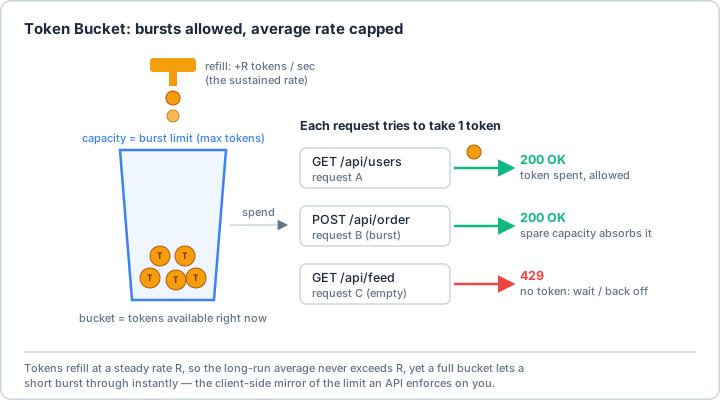
- Explain the token-bucket mental model behind most rate limits — a steady refill rate R caps your long-run average while a full bucket allows short bursts
- Read rate-limit signals from response headers (
X-RateLimit-Remaining,Retry-After) and the 429 status code - Implement client-side limiters (token bucket, sliding window, leaky bucket, concurrent) so you throttle yourself before the API has to
- Handle 429 responses gracefully with exponential backoff and honor
Retry-Afterinstead of hammering - Coordinate limits across processes with a distributed (Redis) limiter and track usage metrics
⏱️ Estimated Time: 45–60 minutes
🎯 Project: Build a token-bucket rate limiter and wrap an API client so it self-throttles and backs off on 429s using Retry-After.
Rate limiting is the traffic control system of the API world - it ensures fair usage, prevents abuse, and keeps services running smoothly for everyone. Like a highway with speed limits and lane management, rate limiting helps you navigate API restrictions while maximizing throughput. Master these patterns to build respectful, efficient API clients that never get blocked! 🚦
The Rate Limiting Ecosystem
APIs implement rate limits to protect their infrastructure and ensure quality of service. Think of it as a restaurant that can only serve so many customers at once - respecting these limits ensures everyone gets served. Understanding different rate limiting strategies, implementing intelligent throttling, and handling limit violations gracefully are essential skills for robust API automation!
Real-World Scenario: The Multi-API Rate Manager 🎯
You're building a rate limiting system that manages multiple APIs with different limits - some allow 100 requests/minute, others 1000/hour, some have burst allowances, others strict limits. Your system must track usage across multiple API keys, implement various throttling algorithms, handle 429 responses gracefully, provide detailed metrics, and optimize throughput while never exceeding limits. Let's build a comprehensive rate limiting framework!
# First, install required packages:
# pip install requests aiohttp asyncio-throttle ratelimit backoff redis
import time
import asyncio
import threading
import logging
from typing import Dict, List, Optional, Any, Callable, Union
from dataclasses import dataclass, field
from datetime import datetime, timedelta
from enum import Enum
from collections import deque, defaultdict
import heapq
from functools import wraps
import json
import redis
import requests
from requests.adapters import HTTPAdapter
from urllib3.util.retry import Retry
# ==================== Rate Limit Types ====================
class RateLimitType(Enum):
"""Types of rate limits."""
FIXED_WINDOW = "fixed_window"
SLIDING_WINDOW = "sliding_window"
TOKEN_BUCKET = "token_bucket"
LEAKY_BUCKET = "leaky_bucket"
CONCURRENT = "concurrent"
BURST = "burst"
@dataclass
class RateLimitConfig:
"""Configuration for rate limiting."""
limit_type: RateLimitType = RateLimitType.SLIDING_WINDOW
requests_per_second: Optional[float] = None
requests_per_minute: Optional[int] = None
requests_per_hour: Optional[int] = None
requests_per_day: Optional[int] = None
# Burst configuration
burst_size: Optional[int] = None
burst_duration: Optional[float] = None
# Concurrent limits
max_concurrent: Optional[int] = None
# Backoff configuration
enable_backoff: bool = True
initial_backoff: float = 1.0
max_backoff: float = 60.0
backoff_factor: float = 2.0
# Monitoring
track_metrics: bool = True
alert_threshold: float = 0.9 # Alert at 90% of limit
# ==================== Rate Limit Tracker ====================
class RateLimitTracker:
"""
Track API rate limit usage from response headers.
"""
def __init__(self):
self.limits = {}
self.logger = logging.getLogger(__name__)
def update_from_headers(self, api_name: str, headers: Dict[str, str]):
"""
Update rate limit info from response headers.
Common header patterns:
- X-RateLimit-Limit: Maximum requests
- X-RateLimit-Remaining: Requests left
- X-RateLimit-Reset: Reset timestamp
- Retry-After: Seconds to wait
"""
limit_info = {}
# Standard headers
if "X-RateLimit-Limit" in headers:
limit_info["limit"] = int(headers["X-RateLimit-Limit"])
if "X-RateLimit-Remaining" in headers:
limit_info["remaining"] = int(headers["X-RateLimit-Remaining"])
if "X-RateLimit-Reset" in headers:
reset_time = int(headers["X-RateLimit-Reset"])
limit_info["reset"] = datetime.fromtimestamp(reset_time)
if "Retry-After" in headers:
retry_after = headers["Retry-After"]
if retry_after.isdigit():
limit_info["retry_after"] = int(retry_after)
else:
# HTTP date format
limit_info["retry_after_date"] = retry_after
# GitHub style
if "X-RateLimit-Used" in headers:
limit_info["used"] = int(headers["X-RateLimit-Used"])
# Alternative patterns
if "RateLimit-Limit" in headers:
limit_info["limit"] = int(headers["RateLimit-Limit"])
if "RateLimit-Remaining" in headers:
limit_info["remaining"] = int(headers["RateLimit-Remaining"])
# Store info
if limit_info:
self.limits[api_name] = {
"info": limit_info,
"timestamp": datetime.now()
}
self.logger.debug(f"Rate limit for {api_name}: {limit_info}")
# Check if approaching limit
if "limit" in limit_info and "remaining" in limit_info:
usage_percent = 1 - (limit_info["remaining"] / limit_info["limit"])
if usage_percent > 0.8:
self.logger.warning(
f"Rate limit warning for {api_name}: "
f"{usage_percent:.1%} used"
)
def get_wait_time(self, api_name: str) -> float:
"""Get wait time until rate limit resets."""
if api_name not in self.limits:
return 0
limit_info = self.limits[api_name]["info"]
# Check Retry-After
if "retry_after" in limit_info:
return limit_info["retry_after"]
# Check reset time
if "reset" in limit_info:
reset_time = limit_info["reset"]
wait_time = (reset_time - datetime.now()).total_seconds()
return max(0, wait_time)
return 0
def is_limit_exceeded(self, api_name: str) -> bool:
"""Check if rate limit is exceeded."""
if api_name not in self.limits:
return False
limit_info = self.limits[api_name]["info"]
# Check remaining requests
if "remaining" in limit_info and limit_info["remaining"] <= 0:
return True
return False
# ==================== Token Bucket Algorithm ====================
class TokenBucket:
"""
Token bucket rate limiter.
Allows burst traffic while maintaining average rate.
"""
def __init__(self, capacity: int, refill_rate: float):
"""
Args:
capacity: Maximum number of tokens (burst size)
refill_rate: Tokens added per second
"""
self.capacity = capacity
self.refill_rate = refill_rate
self.tokens = capacity
self.last_refill = time.time()
self.lock = threading.Lock()
def _refill(self):
"""Refill tokens based on elapsed time."""
now = time.time()
elapsed = now - self.last_refill
# Add tokens based on refill rate
tokens_to_add = elapsed * self.refill_rate
self.tokens = min(self.capacity, self.tokens + tokens_to_add)
self.last_refill = now
def consume(self, tokens: int = 1) -> bool:
"""
Try to consume tokens.
Returns True if successful, False if not enough tokens.
"""
with self.lock:
self._refill()
if self.tokens >= tokens:
self.tokens -= tokens
return True
return False
def wait_time(self, tokens: int = 1) -> float:
"""Get wait time until tokens are available."""
with self.lock:
self._refill()
if self.tokens >= tokens:
return 0
tokens_needed = tokens - self.tokens
wait_time = tokens_needed / self.refill_rate
return wait_time
def wait_and_consume(self, tokens: int = 1) -> bool:
"""Wait for tokens and consume them."""
wait_time = self.wait_time(tokens)
if wait_time > 0:
time.sleep(wait_time)
return self.consume(tokens)
# ==================== Sliding Window Algorithm ====================
class SlidingWindow:
"""
Sliding window rate limiter.
Tracks requests over a moving time window.
"""
def __init__(self, window_size: int, max_requests: int):
"""
Args:
window_size: Window size in seconds
max_requests: Maximum requests in window
"""
self.window_size = window_size
self.max_requests = max_requests
self.requests = deque()
self.lock = threading.Lock()
def _clean_old_requests(self):
"""Remove requests outside the window."""
now = time.time()
cutoff = now - self.window_size
while self.requests and self.requests[0] < cutoff:
self.requests.popleft()
def allow_request(self) -> bool:
"""Check if request is allowed."""
with self.lock:
now = time.time()
self._clean_old_requests()
if len(self.requests) < self.max_requests:
self.requests.append(now)
return True
return False
def wait_time(self) -> float:
"""Get wait time until next request is allowed."""
with self.lock:
self._clean_old_requests()
if len(self.requests) < self.max_requests:
return 0
# Wait until oldest request expires
oldest = self.requests[0]
wait_time = self.window_size - (time.time() - oldest)
return max(0, wait_time)
def get_usage(self) -> Dict[str, Any]:
"""Get current usage statistics."""
with self.lock:
self._clean_old_requests()
return {
"current_requests": len(self.requests),
"max_requests": self.max_requests,
"usage_percent": len(self.requests) / self.max_requests * 100,
"window_size": self.window_size
}
# ==================== Leaky Bucket Algorithm ====================
class LeakyBucket:
"""
Leaky bucket rate limiter.
Processes requests at a constant rate.
"""
def __init__(self, capacity: int, leak_rate: float):
"""
Args:
capacity: Maximum bucket size
leak_rate: Requests processed per second
"""
self.capacity = capacity
self.leak_rate = leak_rate
self.queue = deque()
self.last_leak = time.time()
self.lock = threading.Lock()
self.processing = False
def _leak(self):
"""Process queued requests."""
now = time.time()
elapsed = now - self.last_leak
# Calculate how many requests to process
to_process = int(elapsed * self.leak_rate)
for _ in range(min(to_process, len(self.queue))):
if self.queue:
self.queue.popleft()
self.last_leak = now
def add_request(self) -> bool:
"""Add request to bucket."""
with self.lock:
self._leak()
if len(self.queue) < self.capacity:
self.queue.append(time.time())
return True
return False
def wait_time(self) -> float:
"""Get wait time for next available slot."""
with self.lock:
self._leak()
if len(self.queue) < self.capacity:
return 0
# Calculate when next slot will be available
wait_time = len(self.queue) / self.leak_rate
return wait_time
# ==================== Concurrent Request Limiter ====================
class ConcurrentLimiter:
"""
Limit concurrent requests.
"""
def __init__(self, max_concurrent: int):
self.max_concurrent = max_concurrent
self.current = 0
self.lock = threading.Lock()
self.condition = threading.Condition(self.lock)
def acquire(self, timeout: Optional[float] = None) -> bool:
"""Acquire a slot for concurrent execution."""
with self.condition:
end_time = time.time() + timeout if timeout else None
while self.current >= self.max_concurrent:
if timeout:
remaining = end_time - time.time()
if remaining <= 0:
return False
if not self.condition.wait(remaining):
return False
else:
self.condition.wait()
self.current += 1
return True
def release(self):
"""Release a concurrent execution slot."""
with self.condition:
self.current = max(0, self.current - 1)
self.condition.notify()
def __enter__(self):
"""Context manager entry."""
self.acquire()
return self
def __exit__(self, exc_type, exc_val, exc_tb):
"""Context manager exit."""
self.release()
# ==================== Distributed Rate Limiter ====================
class DistributedRateLimiter:
"""
Distributed rate limiter using Redis.
Supports multiple processes/servers.
"""
def __init__(self, redis_client: redis.Redis,
key_prefix: str = "rate_limit"):
self.redis = redis_client
self.key_prefix = key_prefix
self.logger = logging.getLogger(__name__)
def sliding_window_allow(self, identifier: str,
window_seconds: int,
max_requests: int) -> bool:
"""
Check if request is allowed using sliding window in Redis.
"""
key = f"{self.key_prefix}:{identifier}"
now = time.time()
pipeline = self.redis.pipeline()
try:
# Remove old entries
pipeline.zremrangebyscore(key, 0, now - window_seconds)
# Count current entries
pipeline.zcard(key)
# Add current request
pipeline.zadd(key, {str(now): now})
# Set expiry
pipeline.expire(key, window_seconds + 1)
results = pipeline.execute()
current_requests = results[1]
# Check if within limit (we already added, so check +1)
if current_requests < max_requests:
return True
else:
# Remove the request we just added
self.redis.zrem(key, str(now))
return False
except Exception as e:
self.logger.error(f"Redis rate limit error: {e}")
return True # Fail open
def get_usage(self, identifier: str, window_seconds: int) -> int:
"""Get current usage count."""
key = f"{self.key_prefix}:{identifier}"
now = time.time()
# Remove old entries and count
pipeline = self.redis.pipeline()
pipeline.zremrangebyscore(key, 0, now - window_seconds)
pipeline.zcard(key)
results = pipeline.execute()
return results[1]
# ==================== Rate Limit Manager ====================
class RateLimitManager:
"""
Comprehensive rate limit management system.
"""
def __init__(self):
self.limiters = {}
self.tracker = RateLimitTracker()
self.metrics = defaultdict(lambda: {
"requests": 0,
"throttled": 0,
"errors": 0,
"total_wait_time": 0
})
self.logger = logging.getLogger(__name__)
def register_api(self, api_name: str, config: RateLimitConfig):
"""Register API with rate limit configuration."""
# Create appropriate limiter
if config.limit_type == RateLimitType.TOKEN_BUCKET:
if config.requests_per_second:
limiter = TokenBucket(
capacity=config.burst_size or int(config.requests_per_second * 10),
refill_rate=config.requests_per_second
)
else:
raise ValueError("Token bucket requires requests_per_second")
elif config.limit_type == RateLimitType.SLIDING_WINDOW:
if config.requests_per_minute:
limiter = SlidingWindow(
window_size=60,
max_requests=config.requests_per_minute
)
elif config.requests_per_hour:
limiter = SlidingWindow(
window_size=3600,
max_requests=config.requests_per_hour
)
else:
raise ValueError("Sliding window requires time-based limit")
elif config.limit_type == RateLimitType.LEAKY_BUCKET:
if config.requests_per_second:
limiter = LeakyBucket(
capacity=config.burst_size or 100,
leak_rate=config.requests_per_second
)
else:
raise ValueError("Leaky bucket requires requests_per_second")
elif config.limit_type == RateLimitType.CONCURRENT:
if config.max_concurrent:
limiter = ConcurrentLimiter(config.max_concurrent)
else:
raise ValueError("Concurrent limiter requires max_concurrent")
else:
raise ValueError(f"Unsupported limit type: {config.limit_type}")
self.limiters[api_name] = {
"limiter": limiter,
"config": config
}
self.logger.info(f"Registered {api_name} with {config.limit_type.value} rate limiting")
def check_limit(self, api_name: str) -> bool:
"""Check if request is allowed."""
if api_name not in self.limiters:
return True
limiter_info = self.limiters[api_name]
limiter = limiter_info["limiter"]
# Check based on limiter type
if isinstance(limiter, TokenBucket):
return limiter.consume()
elif isinstance(limiter, SlidingWindow):
return limiter.allow_request()
elif isinstance(limiter, LeakyBucket):
return limiter.add_request()
elif isinstance(limiter, ConcurrentLimiter):
return limiter.acquire(timeout=0)
return True
def wait_if_needed(self, api_name: str) -> float:
"""Wait if rate limit requires it."""
if api_name not in self.limiters:
return 0
limiter_info = self.limiters[api_name]
limiter = limiter_info["limiter"]
config = limiter_info["config"]
wait_time = 0
# Get wait time based on limiter type
if isinstance(limiter, TokenBucket):
wait_time = limiter.wait_time()
elif isinstance(limiter, SlidingWindow):
wait_time = limiter.wait_time()
elif isinstance(limiter, LeakyBucket):
wait_time = limiter.wait_time()
# Apply backoff if configured
if wait_time > 0 and config.enable_backoff:
wait_time = min(wait_time * config.backoff_factor, config.max_backoff)
if wait_time > 0:
self.logger.info(f"Rate limit wait for {api_name}: {wait_time:.2f}s")
self.metrics[api_name]["throttled"] += 1
self.metrics[api_name]["total_wait_time"] += wait_time
time.sleep(wait_time)
return wait_time
def handle_response(self, api_name: str, response: requests.Response):
"""Handle response and update rate limit tracking."""
# Update tracker from headers
self.tracker.update_from_headers(api_name, dict(response.headers))
# Update metrics
self.metrics[api_name]["requests"] += 1
# Check for rate limit error
if response.status_code == 429:
self.metrics[api_name]["errors"] += 1
# Get wait time from tracker
wait_time = self.tracker.get_wait_time(api_name)
if wait_time > 0:
self.logger.warning(f"Rate limit hit for {api_name}, waiting {wait_time}s")
time.sleep(wait_time)
def get_metrics(self, api_name: Optional[str] = None) -> Dict:
"""Get rate limiting metrics."""
if api_name:
return dict(self.metrics[api_name])
return dict(self.metrics)
# ==================== Rate Limit Decorators ====================
def rate_limit(requests_per_second: float):
"""
Decorator to rate limit function calls.
"""
min_interval = 1.0 / requests_per_second
last_called = [0.0]
def decorator(func):
@wraps(func)
def wrapper(*args, **kwargs):
elapsed = time.time() - last_called[0]
left_to_wait = min_interval - elapsed
if left_to_wait > 0:
time.sleep(left_to_wait)
ret = func(*args, **kwargs)
last_called[0] = time.time()
return ret
return wrapper
return decorator
def retry_on_rate_limit(max_retries: int = 3, backoff_factor: float = 2.0):
"""
Decorator to retry on rate limit errors.
"""
def decorator(func):
@wraps(func)
def wrapper(*args, **kwargs):
retries = 0
backoff = 1.0
while retries < max_retries:
try:
response = func(*args, **kwargs)
if hasattr(response, 'status_code') and response.status_code == 429:
# Rate limited
retry_after = response.headers.get('Retry-After')
if retry_after:
wait_time = int(retry_after)
else:
wait_time = backoff
logging.warning(f"Rate limited, waiting {wait_time}s")
time.sleep(wait_time)
retries += 1
backoff *= backoff_factor
else:
return response
except Exception as e:
logging.error(f"Error in rate limited call: {e}")
raise
raise Exception(f"Max retries ({max_retries}) exceeded")
return wrapper
return decorator
# ==================== Async Rate Limiter ====================
class AsyncRateLimiter:
"""
Asynchronous rate limiter for async/await code.
"""
def __init__(self, rate: float, per: float = 1.0):
"""
Args:
rate: Number of requests
per: Time period in seconds
"""
self.rate = rate
self.per = per
self.allowance = rate
self.last_check = time.time()
self.lock = asyncio.Lock()
async def acquire(self):
"""Acquire permission to make a request."""
async with self.lock:
current = time.time()
time_passed = current - self.last_check
self.last_check = current
self.allowance += time_passed * (self.rate / self.per)
if self.allowance > self.rate:
self.allowance = self.rate
if self.allowance < 1.0:
sleep_time = (1.0 - self.allowance) * (self.per / self.rate)
await asyncio.sleep(sleep_time)
self.allowance = 0.0
else:
self.allowance -= 1.0
# Example usage
if __name__ == "__main__":
print("⏱️ Rate Limiting Examples\n")
# Example 1: Rate limit types
print("1️⃣ Rate Limit Types:")
limit_types = [
("Fixed Window", "Reset at fixed intervals", "100 req/hour from 2:00-3:00"),
("Sliding Window", "Rolling time window", "100 req in last 60 minutes"),
("Token Bucket", "Burst with average rate", "10 req/s with burst of 50"),
("Leaky Bucket", "Constant processing rate", "Process 5 req/s steadily"),
("Concurrent", "Parallel request limit", "Max 10 concurrent requests")
]
for limit_type, description, example in limit_types:
print(f" {limit_type}:")
print(f" {description}")
print(f" Example: {example}\n")
# Example 2: Token bucket demo
print("2️⃣ Token Bucket Example:")
bucket = TokenBucket(capacity=10, refill_rate=2) # 2 tokens/second, burst of 10
print(" Initial tokens: 10")
print(" Refill rate: 2 tokens/second")
print(" Making 5 rapid requests...")
for i in range(5):
if bucket.consume():
print(f" Request {i+1}: ✅ Allowed")
else:
print(f" Request {i+1}: ❌ Denied")
print(f" Remaining tokens: {bucket.tokens:.1f}")
# Example 3: Sliding window demo
print("\n3️⃣ Sliding Window Example:")
window = SlidingWindow(window_size=10, max_requests=5) # 5 requests per 10 seconds
print(" Window: 10 seconds")
print(" Max requests: 5")
for i in range(7):
if window.allow_request():
print(f" Request {i+1}: ✅ Allowed")
else:
wait = window.wait_time()
print(f" Request {i+1}: ❌ Denied (wait {wait:.1f}s)")
usage = window.get_usage()
print(f" Current usage: {usage['usage_percent']:.0f}%")
# Example 4: Rate limit headers
print("\n4️⃣ Common Rate Limit Headers:")
headers = [
("X-RateLimit-Limit", "Maximum requests allowed"),
("X-RateLimit-Remaining", "Requests remaining in window"),
("X-RateLimit-Reset", "Unix timestamp when limit resets"),
("Retry-After", "Seconds to wait before retry"),
("X-RateLimit-Used", "Requests used in current window")
]
for header, description in headers:
print(f" {header}:")
print(f" {description}")
# Example 5: Rate limit manager
print("\n5️⃣ Rate Limit Manager:")
manager = RateLimitManager()
# Register APIs with different limits
manager.register_api("github", RateLimitConfig(
limit_type=RateLimitType.SLIDING_WINDOW,
requests_per_hour=5000
))
manager.register_api("twitter", RateLimitConfig(
limit_type=RateLimitType.TOKEN_BUCKET,
requests_per_second=1,
burst_size=10
))
manager.register_api("stripe", RateLimitConfig(
limit_type=RateLimitType.CONCURRENT,
max_concurrent=25
))
print(" Registered APIs:")
print(" • GitHub: 5000 req/hour (sliding window)")
print(" • Twitter: 1 req/s with burst of 10 (token bucket)")
print(" • Stripe: Max 25 concurrent requests")
# Example 6: Backoff strategies
print("\n6️⃣ Backoff Strategies:")
strategies = [
("Linear", "Wait fixed time", "1s, 1s, 1s..."),
("Exponential", "Double wait time", "1s, 2s, 4s, 8s..."),
("Fibonacci", "Fibonacci sequence", "1s, 1s, 2s, 3s, 5s..."),
("Jittered", "Random variation", "1-2s, 2-4s, 4-8s..."),
("Decorrelated", "Based on previous", "Random based on last")
]
for strategy, description, example in strategies:
print(f" {strategy}:")
print(f" {description}")
print(f" Pattern: {example}")
# Example 7: Handling 429 errors
print("\n7️⃣ Handling 429 (Too Many Requests):")
print(" @retry_on_rate_limit(max_retries=3)")
print(" def make_api_call():")
print(" response = requests.get(url)")
print(" if response.status_code == 429:")
print(" # Automatic retry with backoff")
print(" return response")
# Example 8: Best practices
print("\n8️⃣ Rate Limiting Best Practices:")
practices = [
"📊 Monitor rate limit headers",
"⏰ Implement proper backoff",
"🔄 Use retry logic wisely",
"💾 Cache responses when possible",
"🎯 Batch requests when allowed",
"📈 Track usage metrics",
"🔔 Set up alerts for limits",
"🌐 Use distributed limiting for scale",
"📝 Log all rate limit events",
"🛡️ Fail gracefully when limited"
]
for practice in practices:
print(f" {practice}")
# Example 9: Optimization tips
print("\n9️⃣ Rate Limit Optimization:")
tips = [
"Prioritize critical requests",
"Use webhooks instead of polling",
"Implement request queuing",
"Spread requests over time",
"Use multiple API keys/tokens",
"Cache frequently accessed data",
"Batch operations when possible",
"Use conditional requests (ETags)"
]
for tip in tips:
print(f" • {tip}")
# Example 10: Metrics and monitoring
print("\n🔟 Rate Limit Metrics:")
sample_metrics = {
"github": {
"requests": 1523,
"throttled": 12,
"errors": 2,
"total_wait_time": 45.3,
"avg_wait": 3.78
}
}
print(" Sample metrics for GitHub API:")
for metric, value in sample_metrics["github"].items():
print(f" {metric}: {value}")
print("\n✅ Rate limiting demonstration complete!")
Key Takeaways and Best Practices 🎯
- Respect Rate Limits: Never try to bypass or abuse API limits.
- Monitor Headers: Track rate limit info from response headers.
- Implement Backoff: Use exponential backoff for retries.
- Choose Right Algorithm: Match rate limiter to your use case.
- Cache Aggressively: Reduce API calls with intelligent caching.
- Queue Requests: Smooth out burst traffic with queuing.
- Track Metrics: Monitor usage to optimize patterns.
- Handle Errors Gracefully: Fail safely when rate limited.
Rate Limiting Best Practices 📋
Mastering rate limiting ensures your API integrations are reliable, respectful, and resilient. You can now build systems that maximize throughput while staying within limits, handle rate limit responses gracefully, and optimize API usage patterns. Whether you're building high-volume data pipelines or real-time applications, these rate limiting skills keep your API connections running smoothly! ⚡
📓 Learning Journal
Keep a learning journal — digital or physical. After this lesson, take a few minutes to write down:
- Key concepts you learned
- Techniques that clicked for you
- Questions or confusion points to revisit
- Ideas you want to try
- Your progress and feelings about learning this
✍️ This lesson's prompt: Rate limits exist to keep a shared service fair and stable. How does mirroring the API's own token-bucket policy on your side — throttling yourself before you're told to — change the way you think about being a "good citizen" of the services you consume?
📝 Lesson Summary
🎓 Key Takeaways
- The token bucket is the mental model behind almost every rate limit: tokens refill at a steady rate R, capping your long-run average, while a full bucket lets a short burst through instantly.
- Implement a limiter client-side and you mirror the exact policy the API enforces, so you throttle yourself before it has to.
- APIs tell you their limits — read
X-RateLimit-*headers and honorRetry-Afteron a 429 instead of retrying blindly. - Different algorithms suit different needs: token bucket for bursts, sliding window for steady rates, concurrent limiters for parallelism, and Redis for limits shared across processes.
🎉 What You've Accomplished
You can now build API clients that maximize throughput without ever getting blocked — self-throttling to match a service's policy, backing off intelligently when limited, and coordinating limits across many workers. That's what makes high-volume automation both fast and welcome.
❓ Common Questions at This Stage
Why implement a limiter myself if the API already enforces one?
Because hitting the server's limit means wasted requests, 429s, and possible penalties. A client-side limiter that mirrors the policy keeps you just under the line, so you spend every request productively instead of getting rejected.
What should I do when I get a 429?
Stop and wait. Honor the Retry-After header if present; otherwise back off exponentially. Never immediately retry in a tight loop — that makes things worse and can escalate a temporary limit into a ban.
Token bucket vs sliding window — which do I use?
Use a token bucket when you want to allow short bursts while capping the average rate. Use a sliding window when you need a strict "no more than N requests per period" with no bursting. Match the algorithm to how the API describes its own limit.
🔭 Looking Ahead
Next you'll implement webhooks — the push-based alternative to polling, which is often the best way to reduce the request volume that rate limits constrain in the first place.
✅ Before the Next Lesson
- Implement a token bucket and confirm that a burst is allowed until the bucket empties, then requests are paced at the refill rate.
- Add 429 handling to a client that reads
Retry-Afterand backs off exponentially when it's absent. - Write your Learning Journal entry for this lesson.
🌟 Encouragement for the Journey
Respecting limits isn't a constraint on your automation — it's what lets it run for the long haul without getting blocked. A client that paces itself is a client people trust. You're building that maturity now. Keep going.
Pro Tip: Think of rate limiting as driving in traffic - you need to maintain safe distances, respect speed limits, and adjust to conditions. Always check response headers for rate limit information - APIs tell you their limits if you listen. Implement proper backoff strategies - hammering a rate-limited API is like honking in traffic, it doesn't help and annoys everyone. Choose the right algorithm: token bucket for burst traffic, sliding window for steady rates, concurrent limits for parallel requests. Cache aggressively to reduce API calls - why ask for the same data twice? Queue non-urgent requests to spread load over time. Monitor your usage patterns to identify optimization opportunities. When you hit limits, fail gracefully with user-friendly messages. Consider using multiple API keys or upgrading your plan if you consistently hit limits. Most importantly: rate limits exist to ensure fair usage and service stability - respect them as a good API citizen!