🔐 Authentication Methods: Secure Your API Connections
📚 What You'll Learn
By the end of this lesson, you will be able to:
- Compare the major API auth schemes — API key, Basic, Bearer/JWT, OAuth 2.0, HMAC, AWS SigV4 — and recognize that each simply attaches a credential (usually the
Authorizationheader) - Explain why Basic auth is base64 encoding, not encryption, and why HTTPS is non-negotiable
- Implement custom
requestsauth handlers and walk the OAuth 2.0 flow to obtain and refresh access tokens - Store secrets safely (environment variables, OS keyring) and keep them out of code and URLs
- Manage credentials over time — refresh before expiry, rotate keys while preserving the auth type, and audit auth events
⏱️ Estimated Time: 45–60 minutes
🎯 Project: Build a small auth manager that attaches the right credential per API (key, Bearer, HMAC), loading secrets from env vars or a keyring rather than hardcoding them.
Authentication is the digital bouncer of the API world - it verifies who you are and what you're allowed to access. Like having the right keys for different doors, mastering authentication methods lets you securely access any API, from simple token-based services to complex OAuth flows. Whether you're integrating with enterprise systems or public APIs, understanding authentication is crucial for secure and reliable API automation! 🗝️
The Authentication Landscape
Modern APIs use various authentication methods, each with its own security model and use cases. Think of it as a security clearance system - some doors need just a password, others require biometric scans, and the most secure ones need multiple forms of identification. Master these patterns to access any API securely and efficiently!
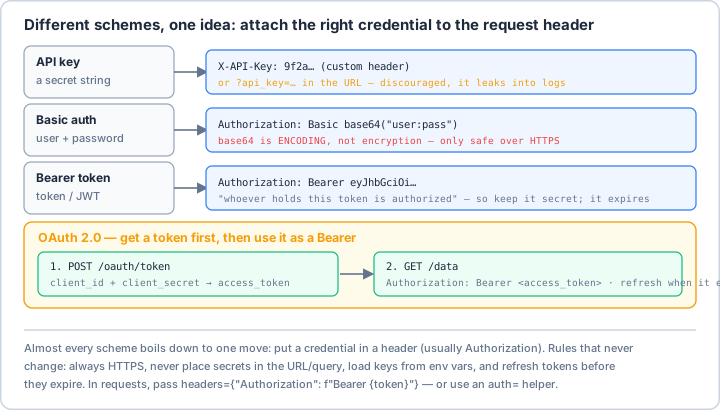
Authorization header. An API key is a header string; Basic auth is base64 of user:pass (encoding, not encryption); a Bearer token says "whoever holds this is authorized"; and OAuth 2.0 just adds a first step to obtain that token. The rules never change: always HTTPS, keep secrets out of the URL, load them from env vars, and refresh tokens before they expire.Real-World Scenario: The Multi-Service Auth Manager 🌟
You're building an authentication management system that handles multiple APIs - social media with OAuth2, payment gateways with HMAC signing, enterprise systems with SAML, cloud services with JWT, and internal APIs with mTLS. Your system must securely store credentials, automatically refresh tokens, handle multi-factor authentication, rotate keys, and provide detailed audit logging. Let's build a comprehensive authentication framework!
# First, install required packages:
# pip install requests pyjwt cryptography python-jose oauthlib requests-oauthlib python-dotenv keyring
import os
import json
import time
import base64
import hashlib
import hmac
import secrets
from typing import Dict, List, Optional, Any, Tuple, Callable
from dataclasses import dataclass, field
from datetime import datetime, timedelta
from enum import Enum
import logging
from urllib.parse import urlencode, parse_qs, urlparse
from pathlib import Path
import requests
from requests.auth import AuthBase, HTTPBasicAuth, HTTPDigestAuth
import jwt
from cryptography.hazmat.primitives import hashes, serialization
from cryptography.hazmat.primitives.asymmetric import rsa, padding
from cryptography.hazmat.backends import default_backend
from oauthlib.oauth2 import BackendApplicationClient, WebApplicationClient
from requests_oauthlib import OAuth1Session, OAuth2Session
import keyring
from functools import wraps
# ==================== Authentication Types ====================
class AuthType(Enum):
"""Supported authentication types."""
NONE = "none"
API_KEY = "api_key"
BASIC = "basic"
DIGEST = "digest"
BEARER = "bearer"
JWT = "jwt"
OAUTH1 = "oauth1"
OAUTH2 = "oauth2"
HMAC = "hmac"
AWS_SIGNATURE = "aws_signature"
MTLS = "mutual_tls"
SAML = "saml"
CUSTOM = "custom"
# ==================== Credential Storage ====================
class SecureCredentialStore:
"""
Secure storage for API credentials.
Uses keyring for OS-level secure storage.
"""
def __init__(self, service_name: str = "api_auth_manager"):
self.service_name = service_name
self.logger = logging.getLogger(__name__)
self._memory_cache = {}
def store_credential(self, api_name: str, key: str, value: str):
"""Store credential securely."""
try:
# Store in OS keyring
keyring.set_password(self.service_name, f"{api_name}:{key}", value)
# Cache in memory for performance
if api_name not in self._memory_cache:
self._memory_cache[api_name] = {}
self._memory_cache[api_name][key] = value
self.logger.info(f"Stored credential for {api_name}:{key}")
except Exception as e:
self.logger.error(f"Failed to store credential: {e}")
raise
def get_credential(self, api_name: str, key: str) -> Optional[str]:
"""Retrieve credential from secure storage."""
# Check memory cache first
if api_name in self._memory_cache and key in self._memory_cache[api_name]:
return self._memory_cache[api_name][key]
try:
# Retrieve from OS keyring
value = keyring.get_password(self.service_name, f"{api_name}:{key}")
if value:
# Update cache
if api_name not in self._memory_cache:
self._memory_cache[api_name] = {}
self._memory_cache[api_name][key] = value
return value
except Exception as e:
self.logger.error(f"Failed to retrieve credential: {e}")
return None
def delete_credential(self, api_name: str, key: str):
"""Delete credential from storage."""
try:
keyring.delete_password(self.service_name, f"{api_name}:{key}")
# Remove from cache
if api_name in self._memory_cache and key in self._memory_cache[api_name]:
del self._memory_cache[api_name][key]
self.logger.info(f"Deleted credential for {api_name}:{key}")
except Exception as e:
self.logger.error(f"Failed to delete credential: {e}")
def clear_cache(self):
"""Clear memory cache."""
self._memory_cache.clear()
# ==================== Base Authentication ====================
class BaseAuthHandler(AuthBase):
"""Base class for authentication handlers."""
def __init__(self):
self.logger = logging.getLogger(self.__class__.__name__)
def __call__(self, request):
"""Apply authentication to request."""
raise NotImplementedError
# ==================== API Key Authentication ====================
class APIKeyAuth(BaseAuthHandler):
"""
API Key authentication handler.
Supports header, query parameter, and custom placement.
"""
def __init__(self, api_key: str,
location: str = "header",
key_name: str = "X-API-Key"):
super().__init__()
self.api_key = api_key
self.location = location
self.key_name = key_name
def __call__(self, request):
"""Add API key to request."""
if self.location == "header":
request.headers[self.key_name] = self.api_key
elif self.location == "query":
# Add to query parameters
if "?" in request.url:
request.url += f"&{self.key_name}={self.api_key}"
else:
request.url += f"?{self.key_name}={self.api_key}"
elif self.location == "body":
# Add to request body (for POST requests)
if request.body:
body = json.loads(request.body)
body[self.key_name] = self.api_key
request.body = json.dumps(body)
return request
# ==================== Bearer Token Authentication ====================
class BearerTokenAuth(BaseAuthHandler):
"""Bearer token authentication with automatic refresh."""
def __init__(self, token: str,
refresh_token: Optional[str] = None,
refresh_callback: Optional[Callable] = None):
super().__init__()
self.token = token
self.refresh_token = refresh_token
self.refresh_callback = refresh_callback
self.token_expiry = None
def __call__(self, request):
"""Add bearer token to request."""
# Check if token needs refresh
if self.token_expiry and datetime.now() >= self.token_expiry:
self.refresh()
request.headers["Authorization"] = f"Bearer {self.token}"
return request
def refresh(self):
"""Refresh the access token."""
if self.refresh_callback and self.refresh_token:
try:
new_token, new_refresh = self.refresh_callback(self.refresh_token)
self.token = new_token
self.refresh_token = new_refresh
self.logger.info("Token refreshed successfully")
except Exception as e:
self.logger.error(f"Token refresh failed: {e}")
raise
def set_expiry(self, expires_in: int):
"""Set token expiry time."""
self.token_expiry = datetime.now() + timedelta(seconds=expires_in)
# ==================== JWT Authentication ====================
class JWTAuth(BaseAuthHandler):
"""
JWT (JSON Web Token) authentication.
Supports token creation and validation.
"""
def __init__(self, secret_or_key: str,
algorithm: str = "HS256",
issuer: Optional[str] = None,
audience: Optional[str] = None,
expiry_minutes: int = 30):
super().__init__()
self.secret_or_key = secret_or_key
self.algorithm = algorithm
self.issuer = issuer
self.audience = audience
self.expiry_minutes = expiry_minutes
self._token = None
self._token_expiry = None
def create_token(self, payload: Dict[str, Any]) -> str:
"""Create a JWT token."""
now = datetime.utcnow()
# Add standard claims
token_payload = {
"iat": now,
"exp": now + timedelta(minutes=self.expiry_minutes),
"nbf": now,
**payload
}
if self.issuer:
token_payload["iss"] = self.issuer
if self.audience:
token_payload["aud"] = self.audience
# Create token
token = jwt.encode(
token_payload,
self.secret_or_key,
algorithm=self.algorithm
)
self._token = token
self._token_expiry = token_payload["exp"]
return token
def decode_token(self, token: str) -> Dict[str, Any]:
"""Decode and validate a JWT token."""
try:
payload = jwt.decode(
token,
self.secret_or_key,
algorithms=[self.algorithm],
issuer=self.issuer,
audience=self.audience
)
return payload
except jwt.ExpiredSignatureError:
self.logger.error("Token has expired")
raise
except jwt.InvalidTokenError as e:
self.logger.error(f"Invalid token: {e}")
raise
def __call__(self, request):
"""Add JWT to request."""
# Create or refresh token if needed
if not self._token or (self._token_expiry and datetime.utcnow() >= self._token_expiry):
self.create_token({"sub": "api_client"})
request.headers["Authorization"] = f"Bearer {self._token}"
return request
# ==================== OAuth 2.0 Authentication ====================
class OAuth2Handler:
"""
OAuth 2.0 authentication handler.
Supports various grant types.
"""
def __init__(self, client_id: str, client_secret: str,
authorization_url: str, token_url: str,
redirect_uri: str = "http://localhost:8080",
scope: Optional[str] = None):
self.client_id = client_id
self.client_secret = client_secret
self.authorization_url = authorization_url
self.token_url = token_url
self.redirect_uri = redirect_uri
self.scope = scope
self.logger = logging.getLogger(__name__)
self.session = None
self.token = None
def get_authorization_url(self) -> Tuple[str, str]:
"""
Get authorization URL for user consent.
Returns (authorization_url, state).
"""
self.session = OAuth2Session(
client_id=self.client_id,
redirect_uri=self.redirect_uri,
scope=self.scope
)
authorization_url, state = self.session.authorization_url(
self.authorization_url
)
return authorization_url, state
def fetch_token(self, authorization_response: str, state: str) -> Dict:
"""
Exchange authorization code for access token.
"""
self.session = OAuth2Session(
client_id=self.client_id,
redirect_uri=self.redirect_uri,
state=state
)
token = self.session.fetch_token(
self.token_url,
authorization_response=authorization_response,
client_secret=self.client_secret
)
self.token = token
return token
def refresh_token(self, refresh_token: str) -> Dict:
"""Refresh access token."""
extra = {
'client_id': self.client_id,
'client_secret': self.client_secret
}
self.session = OAuth2Session(
client_id=self.client_id,
token={'refresh_token': refresh_token}
)
self.token = self.session.refresh_token(
self.token_url,
refresh_token=refresh_token,
**extra
)
return self.token
def client_credentials_grant(self) -> Dict:
"""
OAuth2 client credentials grant (for server-to-server).
"""
client = BackendApplicationClient(client_id=self.client_id)
oauth = OAuth2Session(client=client)
token = oauth.fetch_token(
token_url=self.token_url,
client_id=self.client_id,
client_secret=self.client_secret,
scope=self.scope
)
self.token = token
return token
def get_authenticated_session(self) -> OAuth2Session:
"""Get authenticated OAuth2 session."""
if not self.token:
raise ValueError("No token available. Authenticate first.")
return OAuth2Session(
client_id=self.client_id,
token=self.token
)
# ==================== HMAC Signature Authentication ====================
class HMACAuth(BaseAuthHandler):
"""
HMAC signature authentication.
Signs requests with secret key.
"""
def __init__(self, access_key: str, secret_key: str,
algorithm: str = "sha256",
include_headers: Optional[List[str]] = None):
super().__init__()
self.access_key = access_key
self.secret_key = secret_key
self.algorithm = algorithm
self.include_headers = include_headers or ["host", "date"]
def __call__(self, request):
"""Sign request with HMAC."""
# Get request components
method = request.method
path = urlparse(request.url).path
# Create canonical request
canonical_parts = [
method,
path
]
# Add headers to signature
for header_name in self.include_headers:
if header_name.lower() in request.headers:
canonical_parts.append(
f"{header_name.lower()}:{request.headers[header_name.lower()]}"
)
# Add body if present
if request.body:
body_hash = hashlib.sha256(request.body.encode()).hexdigest()
canonical_parts.append(body_hash)
canonical_request = "\n".join(canonical_parts)
# Create signature
signature = hmac.new(
self.secret_key.encode(),
canonical_request.encode(),
getattr(hashlib, self.algorithm)
).hexdigest()
# Add authorization header
request.headers["Authorization"] = f"HMAC {self.access_key}:{signature}"
return request
# ==================== AWS Signature V4 Authentication ====================
class AWSSignatureV4Auth(BaseAuthHandler):
"""
AWS Signature Version 4 authentication.
"""
def __init__(self, access_key: str, secret_key: str,
region: str, service: str,
session_token: Optional[str] = None):
super().__init__()
self.access_key = access_key
self.secret_key = secret_key
self.region = region
self.service = service
self.session_token = session_token
def _sign(self, key: bytes, msg: str) -> bytes:
"""Sign message with key."""
return hmac.new(key, msg.encode('utf-8'), hashlib.sha256).digest()
def _get_signature_key(self, date_stamp: str) -> bytes:
"""Derive signing key."""
k_date = self._sign(('AWS4' + self.secret_key).encode('utf-8'), date_stamp)
k_region = self._sign(k_date, self.region)
k_service = self._sign(k_region, self.service)
k_signing = self._sign(k_service, 'aws4_request')
return k_signing
def __call__(self, request):
"""Sign request with AWS Signature V4."""
# Get current time
t = datetime.utcnow()
amz_date = t.strftime('%Y%m%dT%H%M%SZ')
date_stamp = t.strftime('%Y%m%d')
# Parse URL
parsed_url = urlparse(request.url)
host = parsed_url.netloc
canonical_uri = parsed_url.path or '/'
canonical_querystring = parsed_url.query or ''
# Create canonical headers
canonical_headers = f'host:{host}\nx-amz-date:{amz_date}\n'
signed_headers = 'host;x-amz-date'
if self.session_token:
canonical_headers += f'x-amz-security-token:{self.session_token}\n'
signed_headers += ';x-amz-security-token'
# Create payload hash
payload_hash = hashlib.sha256(
request.body.encode('utf-8') if request.body else b''
).hexdigest()
# Create canonical request
canonical_request = f"{request.method}\n{canonical_uri}\n{canonical_querystring}\n{canonical_headers}\n{signed_headers}\n{payload_hash}"
# Create string to sign
algorithm = 'AWS4-HMAC-SHA256'
credential_scope = f'{date_stamp}/{self.region}/{self.service}/aws4_request'
string_to_sign = f"{algorithm}\n{amz_date}\n{credential_scope}\n{hashlib.sha256(canonical_request.encode('utf-8')).hexdigest()}"
# Calculate signature
signing_key = self._get_signature_key(date_stamp)
signature = hmac.new(
signing_key,
string_to_sign.encode('utf-8'),
hashlib.sha256
).hexdigest()
# Create authorization header
authorization_header = (
f'{algorithm} Credential={self.access_key}/{credential_scope}, '
f'SignedHeaders={signed_headers}, Signature={signature}'
)
# Add headers
request.headers['x-amz-date'] = amz_date
request.headers['Authorization'] = authorization_header
if self.session_token:
request.headers['x-amz-security-token'] = self.session_token
return request
# ==================== Multi-Factor Authentication ====================
class MFAHandler:
"""
Multi-factor authentication handler.
"""
def __init__(self):
self.logger = logging.getLogger(__name__)
def generate_totp_secret(self) -> str:
"""Generate TOTP secret for 2FA."""
import pyotp
return pyotp.random_base32()
def get_totp_token(self, secret: str) -> str:
"""Get current TOTP token."""
import pyotp
totp = pyotp.TOTP(secret)
return totp.now()
def verify_totp_token(self, secret: str, token: str) -> bool:
"""Verify TOTP token."""
import pyotp
totp = pyotp.TOTP(secret)
return totp.verify(token, valid_window=1)
def generate_backup_codes(self, count: int = 10) -> List[str]:
"""Generate backup codes for 2FA."""
codes = []
for _ in range(count):
code = secrets.token_hex(4)
formatted_code = f"{code[:4]}-{code[4:]}"
codes.append(formatted_code)
return codes
# ==================== Authentication Manager ====================
class AuthenticationManager:
"""
Centralized authentication management system.
"""
def __init__(self, credential_store: Optional[SecureCredentialStore] = None):
self.credential_store = credential_store or SecureCredentialStore()
self.auth_handlers = {}
self.auth_types = {} # Remember each API's auth type for rotation
self.logger = logging.getLogger(__name__)
# Audit log
self.audit_log = []
def register_api(self, api_name: str, auth_type: AuthType,
credentials: Dict[str, Any]):
"""Register API with authentication details."""
# Store credentials securely
for key, value in credentials.items():
if isinstance(value, str):
self.credential_store.store_credential(api_name, key, value)
# Create auth handler
handler = self._create_auth_handler(auth_type, api_name, credentials)
self.auth_handlers[api_name] = handler
self.auth_types[api_name] = auth_type
# Log registration
self._audit_log("register", api_name, auth_type)
self.logger.info(f"Registered {api_name} with {auth_type.value} authentication")
def _create_auth_handler(self, auth_type: AuthType,
api_name: str,
credentials: Dict) -> Optional[AuthBase]:
"""Create appropriate auth handler."""
if auth_type == AuthType.API_KEY:
api_key = self.credential_store.get_credential(api_name, "api_key")
return APIKeyAuth(
api_key,
location=credentials.get("location", "header"),
key_name=credentials.get("key_name", "X-API-Key")
)
elif auth_type == AuthType.BASIC:
username = self.credential_store.get_credential(api_name, "username")
password = self.credential_store.get_credential(api_name, "password")
return HTTPBasicAuth(username, password)
elif auth_type == AuthType.BEARER:
token = self.credential_store.get_credential(api_name, "token")
return BearerTokenAuth(token)
elif auth_type == AuthType.JWT:
secret = self.credential_store.get_credential(api_name, "secret")
return JWTAuth(
secret,
algorithm=credentials.get("algorithm", "HS256")
)
elif auth_type == AuthType.HMAC:
access_key = self.credential_store.get_credential(api_name, "access_key")
secret_key = self.credential_store.get_credential(api_name, "secret_key")
return HMACAuth(access_key, secret_key)
elif auth_type == AuthType.OAUTH2:
# OAuth2 is handled differently
return None
else:
return None
def get_auth_handler(self, api_name: str) -> Optional[AuthBase]:
"""Get auth handler for API."""
return self.auth_handlers.get(api_name)
def rotate_credentials(self, api_name: str, new_credentials: Dict[str, str]):
"""Rotate API credentials."""
# Store new credentials
for key, value in new_credentials.items():
self.credential_store.store_credential(api_name, key, value)
# Recreate auth handler
if api_name in self.auth_handlers:
# Reuse the auth type recorded at registration so rotation
# preserves Bearer/JWT/HMAC/etc instead of resetting to API_KEY
auth_type = self.auth_types.get(api_name, AuthType.API_KEY)
handler = self._create_auth_handler(
auth_type, api_name, new_credentials
)
self.auth_handlers[api_name] = handler
# Log rotation
self._audit_log("rotate", api_name)
self.logger.info(f"Rotated credentials for {api_name}")
def revoke_api(self, api_name: str):
"""Revoke API authentication."""
# Remove from handlers
if api_name in self.auth_handlers:
del self.auth_handlers[api_name]
# Clear credentials
# Note: In real implementation, should track all keys
common_keys = ["api_key", "token", "username", "password",
"access_key", "secret_key", "client_id", "client_secret"]
for key in common_keys:
try:
self.credential_store.delete_credential(api_name, key)
except:
pass
# Log revocation
self._audit_log("revoke", api_name)
self.logger.info(f"Revoked authentication for {api_name}")
def _audit_log(self, action: str, api_name: str,
auth_type: Optional[AuthType] = None):
"""Add entry to audit log."""
entry = {
"timestamp": datetime.now().isoformat(),
"action": action,
"api_name": api_name,
"auth_type": auth_type.value if auth_type else None
}
self.audit_log.append(entry)
# Optionally persist to file
self._save_audit_log()
def _save_audit_log(self):
"""Save audit log to file."""
log_file = Path("auth_audit.log")
with open(log_file, "a") as f:
if self.audit_log:
latest = self.audit_log[-1]
f.write(json.dumps(latest) + "\n")
def get_audit_log(self, api_name: Optional[str] = None) -> List[Dict]:
"""Get audit log entries."""
if api_name:
return [e for e in self.audit_log if e["api_name"] == api_name]
return self.audit_log
# ==================== Auth Decorators ====================
def requires_auth(auth_type: AuthType):
"""Decorator to require specific authentication."""
def decorator(func):
@wraps(func)
def wrapper(*args, **kwargs):
# Check for auth in kwargs
auth = kwargs.get('auth')
if not auth:
raise ValueError(f"Authentication required: {auth_type.value}")
# Validate auth type
if hasattr(auth, 'auth_type') and auth.auth_type != auth_type:
raise ValueError(f"Invalid auth type. Required: {auth_type.value}")
return func(*args, **kwargs)
return wrapper
return decorator
def rate_limit_auth(calls: int, period: int):
"""Decorator to rate limit authenticated calls."""
call_times = []
def decorator(func):
@wraps(func)
def wrapper(*args, **kwargs):
now = time.time()
# Remove old calls outside the period
nonlocal call_times
call_times = [t for t in call_times if now - t < period]
if len(call_times) >= calls:
sleep_time = period - (now - call_times[0])
if sleep_time > 0:
time.sleep(sleep_time)
call_times = []
call_times.append(now)
return func(*args, **kwargs)
return wrapper
return decorator
# Example usage
if __name__ == "__main__":
print("🔐 Authentication Methods Examples\n")
# Example 1: Authentication types
print("1️⃣ Common Authentication Types:")
auth_types = [
("API Key", "Simple key-based auth", "X-API-Key: abc123"),
("Basic Auth", "Username/password", "Authorization: Basic base64(user:pass)"),
("Bearer Token", "Token-based auth", "Authorization: Bearer token123"),
("JWT", "JSON Web Tokens", "Self-contained tokens with claims"),
("OAuth 2.0", "Delegated authorization", "Complex flow with tokens"),
("HMAC", "Signature-based auth", "Sign requests with secret")
]
for auth_type, description, example in auth_types:
print(f" {auth_type}:")
print(f" {description}")
print(f" Example: {example}\n")
# Example 2: Secure credential storage
print("2️⃣ Secure Credential Storage:")
store = SecureCredentialStore()
# Store credentials
store.store_credential("github", "token", "ghp_example123")
store.store_credential("aws", "access_key", "AKIA_example")
store.store_credential("aws", "secret_key", "secret_example")
print(" Stored credentials securely in OS keyring")
print(" ✅ Encrypted at rest")
print(" ✅ OS-level protection")
print(" ✅ Memory caching for performance")
# Example 3: JWT token creation
print("\n3️⃣ JWT Token Example:")
jwt_auth = JWTAuth(
secret_or_key="your-secret-key",
algorithm="HS256",
issuer="api.example.com",
expiry_minutes=30
)
payload = {
"sub": "user123",
"role": "admin",
"permissions": ["read", "write"]
}
token = jwt_auth.create_token(payload)
print(f" Created JWT: {token[:50]}...")
# Decode token
decoded = jwt_auth.decode_token(token)
print(f" Decoded claims: {decoded}")
# Example 4: OAuth2 flow
print("\n4️⃣ OAuth 2.0 Flow:")
oauth_steps = [
"1. Redirect user to authorization URL",
"2. User approves access",
"3. Receive authorization code",
"4. Exchange code for access token",
"5. Use token for API requests",
"6. Refresh token when expired"
]
for step in oauth_steps:
print(f" {step}")
# Example 5: HMAC signature
print("\n5️⃣ HMAC Signature Example:")
print(" Creating canonical request:")
print(" Method: POST")
print(" Path: /api/v1/users")
print(" Headers: host, date, content-type")
print(" Body hash: sha256(body)")
print(" ")
print(" Signature = HMAC-SHA256(secret, canonical_request)")
print(" Authorization: HMAC access_key:signature")
# Example 6: Authentication manager
print("\n6️⃣ Authentication Manager:")
auth_manager = AuthenticationManager()
# Register APIs
auth_manager.register_api(
"github",
AuthType.BEARER,
{"token": "ghp_example123"}
)
auth_manager.register_api(
"stripe",
AuthType.API_KEY,
{
"api_key": "sk_test_example",
"location": "header",
"key_name": "Authorization"
}
)
print(" Registered APIs:")
print(" • GitHub (Bearer Token)")
print(" • Stripe (API Key)")
print(" ")
print(" Features:")
print(" • Centralized management")
print(" • Credential rotation")
print(" • Audit logging")
# Example 7: MFA/2FA
print("\n7️⃣ Multi-Factor Authentication:")
mfa = MFAHandler()
# Generate TOTP secret
secret = mfa.generate_totp_secret()
print(f" TOTP Secret: {secret}")
# Get current token
token = mfa.get_totp_token(secret)
print(f" Current token: {token}")
# Generate backup codes
backup_codes = mfa.generate_backup_codes(5)
print(" Backup codes:")
for code in backup_codes:
print(f" • {code}")
# Example 8: Security best practices
print("\n8️⃣ Authentication Security Best Practices:")
practices = [
"🔐 Never hardcode credentials",
"🔄 Rotate credentials regularly",
"⏱️ Use short-lived tokens",
"🔑 Store secrets in secure vaults",
"📝 Audit all authentication events",
"🛡️ Use HTTPS/TLS always",
"🎯 Implement least privilege",
"🔍 Monitor for suspicious activity",
"💾 Encrypt credentials at rest",
"🚫 Revoke compromised credentials immediately"
]
for practice in practices:
print(f" {practice}")
# Example 9: Common authentication errors
print("\n9️⃣ Common Authentication Errors:")
errors = [
("401 Unauthorized", "Invalid or missing credentials"),
("403 Forbidden", "Valid credentials but insufficient permissions"),
("419 Authentication Timeout", "Session expired"),
("Token Expired", "JWT or OAuth token needs refresh"),
("Invalid Signature", "HMAC signature mismatch"),
("Rate Limited", "Too many auth attempts")
]
for error, description in errors:
print(f" {error}: {description}")
# Example 10: Advanced patterns
print("\n🔟 Advanced Authentication Patterns:")
patterns = [
"🔄 Token refresh with retry queue",
"🎯 Service-to-service auth with mTLS",
"🌐 Federation with SAML/OIDC",
"🔑 Hardware token integration",
"📱 Biometric authentication",
"🎭 Impersonation/delegation",
"⚡ Zero-knowledge proofs",
"🔐 End-to-end encryption"
]
for pattern in patterns:
print(f" {pattern}")
print("\n✅ Authentication methods demonstration complete!")
Key Takeaways and Best Practices 🎯
- Never Hardcode Credentials: Use secure storage and environment variables.
- Implement Token Refresh: Automatically refresh expired tokens.
- Use Appropriate Auth Method: Match security requirements to use case.
- Rotate Credentials Regularly: Implement key rotation policies.
- Audit Everything: Log all authentication events for security.
- Handle Errors Gracefully: Implement retry logic for auth failures.
- Use HTTPS Always: Never send credentials over unencrypted connections.
- Implement MFA: Add extra security layers for sensitive operations.
Authentication Best Practices 📋
Mastering authentication methods ensures your API integrations are both secure and reliable. You can now implement any authentication scheme, from simple API keys to complex OAuth flows, while maintaining security best practices. Whether you're building enterprise integrations or public APIs, these authentication skills keep your connections secure! 🔒
📓 Learning Journal
Keep a learning journal — digital or physical. After this lesson, take a few minutes to write down:
- Key concepts you learned
- Techniques that clicked for you
- Questions or confusion points to revisit
- Ideas you want to try
- Your progress and feelings about learning this
✍️ This lesson's prompt: Every scheme here comes down to attaching a credential and never leaking it. Audit your own past projects: where might a secret have ended up in code, a URL, or a log — and how will you handle secrets differently from now on?
📝 Lesson Summary
🎓 Key Takeaways
- The auth schemes look different but share one move: attach a credential to the request, usually via the
Authorizationheader. - Basic auth is base64 of
user:pass— encoding, not encryption — so it (and every scheme) depends on HTTPS to stay safe. - OAuth 2.0 isn't fundamentally different — it just adds a first step to obtain the Bearer token you then send on each call.
- The rules never change: always HTTPS, keep secrets out of the URL and code, load them from env vars or a keyring, and refresh tokens before they expire.
🎉 What You've Accomplished
You can now authenticate against almost any API — from a simple key to a full OAuth 2.0 flow or a signed HMAC request — and do it securely, keeping credentials out of your source and rotating them without breaking the scheme in use.
❓ Common Questions at This Stage
Is Basic auth secure?
Only over HTTPS. Basic auth base64-encodes username:password, which is trivially reversible — it's encoding, not encryption. Without TLS, anyone on the wire can read it. Over HTTPS it's acceptable for simple cases, though tokens are usually better.
What's the real difference between OAuth 2.0 and a Bearer token?
Not much at request time — OAuth 2.0 ends with you sending Authorization: Bearer <token>. The difference is how you get that token: OAuth adds a flow (authorization code, client credentials, etc.) to obtain and refresh it, often on a user's behalf.
Where should I keep API secrets?
Never in code or version control. Use environment variables for most cases, or an OS keyring / secrets vault for stronger protection. Load them at runtime, keep them out of URLs and logs, and rotate them if they're ever exposed.
🔭 Looking Ahead
Next you'll tackle rate limiting — because once you can authenticate, the API's next concern (and yours) is how often you're allowed to call it, and how to back off gracefully.
✅ Before the Next Lesson
- Move a hardcoded credential in one of your scripts into an environment variable and load it with
os.getenv. - Write a small custom
requestsauth handler that adds an API key header, and confirm the secret never appears in the URL. - Write your Learning Journal entry for this lesson.
🌟 Encouragement for the Journey
Authentication can feel like an intimidating wall of acronyms, but you've seen the single idea underneath them all. Handle secrets with care and every locked door on the web opens for you. Keep going.
Pro Tip: Think of API authentication as a security checkpoint - you need the right credentials, presented the right way, at the right time. Never, ever hardcode credentials in your code - use environment variables, secure vaults, or OS keyrings. Implement automatic token refresh before they expire - it's like renewing your passport before it runs out. Choose the right auth method for your needs: API keys for simple scenarios, OAuth for user delegation, JWT for stateless auth, and HMAC for request signing. Always use HTTPS - sending credentials over HTTP is like shouting your password in public. Implement comprehensive audit logging - you need to know who accessed what and when. Rotate credentials regularly like changing locks. Handle auth errors gracefully with exponential backoff - don't hammer the API when auth fails. For sensitive operations, implement multi-factor authentication. Most importantly: treat credentials like house keys - guard them carefully and change them if compromised!