🚀 Apache Airflow Basics: Orchestrate Complex Workflows at Scale
📚 What You'll Learn
By the end of this lesson, you will be able to:
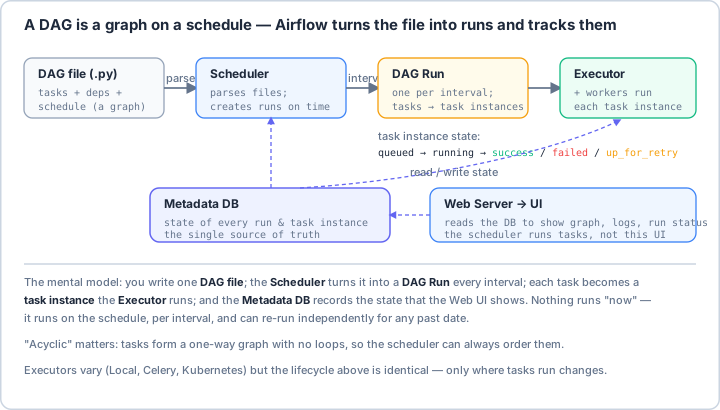
- Explain how Airflow's core components — the scheduler, executor, metadata database, and web server — turn a DAG file into scheduled runs
- Describe a DAG as a directed acyclic graph of tasks on a schedule interval, and why nothing runs "now"
- Write a basic DAG with
PythonOperatortasks and set their order with the>>dependency operator - Pass small values between tasks using XCom and choose static
start_dates withcatchup=False - Use sensors, branching, and the TaskFlow
@taskAPI to build conditional and dynamic workflows - Apply the idempotent-and-atomic task principles that make retries and scheduling safe
⏱️ Estimated Time: 45–60 minutes
🎯 Project: Build and schedule a small daily DAG that extracts, processes, and saves data across three linked PythonOperator tasks.
Apache Airflow is a powerful platform for programmatically authoring, scheduling, and monitoring workflows - it transforms complex task dependencies into manageable, visual pipelines that can scale from simple scripts to enterprise data operations. Like having an intelligent conductor for your data orchestra, Airflow ensures tasks run in the right order, at the right time, with automatic retry logic and comprehensive monitoring. Whether you're building ETL pipelines, orchestrating machine learning workflows, or automating business processes, Airflow provides the foundation for reliable, scalable task orchestration. Let's explore the fundamentals of workflow automation with Apache Airflow! 🎯
The Apache Airflow Architecture
Think of Airflow as a sophisticated workflow management system - it uses Directed Acyclic Graphs (DAGs) to define task dependencies, executors to run tasks in parallel, schedulers to trigger workflows, and a rich UI for monitoring and troubleshooting. Built on Python, Airflow treats workflows as code, enabling version control, testing, and dynamic pipeline generation. Understanding DAGs, operators, tasks, and scheduling is essential for mastering workflow orchestration!
Real-World Scenario: The Data Pipeline Platform 📊
You're building a comprehensive data pipeline platform that processes daily sales data from multiple sources, performs data quality checks and transformations, trains machine learning models on clean data, generates reports and dashboards, sends notifications on completion or failure, handles dependencies between complex tasks, retries failed operations automatically, and scales to handle varying workloads. Your system must support scheduling flexibility, provide clear visibility into pipeline status, handle errors gracefully, and maintain audit trails. Let's build a robust Airflow orchestration system!
# First, install Apache Airflow:
# pip install apache-airflow==2.7.0
# pip install apache-airflow-providers-http
# pip install apache-airflow-providers-postgres
# pip install pandas numpy requests
# Initialize Airflow database:
# airflow db init
# Create a user:
# airflow users create --username admin --password admin --firstname Admin --lastname User --role Admin --email admin@example.com
# Start webserver: airflow webserver --port 8080
# Start scheduler: airflow scheduler
import os
import json
import logging
from datetime import datetime, timedelta
from typing import Dict, List, Any, Optional, Callable
from pathlib import Path
import pandas as pd
import numpy as np
# Airflow imports
from airflow import DAG
from airflow.decorators import dag, task
from airflow.operators.python import PythonOperator
from airflow.operators.bash import BashOperator
from airflow.operators.empty import EmptyOperator
from airflow.operators.email import EmailOperator
from airflow.sensors.filesystem import FileSensor
from airflow.sensors.external_task import ExternalTaskSensor
from airflow.providers.http.operators.http import SimpleHttpOperator
from airflow.providers.http.sensors.http import HttpSensor
from airflow.models import Variable
from airflow.utils.dates import days_ago # Deprecated in Airflow 2.x; prefer a static start_date, e.g. pendulum.datetime(2023, 1, 1) or datetime(2023, 1, 1)
from airflow.utils.task_group import TaskGroup
from airflow.utils.trigger_rule import TriggerRule
from airflow.exceptions import AirflowException, AirflowSkipException
# ==================== Configuration ====================
# Default arguments for all tasks
default_args = {
'owner': 'data_team',
'depends_on_past': False,
'start_date': days_ago(1),
'email': ['admin@example.com'],
'email_on_failure': True,
'email_on_retry': False,
'retries': 2,
'retry_delay': timedelta(minutes=5),
# NOTE: max_active_runs and catchup are DAG-level parameters, not task
# defaults. Placing them in default_args forwards them to every operator
# constructor as invalid kwargs, so they belong on each DAG(...) call below.
}
# ==================== Helper Functions ====================
def create_logger(name: str) -> logging.Logger:
"""Create a logger for the DAG."""
logger = logging.getLogger(name)
logger.setLevel(logging.INFO)
# Create console handler
handler = logging.StreamHandler()
handler.setLevel(logging.INFO)
# Create formatter
formatter = logging.Formatter(
'%(asctime)s - %(name)s - %(levelname)s - %(message)s'
)
handler.setFormatter(formatter)
# Add handler to logger
if not logger.handlers:
logger.addHandler(handler)
return logger
# ==================== Basic DAG Example ====================
# Create a basic DAG
basic_dag = DAG(
'basic_workflow',
default_args=default_args,
description='A basic Airflow workflow example',
schedule_interval='@daily', # Run daily
tags=['example', 'basic'],
max_active_runs=1,
catchup=False,
)
# Define tasks
def print_hello():
"""Simple Python task."""
print("Hello from Airflow!")
return "Hello completed"
def process_data(**context):
"""Process data with context."""
# Access context variables
execution_date = context['execution_date']
dag_run = context['dag_run']
print(f"Processing data for date: {execution_date}")
print(f"DAG run ID: {dag_run.run_id}")
# Simulate data processing
data = {'date': str(execution_date), 'status': 'processed'}
# Push data to XCom for downstream tasks
context['task_instance'].xcom_push(key='processed_data', value=data)
return "Processing completed"
def save_results(**context):
"""Save results from upstream task."""
# Pull data from XCom
task_instance = context['task_instance']
processed_data = task_instance.xcom_pull(
task_ids='process_task',
key='processed_data'
)
print(f"Saving results: {processed_data}")
# Simulate saving to database
return "Results saved"
# Create task instances
with basic_dag:
hello_task = PythonOperator(
task_id='hello_task',
python_callable=print_hello,
)
process_task = PythonOperator(
task_id='process_task',
python_callable=process_data,
)
save_task = PythonOperator(
task_id='save_task',
python_callable=save_results,
)
# Define dependencies
hello_task >> process_task >> save_task
# ==================== Advanced DAG with Task Groups ====================
@dag(
'advanced_data_pipeline',
default_args=default_args,
description='Advanced data pipeline with task groups',
schedule_interval='0 2 * * *', # Run at 2 AM daily
tags=['advanced', 'data_pipeline'],
max_active_runs=1,
catchup=False,
)
def advanced_data_pipeline():
"""Advanced DAG using TaskFlow API."""
@task
def extract_data(source: str) -> Dict[str, Any]:
"""Extract data from source."""
print(f"Extracting data from {source}")
# Simulate data extraction
data = {
'source': source,
'records': np.random.randint(1000, 10000),
'timestamp': datetime.now().isoformat()
}
return data
@task
def validate_data(data: Dict[str, Any]) -> Dict[str, Any]:
"""Validate extracted data."""
print(f"Validating {data['records']} records from {data['source']}")
# Simulate validation
data['validation'] = {
'passed': True,
'errors': [],
'warnings': []
}
if data['records'] < 5000:
data['validation']['warnings'].append('Low record count')
return data
@task
def transform_data(data: Dict[str, Any]) -> Dict[str, Any]:
"""Transform validated data."""
print(f"Transforming data from {data['source']}")
# Simulate transformation
data['transformed'] = {
'records_processed': data['records'],
'transformations_applied': ['normalize', 'deduplicate', 'enrich']
}
return data
@task
def load_to_warehouse(data: Dict[str, Any], table: str) -> str:
"""Load data to data warehouse."""
print(f"Loading {data['transformed']['records_processed']} records to {table}")
# Simulate loading to warehouse
return f"Loaded to {table} successfully"
@task
def send_notification(results: List[str]):
"""Send completion notification."""
print("Sending notification...")
for result in results:
print(f" - {result}")
# Simulate sending email/slack notification
return "Notification sent"
# Define task groups for different data sources
with TaskGroup('sales_pipeline') as sales_group:
sales_data = extract_data('sales_database')
validated_sales = validate_data(sales_data)
transformed_sales = transform_data(validated_sales)
loaded_sales = load_to_warehouse(transformed_sales, 'fact_sales')
with TaskGroup('inventory_pipeline') as inventory_group:
inventory_data = extract_data('inventory_system')
validated_inventory = validate_data(inventory_data)
transformed_inventory = transform_data(validated_inventory)
loaded_inventory = load_to_warehouse(transformed_inventory, 'fact_inventory')
with TaskGroup('customer_pipeline') as customer_group:
customer_data = extract_data('crm_system')
validated_customer = validate_data(customer_data)
transformed_customer = transform_data(validated_customer)
loaded_customer = load_to_warehouse(transformed_customer, 'dim_customer')
# Combine results and send notification
notification = send_notification([loaded_sales, loaded_inventory, loaded_customer])
# Dependencies are automatically handled by TaskFlow API
# Instantiate the DAG
advanced_dag = advanced_data_pipeline()
# ==================== Dynamic DAG Generation ====================
def create_dynamic_dag(
dag_id: str,
sources: List[str],
schedule: str = '@daily'
) -> DAG:
"""Dynamically create a DAG based on configuration."""
dag = DAG(
dag_id,
default_args=default_args,
description=f'Dynamic DAG for {", ".join(sources)}',
schedule_interval=schedule,
tags=['dynamic'],
max_active_runs=1,
catchup=False,
)
with dag:
start = EmptyOperator(task_id='start')
end = EmptyOperator(task_id='end')
for source in sources:
# Create tasks for each source
extract = PythonOperator(
task_id=f'extract_{source}',
python_callable=lambda s=source: print(f"Extracting from {s}"),
)
process = PythonOperator(
task_id=f'process_{source}',
python_callable=lambda s=source: print(f"Processing {s}"),
)
# Define dependencies
start >> extract >> process >> end
return dag
# Create dynamic DAGs from configuration
data_sources = ['api', 'database', 'files']
dynamic_dag = create_dynamic_dag('dynamic_pipeline', data_sources)
# ==================== Sensor Example ====================
sensor_dag = DAG(
'sensor_workflow',
default_args=default_args,
description='DAG with sensors',
schedule_interval=None, # Triggered manually or by other DAGs
tags=['sensors'],
max_active_runs=1,
catchup=False,
)
with sensor_dag:
# Wait for file to appear
wait_for_file = FileSensor(
task_id='wait_for_file',
filepath='/tmp/data/input.csv',
fs_conn_id='fs_default',
poke_interval=30, # Check every 30 seconds
timeout=300, # Timeout after 5 minutes
mode='poke', # or 'reschedule' to free up worker
)
# Wait for API to be available
wait_for_api = HttpSensor(
task_id='wait_for_api',
http_conn_id='api_default',
endpoint='health',
poke_interval=60,
timeout=600,
)
# Process after both sensors succeed
process = PythonOperator(
task_id='process_when_ready',
python_callable=lambda: print("All dependencies met, processing..."),
)
[wait_for_file, wait_for_api] >> process
# ==================== Branching Example ====================
@dag(
'branching_workflow',
default_args=default_args,
description='DAG with conditional branching',
schedule_interval='@daily',
tags=['branching'],
max_active_runs=1,
catchup=False,
)
def branching_workflow():
"""DAG with conditional execution paths."""
@task.branch
def check_data_quality() -> str:
"""Check data quality and decide path."""
import random
# Simulate quality check
quality_score = random.random()
if quality_score > 0.8:
return 'high_quality_path'
elif quality_score > 0.5:
return 'medium_quality_path'
else:
return 'low_quality_path'
@task
def high_quality_processing():
"""Process high quality data."""
print("Processing high quality data - minimal cleaning needed")
return "High quality processed"
@task
def medium_quality_processing():
"""Process medium quality data."""
print("Processing medium quality data - standard cleaning")
return "Medium quality processed"
@task
def low_quality_processing():
"""Process low quality data."""
print("Processing low quality data - extensive cleaning")
return "Low quality processed"
@task(trigger_rule=TriggerRule.NONE_FAILED_MIN_ONE_SUCCESS)
def merge_results(results: Optional[str] = None):
"""Merge results from any path."""
print(f"Merging results: {results}")
return "Results merged"
# Define the workflow
quality_check = check_data_quality()
high_path = high_quality_processing()
high_path.task_id = 'high_quality_path'
medium_path = medium_quality_processing()
medium_path.task_id = 'medium_quality_path'
low_path = low_quality_processing()
low_path.task_id = 'low_quality_path'
merge = merge_results()
# Set up branching
quality_check >> [high_path, medium_path, low_path] >> merge
branching_dag = branching_workflow()
# ==================== Custom Operators ====================
from airflow.models import BaseOperator
from airflow.utils.decorators import apply_defaults
class DataQualityOperator(BaseOperator):
"""Custom operator for data quality checks."""
template_fields = ['table_name', 'quality_checks']
@apply_defaults
def __init__(
self,
table_name: str,
quality_checks: List[Dict[str, Any]],
conn_id: str = 'postgres_default',
*args,
**kwargs
):
super().__init__(*args, **kwargs)
self.table_name = table_name
self.quality_checks = quality_checks
self.conn_id = conn_id
def execute(self, context):
"""Execute data quality checks."""
self.log.info(f"Running quality checks on {self.table_name}")
failed_checks = []
for check in self.quality_checks:
check_name = check.get('name', 'Unknown')
check_sql = check.get('sql')
expected = check.get('expected')
self.log.info(f"Running check: {check_name}")
# Simulate running SQL query
# In real implementation, use PostgresHook
result = self._run_check(check_sql)
if result != expected:
failed_checks.append(check_name)
self.log.error(f"Check failed: {check_name}")
else:
self.log.info(f"Check passed: {check_name}")
if failed_checks:
raise AirflowException(f"Data quality checks failed: {failed_checks}")
self.log.info("All quality checks passed")
return True
def _run_check(self, sql: str) -> Any:
"""Run a single quality check."""
# Simulate SQL execution
import random
return random.choice([True, False])
# ==================== Configuration Management ====================
class AirflowConfig:
"""Centralized configuration for Airflow DAGs."""
@staticmethod
def get_config(key: str, default: Any = None) -> Any:
"""Get configuration value."""
try:
# Try to get from Airflow Variables
return Variable.get(key, default_var=default)
except:
# Fall back to environment variables
return os.environ.get(key, default)
@staticmethod
def get_connection_string(conn_id: str) -> str:
"""Get connection string for database."""
# In production, use Airflow Connections
return f"postgresql://user:pass@localhost:5432/{conn_id}"
@staticmethod
def get_email_config() -> Dict[str, Any]:
"""Get email configuration."""
return {
'to': Variable.get('alert_emails', default_var=['admin@example.com']),
'subject_prefix': '[Airflow Alert]',
'smtp_host': Variable.get('smtp_host', default_var='localhost'),
'smtp_port': Variable.get('smtp_port', default_var=587),
}
# ==================== Monitoring and Alerting ====================
def create_monitoring_dag() -> DAG:
"""Create a DAG for monitoring other DAGs."""
dag = DAG(
'airflow_monitoring',
default_args=default_args,
description='Monitor Airflow DAGs and send alerts',
schedule_interval='*/30 * * * *', # Every 30 minutes
tags=['monitoring', 'meta'],
max_active_runs=1,
catchup=False,
)
with dag:
def check_dag_status(**context):
"""Check status of all DAGs."""
from airflow.models import DagRun, DagModel
from airflow.utils.state import State
# NOTE: the two calls below are ILLUSTRATIVE PSEUDO-CODE, not real
# Airflow APIs. `context['dag'].get_active_dags()` does not exist,
# and `DagRun.find()` has no `execution_date__gte` kwarg. In real
# code you would query DagModel/DagRun via the ORM session (e.g.
# session.query(DagRun).filter(DagRun.execution_date >= cutoff)).
active_dags = context['dag'].get_active_dags()
issues = []
for dag_id in active_dags:
# Check for failed runs (pseudo-code, see note above)
failed_runs = DagRun.find(
dag_id=dag_id,
state=State.FAILED,
execution_date__gte=context['execution_date'] - timedelta(hours=24)
)
if failed_runs:
issues.append(f"DAG {dag_id} has {len(failed_runs)} failed runs")
if issues:
context['task_instance'].xcom_push(key='issues', value=issues)
return 'send_alert'
return 'all_healthy'
# NOTE: check_dag_status returns a task-id ('send_alert' / 'all_healthy')
# to select the next branch, but a plain PythonOperator's return value
# does NOT route execution. To actually branch on that return value use
# BranchPythonOperator (from airflow.operators.python) instead.
check_status = PythonOperator(
task_id='check_dag_status',
python_callable=check_dag_status,
)
send_alert = EmailOperator(
task_id='send_alert',
to=AirflowConfig.get_email_config()['to'],
subject='Airflow Monitoring Alert',
html_content="""
Airflow Issues Detected
The following issues were detected:
{% for issue in task_instance.xcom_pull(task_ids='check_dag_status', key='issues') %}
- {{ issue }}
{% endfor %}
""",
trigger_rule=TriggerRule.ONE_SUCCESS,
)
all_healthy = EmptyOperator(
task_id='all_healthy',
trigger_rule=TriggerRule.ONE_SUCCESS,
)
check_status >> [send_alert, all_healthy]
return dag
monitoring_dag = create_monitoring_dag()
# ==================== Best Practices Examples ====================
@dag(
'best_practices_dag',
default_args=default_args,
description='DAG demonstrating Airflow best practices',
schedule_interval='@daily',
tags=['best_practices'],
max_active_runs=1,
catchup=False,
)
def best_practices_dag():
"""DAG demonstrating Airflow best practices."""
@task(retries=3, retry_delay=timedelta(minutes=2))
def idempotent_task(date: str) -> Dict[str, Any]:
"""
Idempotent task - can be safely retried.
Always produces same result for same input.
"""
# Use execution date for idempotency
result_key = f"result_{date}"
# Check if already processed
existing_result = check_if_processed(result_key)
if existing_result:
print(f"Already processed for {date}, returning cached result")
return existing_result
# Process data
result = {
'date': date,
'processed_at': datetime.now().isoformat(),
'status': 'success'
}
# Save result for idempotency
save_result(result_key, result)
return result
@task
def atomic_operation(data: Dict[str, Any]) -> bool:
"""
Atomic operation - either fully completes or fully fails.
No partial state left behind.
"""
import tempfile
from contextlib import contextmanager
@contextmanager
def atomic_write(filepath):
"""Write atomically using temporary file and rename."""
temp_path = f"{filepath}.tmp"
try:
yield temp_path
# Atomic rename
os.rename(temp_path, filepath)
except Exception as e:
# Clean up on failure
if os.path.exists(temp_path):
os.remove(temp_path)
raise e
output_file = f"/tmp/output_{data['date']}.json"
with atomic_write(output_file) as temp_file:
with open(temp_file, 'w') as f:
json.dump(data, f)
return True
@task(pool='limited_resources', pool_slots=1)
def resource_limited_task(data: Dict[str, Any]) -> Dict[str, Any]:
"""
Task with resource limitations.
Uses Airflow pools to limit concurrent execution.
"""
print(f"Processing with limited resources: {data}")
# Simulate resource-intensive operation
import time
time.sleep(5)
return {'processed': True, **data}
@task
def cleanup_task(**context):
"""
Cleanup task that always runs.
Uses trigger_rule to run even if upstream fails.
"""
print("Performing cleanup...")
# Clean up temporary files
temp_dir = Path('/tmp')
for temp_file in temp_dir.glob('*.tmp'):
try:
temp_file.unlink()
print(f"Cleaned up: {temp_file}")
except Exception as e:
print(f"Failed to clean up {temp_file}: {e}")
return "Cleanup completed"
# Define workflow
execution_date = "{{ ds }}" # Airflow template variable
processed_data = idempotent_task(execution_date)
atomic_result = atomic_operation(processed_data)
limited_result = resource_limited_task(processed_data)
# Cleanup runs regardless of upstream success/failure
cleanup = cleanup_task()
cleanup.trigger_rule = TriggerRule.ALL_DONE
[atomic_result, limited_result] >> cleanup
best_practices = best_practices_dag()
# ==================== Helper Functions ====================
def check_if_processed(key: str) -> Optional[Dict[str, Any]]:
"""Check if data has already been processed."""
# In production, check database or cache
# This is a simplified example
cache_file = Path(f'/tmp/airflow_cache/{key}.json')
if cache_file.exists():
with open(cache_file, 'r') as f:
return json.load(f)
return None
def save_result(key: str, result: Dict[str, Any]):
"""Save processing result for idempotency."""
cache_dir = Path('/tmp/airflow_cache')
cache_dir.mkdir(exist_ok=True)
cache_file = cache_dir / f'{key}.json'
with open(cache_file, 'w') as f:
json.dump(result, f)
# Example usage and testing
if __name__ == "__main__":
print("🚀 Apache Airflow DAG Examples\n")
# Example 1: Basic DAG structure
print("1️⃣ Basic DAG Structure:")
print(f" DAG ID: {basic_dag.dag_id}")
print(f" Schedule: {basic_dag.schedule_interval}")
print(f" Tasks: {[task.task_id for task in basic_dag.tasks]}")
# Example 2: Task dependencies
print("\n2️⃣ Task Dependencies:")
for task in basic_dag.tasks:
upstream = [t.task_id for t in task.upstream_list]
downstream = [t.task_id for t in task.downstream_list]
print(f" {task.task_id}:")
if upstream:
print(f" Upstream: {upstream}")
if downstream:
print(f" Downstream: {downstream}")
# Example 3: DAG configuration
print("\n3️⃣ Default Arguments:")
for key, value in default_args.items():
print(f" {key}: {value}")
# Example 4: Available operators
print("\n4️⃣ Common Operators:")
operators = [
"PythonOperator - Execute Python functions",
"BashOperator - Run bash commands",
"EmailOperator - Send emails",
"SqlOperator - Execute SQL queries",
"HttpOperator - Make HTTP requests",
"FileSensor - Wait for files",
"S3KeySensor - Wait for S3 objects",
"ExternalTaskSensor - Wait for other DAGs"
]
for op in operators:
print(f" • {op}")
# Example 5: Schedule intervals
print("\n5️⃣ Schedule Intervals:")
schedules = [
("@once", "Run once"),
("@hourly", "Run every hour"),
("@daily", "Run every day at midnight"),
("@weekly", "Run every week at midnight on Sunday"),
("@monthly", "Run every month at midnight on the first day"),
("@yearly", "Run every year at midnight on January 1"),
("*/5 * * * *", "Run every 5 minutes"),
("0 2 * * *", "Run daily at 2 AM")
]
for schedule, description in schedules:
print(f" {schedule}: {description}")
# Example 6: Trigger rules
print("\n6️⃣ Trigger Rules:")
rules = [
("all_success", "All upstream tasks succeeded (default)"),
("all_failed", "All upstream tasks failed"),
("all_done", "All upstream tasks completed"),
("one_success", "At least one upstream task succeeded"),
("one_failed", "At least one upstream task failed"),
("none_failed", "No upstream tasks failed"),
("none_failed_min_one_success", "No failures and at least one success"),
("dummy", "Dependencies are for show only")
]
for rule, description in rules:
print(f" {rule}: {description}")
# Example 7: XCom usage
print("\n7️⃣ XCom (Cross-Communication):")
print(" Push: context['task_instance'].xcom_push(key='data', value=result)")
print(" Pull: context['task_instance'].xcom_pull(task_ids='task_id', key='data')")
# Example 8: Template variables
print("\n8️⃣ Template Variables:")
variables = [
("{{ ds }}", "Execution date as YYYY-MM-DD"),
("{{ ds_nodash }}", "Execution date as YYYYMMDD"),
("{{ prev_ds }}", "Previous execution date"),
("{{ next_ds }}", "Next execution date"),
("{{ ti }}", "Task instance object"),
("{{ task.task_id }}", "Current task ID"),
("{{ dag.dag_id }}", "Current DAG ID"),
("{{ run_id }}", "Current run ID")
]
for var, description in variables:
print(f" {var}: {description}")
# Example 9: Best practices
print("\n9️⃣ Airflow Best Practices:")
practices = [
"🎯 Keep tasks idempotent - same input produces same output",
"⚛️ Make tasks atomic - fully complete or fully fail",
"📦 Keep tasks small and focused - one task, one purpose",
"🔄 Use retries appropriately - configure retry logic",
"💾 Don't store large data in XCom - use external storage",
"📅 Set proper start_date - use static dates, not dynamic",
"🚫 Avoid top-level code in DAG files - use functions",
"📊 Use pools to limit resource usage",
"🏷️ Tag DAGs for better organization",
"📝 Document DAGs and tasks clearly"
]
for practice in practices:
print(f" {practice}")
# Example 10: CLI commands
print("\n🔟 Useful CLI Commands:")
commands = [
"airflow db init - Initialize database",
"airflow webserver - Start web UI",
"airflow scheduler - Start scheduler",
"airflow dags list - List all DAGs",
"airflow tasks list - List tasks in DAG",
"airflow dags trigger - Manually trigger DAG",
"airflow dags pause - Pause DAG",
"airflow dags unpause - Unpause DAG",
"airflow tasks test - Test single task"
]
for cmd in commands:
print(f" {cmd}")
print("\n✅ Apache Airflow basics demonstration complete!")
Key Takeaways and Best Practices 🎯
- Idempotent Tasks: Design tasks that can be safely retried without side effects.
- Atomic Operations: Ensure tasks either fully complete or fully fail.
- Small, Focused Tasks: Keep tasks simple and single-purpose.
- Proper Dependencies: Define clear task dependencies and use appropriate trigger rules.
- Error Handling: Configure retries and implement proper error handling.
- Resource Management: Use pools to limit concurrent resource usage.
- XCom Wisely: Don't store large data in XCom, use external storage.
- Documentation: Document DAGs, tasks, and their purposes clearly.
Apache Airflow Best Practices 📋
Mastering Apache Airflow basics provides the foundation for building robust, scalable workflow orchestration. You can now create DAGs with complex dependencies, use various operators for different tasks, implement branching and dynamic workflows, handle errors with retries and alerts, and monitor pipeline execution effectively. Whether you're building ETL pipelines, orchestrating ML workflows, or automating business processes, Airflow provides the tools for reliable task orchestration at scale! 🚀
Pro Tip: Think of Airflow as the conductor of your data orchestra - it doesn't play the instruments (run the actual processing) but ensures everyone plays at the right time. Always design tasks to be idempotent - they should produce the same result when run multiple times with the same input. This makes retries safe and debugging easier. Keep tasks atomic - use transactions, temporary files with atomic rename, or two-phase commits. Use static start_dates (not datetime.now()) to ensure consistent scheduling. Leverage XCom for small data passing between tasks, but use external storage (S3, database) for large datasets. Set appropriate retry policies - not all tasks should retry the same way. Use pools to limit concurrent access to resources like database connections. Implement proper monitoring with SLAs and alerts. Use task groups to organize related tasks visually. Test tasks individually using 'airflow tasks test' before running the full DAG. Version control your DAGs and use CI/CD for deployment. Remember that DAG files are parsed frequently - avoid heavy computation at the module level. Most importantly: treat your DAGs as production code with proper testing, documentation, and code review!