⚡ Serverless Functions: Build Event-Driven Applications
📚 What You'll Learn
By the end of this lesson, you will be able to:
- Explain the serverless execution model — event trigger, handler
(event, context), scale-to-zero, and pay-per-invocation billing - Describe what a cold start is, why it happens, and apply strategies (smaller packages, provisioned concurrency, connection reuse, lazy loading) to reduce it
- Identify common event sources (HTTP/API Gateway, S3, DynamoDB streams, SQS, schedules) and route them to the right handler
- Deploy functions to AWS Lambda, Google Cloud Functions, and Azure Functions, including an API Gateway HTTP trigger
- Write stateless, idempotent functions that process files, and orchestrate multi-step flows with Step Functions
- Monitor invocations, errors, and duration with CloudWatch metrics and alarms
⏱️ Estimated Time: 45–60 minutes
🎯 Project: Write a Lambda-style handler that responds to an S3 upload event — reading the object, processing it by file type, and returning a proper status response — then reason about how you would deploy and monitor it.
Serverless computing revolutionizes how we build and deploy applications - you write functions that execute in response to events, while the cloud provider handles all infrastructure, scaling, and maintenance. Like having an infinite army of workers that appear instantly when needed and disappear when done, serverless enables you to build highly scalable, cost-effective applications that respond to HTTP requests, process files, handle database changes, or react to any cloud event. Let's explore the comprehensive world of serverless functions! 🔥
The Serverless Architecture
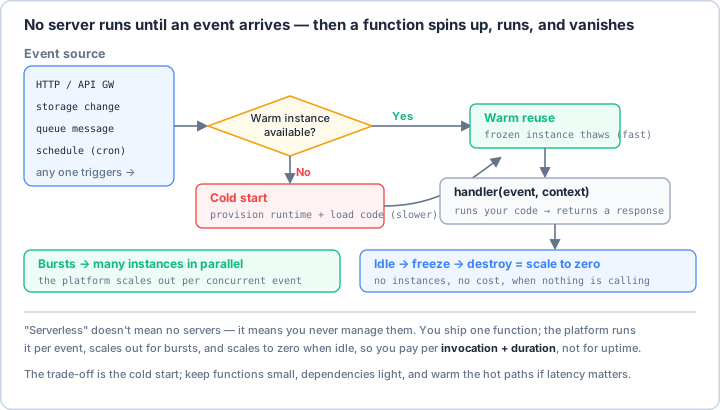
Think of serverless functions as specialized workers in a massive factory - each function performs a specific task, triggered by events like API calls, file uploads, database changes, or scheduled times. Using platforms like AWS Lambda, Google Cloud Functions, and Azure Functions, you can build entire applications without managing servers, automatically scaling from zero to millions of requests. Understanding event sources, execution models, and integration patterns is essential for effective serverless development!
Real-World Scenario: The Serverless Application Platform 🌐
You're building a serverless platform that handles API endpoints for web applications, processes uploaded images and videos, responds to database changes with notifications, runs scheduled data aggregations, integrates with third-party webhooks, manages authentication and authorization, processes payment transactions, and orchestrates complex workflows. Your system must handle millions of events, optimize for cost and performance, manage cold starts, and provide comprehensive monitoring. Let's build a production-ready serverless framework!
# First, install required packages:
# pip install boto3 google-cloud-functions azure-functions requests
# pip install chalice zappa serverless-wsgi mangum fastapi
import os
import json
import base64
import logging
import time
import asyncio
from typing import Dict, Any, List, Optional, Union, Callable
from dataclasses import dataclass, field
from datetime import datetime, timedelta
from enum import Enum
from functools import wraps
import hashlib
import uuid
# AWS Lambda
import boto3
from botocore.exceptions import ClientError
# HTTP handling
import requests
from urllib.parse import parse_qs
# Framework support
from fastapi import FastAPI, HTTPException, Request
from mangum import Mangum # ASGI adapter for Lambda
# ==================== Serverless Configuration ====================
@dataclass
class ServerlessConfig:
"""Serverless function configuration."""
provider: str = "aws" # aws, gcp, azure
runtime: str = "python3.9"
region: str = "us-east-1"
project_id: str = "" # GCP project id (required for the gcp provider)
# Function settings
timeout: int = 30 # seconds
memory: int = 256 # MB
# Concurrency
reserved_concurrency: Optional[int] = None
max_concurrency: int = 1000
# Environment
environment_variables: Dict[str, str] = field(default_factory=dict)
# Layers and dependencies
layers: List[str] = field(default_factory=list)
# Tracing and monitoring
enable_tracing: bool = True
enable_logging: bool = True
log_level: str = "INFO"
# Cost optimization
enable_auto_optimization: bool = True
# Security
vpc_config: Optional[Dict[str, Any]] = None
iam_role: Optional[str] = None
class EventType(Enum):
"""Serverless event types."""
HTTP = "http"
S3 = "s3"
DYNAMODB = "dynamodb"
SNS = "sns"
SQS = "sqs"
SCHEDULE = "schedule"
KINESIS = "kinesis"
CLOUDWATCH = "cloudwatch"
CUSTOM = "custom"
# ==================== Base Serverless Handler ====================
class ServerlessHandler:
"""Base class for serverless function handlers."""
def __init__(self, config: ServerlessConfig):
self.config = config
self.logger = self._setup_logging()
def _setup_logging(self):
"""Setup logging configuration."""
logger = logging.getLogger()
logger.setLevel(getattr(logging, self.config.log_level))
return logger
def handle(self, event: Dict[str, Any], context: Any) -> Dict[str, Any]:
"""Main handler entry point."""
try:
# Log event
self.logger.info(f"Received event: {json.dumps(event)[:500]}")
# Determine event type
event_type = self._detect_event_type(event)
# Route to appropriate handler
if event_type == EventType.HTTP:
return self.handle_http(event, context)
elif event_type == EventType.S3:
return self.handle_s3(event, context)
elif event_type == EventType.DYNAMODB:
return self.handle_dynamodb(event, context)
elif event_type == EventType.SQS:
return self.handle_sqs(event, context)
elif event_type == EventType.SCHEDULE:
return self.handle_schedule(event, context)
else:
return self.handle_custom(event, context)
except Exception as e:
self.logger.error(f"Handler error: {e}", exc_info=True)
return self._error_response(str(e))
def _detect_event_type(self, event: Dict[str, Any]) -> EventType:
"""Detect the type of event."""
if 'httpMethod' in event or 'requestContext' in event:
return EventType.HTTP
elif 'Records' in event:
if event['Records'][0].get('eventSource') == 'aws:s3':
return EventType.S3
elif event['Records'][0].get('eventSource') == 'aws:sqs':
return EventType.SQS
elif event['Records'][0].get('eventSource') == 'aws:dynamodb':
return EventType.DYNAMODB
elif 'source' in event and event['source'] == 'aws.events':
return EventType.SCHEDULE
else:
return EventType.CUSTOM
def handle_http(self, event: Dict[str, Any], context: Any) -> Dict[str, Any]:
"""Handle HTTP/API Gateway events."""
return {
'statusCode': 200,
'headers': {
'Content-Type': 'application/json',
'Access-Control-Allow-Origin': '*'
},
'body': json.dumps({'message': 'HTTP handler not implemented'})
}
def handle_s3(self, event: Dict[str, Any], context: Any) -> Dict[str, Any]:
"""Handle S3 events."""
for record in event['Records']:
bucket = record['s3']['bucket']['name']
key = record['s3']['object']['key']
self.logger.info(f"Processing S3 object: {bucket}/{key}")
return {'statusCode': 200}
def handle_dynamodb(self, event: Dict[str, Any], context: Any) -> Dict[str, Any]:
"""Handle DynamoDB stream events."""
for record in event['Records']:
event_name = record['eventName']
self.logger.info(f"DynamoDB event: {event_name}")
return {'statusCode': 200}
def handle_sqs(self, event: Dict[str, Any], context: Any) -> Dict[str, Any]:
"""Handle SQS messages."""
for record in event['Records']:
message = record['body']
self.logger.info(f"Processing SQS message: {message}")
return {'statusCode': 200}
def handle_schedule(self, event: Dict[str, Any], context: Any) -> Dict[str, Any]:
"""Handle scheduled events."""
self.logger.info("Running scheduled task")
return {'statusCode': 200}
def handle_custom(self, event: Dict[str, Any], context: Any) -> Dict[str, Any]:
"""Handle custom events."""
return {'statusCode': 200}
def _error_response(self, error: str) -> Dict[str, Any]:
"""Generate error response."""
return {
'statusCode': 500,
'headers': {'Content-Type': 'application/json'},
'body': json.dumps({'error': error})
}
# ==================== AWS Lambda Functions ====================
class AWSLambdaFunction:
"""AWS Lambda function implementation."""
def __init__(self, config: ServerlessConfig):
self.config = config
self.lambda_client = boto3.client('lambda', region_name=config.region)
self.logger = logging.getLogger(__name__)
def deploy_function(
self,
function_name: str,
handler: str,
code_zip_path: str,
role_arn: Optional[str] = None,
environment: Optional[Dict[str, str]] = None
):
"""Deploy Lambda function."""
try:
with open(code_zip_path, 'rb') as f:
zip_content = f.read()
function_config = {
'FunctionName': function_name,
'Runtime': self.config.runtime,
'Role': role_arn or self.config.iam_role,
'Handler': handler,
'Code': {'ZipFile': zip_content},
'Timeout': self.config.timeout,
'MemorySize': self.config.memory,
'Environment': {'Variables': environment or self.config.environment_variables}
}
# Add VPC config if specified
if self.config.vpc_config:
function_config['VpcConfig'] = self.config.vpc_config
# Add layers if specified
if self.config.layers:
function_config['Layers'] = self.config.layers
# Add tracing
if self.config.enable_tracing:
function_config['TracingConfig'] = {'Mode': 'Active'}
# Create or update function
try:
response = self.lambda_client.create_function(**function_config)
self.logger.info(f"Created Lambda function: {function_name}")
except self.lambda_client.exceptions.ResourceConflictException:
# Update existing function
response = self.lambda_client.update_function_code(
FunctionName=function_name,
ZipFile=zip_content
)
self.lambda_client.update_function_configuration(
FunctionName=function_name,
Timeout=self.config.timeout,
MemorySize=self.config.memory,
Environment={'Variables': environment or {}}
)
self.logger.info(f"Updated Lambda function: {function_name}")
return response
except Exception as e:
self.logger.error(f"Failed to deploy Lambda function: {e}")
raise
def create_api_gateway_trigger(
self,
function_name: str,
api_name: str,
stage: str = "prod"
):
"""Create API Gateway trigger for Lambda."""
api_client = boto3.client('apigatewayv2', region_name=self.config.region)
try:
# Create HTTP API
response = api_client.create_api(
Name=api_name,
ProtocolType='HTTP',
Target=f"arn:aws:lambda:{self.config.region}:ACCOUNT_ID:function:{function_name}"
)
api_id = response['ApiId']
# Add Lambda permission
self.lambda_client.add_permission(
FunctionName=function_name,
StatementId=f"{api_name}-invoke",
Action='lambda:InvokeFunction',
Principal='apigateway.amazonaws.com',
SourceArn=f"arn:aws:execute-api:{self.config.region}:ACCOUNT_ID:{api_id}/*/*"
)
self.logger.info(f"Created API Gateway trigger for {function_name}")
return response['ApiEndpoint']
except Exception as e:
self.logger.error(f"Failed to create API Gateway trigger: {e}")
raise
# ==================== Google Cloud Functions ====================
class GCPCloudFunction:
"""Google Cloud Functions implementation."""
def __init__(self, config: ServerlessConfig):
self.config = config
self.logger = logging.getLogger(__name__)
def deploy_function(
self,
function_name: str,
source_archive_url: str,
entry_point: str,
trigger_type: str = "https",
environment: Optional[Dict[str, str]] = None
):
"""Deploy Google Cloud Function."""
from google.cloud import functions_v1
client = functions_v1.CloudFunctionsServiceClient()
parent = f"projects/{self.config.project_id}/locations/{self.config.region}"
function = functions_v1.CloudFunction(
name=f"{parent}/functions/{function_name}",
source_archive_url=source_archive_url,
entry_point=entry_point,
# Cloud Functions v1 expects the no-dot runtime id (e.g. "python39",
# not "python3.9"), so strip the dot from the configured value.
runtime=self.config.runtime.replace(".", ""),
available_memory_mb=self.config.memory,
timeout=f"{self.config.timeout}s",
environment_variables=environment or self.config.environment_variables
)
# Set trigger
if trigger_type == "https":
function.https_trigger = functions_v1.HttpsTrigger()
elif trigger_type == "pubsub":
function.event_trigger = functions_v1.EventTrigger(
event_type="google.pubsub.topic.publish",
resource=f"projects/{self.config.project_id}/topics/{function_name}-topic"
)
# Deploy
operation = client.create_function(parent=parent, function=function)
result = operation.result()
self.logger.info(f"Deployed Cloud Function: {function_name}")
return result
# ==================== Azure Functions ====================
class AzureFunction:
"""Azure Functions implementation."""
def __init__(self, config: ServerlessConfig):
self.config = config
self.logger = logging.getLogger(__name__)
def create_function_app(
self,
resource_group: str,
function_app_name: str,
storage_account: str
):
"""Create Azure Function App."""
# Azure Functions deployment typically uses Azure CLI or ARM templates
import subprocess
cmd = [
'az', 'functionapp', 'create',
'--resource-group', resource_group,
'--name', function_app_name,
'--storage-account', storage_account,
'--runtime', 'python',
'--runtime-version', '3.9',
'--functions-version', '4',
'--consumption-plan-location', self.config.region
]
result = subprocess.run(cmd, capture_output=True, text=True)
if result.returncode == 0:
self.logger.info(f"Created Azure Function App: {function_app_name}")
else:
raise Exception(f"Failed to create Function App: {result.stderr}")
# ==================== Serverless HTTP API ====================
class ServerlessAPI:
"""Serverless HTTP API using FastAPI."""
def __init__(self, config: ServerlessConfig):
self.config = config
self.app = FastAPI(title="Serverless API")
self.setup_routes()
# Create Lambda handler
self.handler = Mangum(self.app)
def setup_routes(self):
"""Setup API routes."""
@self.app.get("/")
async def root():
return {"message": "Serverless API", "timestamp": datetime.now().isoformat()}
@self.app.get("/health")
async def health():
return {"status": "healthy"}
@self.app.post("/process")
async def process_data(request: Request):
data = await request.json()
# Process data
result = self._process(data)
return {"result": result}
@self.app.get("/items/{item_id}")
async def get_item(item_id: str):
# Fetch from database
return {"item_id": item_id, "data": "example"}
def _process(self, data: Dict[str, Any]) -> Any:
"""Process data."""
# Implementation
return {"processed": True, "data": data}
def lambda_handler(self, event: Dict[str, Any], context: Any):
"""Lambda handler for FastAPI."""
return self.handler(event, context)
# ==================== Serverless Data Processing ====================
class ServerlessDataProcessor:
"""Serverless data processing functions."""
def __init__(self, config: ServerlessConfig):
self.config = config
self.s3_client = boto3.client('s3')
self.dynamodb = boto3.resource('dynamodb')
self.logger = logging.getLogger(__name__)
def process_s3_upload(self, event: Dict[str, Any], context: Any):
"""Process uploaded S3 files."""
for record in event['Records']:
bucket = record['s3']['bucket']['name']
key = record['s3']['object']['key']
# Download file
response = self.s3_client.get_object(Bucket=bucket, Key=key)
content = response['Body'].read()
# Process based on file type
if key.endswith('.json'):
data = json.loads(content)
self._process_json(data, bucket, key)
elif key.endswith('.csv'):
self._process_csv(content, bucket, key)
elif key.endswith(('.jpg', '.png', '.gif')):
self._process_image(content, bucket, key)
self.logger.info(f"Processed {bucket}/{key}")
return {'statusCode': 200}
def _process_json(self, data: Dict[str, Any], bucket: str, key: str):
"""Process JSON data."""
# Example: Store in DynamoDB
table = self.dynamodb.Table('processed-data')
item = {
'id': str(uuid.uuid4()),
'source_bucket': bucket,
'source_key': key,
'data': data,
'processed_at': datetime.now().isoformat()
}
table.put_item(Item=item)
def _process_csv(self, content: bytes, bucket: str, key: str):
"""Process CSV data."""
import csv
import io
# Parse CSV
csv_data = io.StringIO(content.decode('utf-8'))
reader = csv.DictReader(csv_data)
# Process rows
for row in reader:
# Process each row
pass
def _process_image(self, content: bytes, bucket: str, key: str):
"""Process image files."""
from PIL import Image
import io
# Open image
image = Image.open(io.BytesIO(content))
# Generate thumbnail
thumbnail = image.copy()
thumbnail.thumbnail((128, 128))
# Save thumbnail
thumbnail_buffer = io.BytesIO()
thumbnail.save(thumbnail_buffer, format='JPEG')
# Upload thumbnail
thumbnail_key = f"thumbnails/{key}"
self.s3_client.put_object(
Bucket=bucket,
Key=thumbnail_key,
Body=thumbnail_buffer.getvalue()
)
# ==================== Serverless Workflow Orchestration ====================
class ServerlessWorkflow:
"""Orchestrate serverless workflows."""
def __init__(self, config: ServerlessConfig):
self.config = config
self.step_functions = boto3.client('stepfunctions')
self.logger = logging.getLogger(__name__)
def create_workflow(self, workflow_name: str, definition: Dict[str, Any]):
"""Create Step Functions workflow."""
try:
response = self.step_functions.create_state_machine(
name=workflow_name,
definition=json.dumps(definition),
roleArn=self.config.iam_role
)
self.logger.info(f"Created workflow: {workflow_name}")
return response['stateMachineArn']
except Exception as e:
self.logger.error(f"Failed to create workflow: {e}")
raise
def create_data_pipeline_workflow(self) -> Dict[str, Any]:
"""Create data processing pipeline workflow."""
return {
"Comment": "Data processing pipeline",
"StartAt": "ValidateInput",
"States": {
"ValidateInput": {
"Type": "Task",
"Resource": "arn:aws:lambda:REGION:ACCOUNT:function:validate-input",
"Next": "ProcessData",
"Catch": [{
"ErrorEquals": ["ValidationError"],
"Next": "HandleError"
}]
},
"ProcessData": {
"Type": "Parallel",
"Branches": [
{
"StartAt": "ExtractData",
"States": {
"ExtractData": {
"Type": "Task",
"Resource": "arn:aws:lambda:REGION:ACCOUNT:function:extract-data",
"End": True
}
}
},
{
"StartAt": "TransformData",
"States": {
"TransformData": {
"Type": "Task",
"Resource": "arn:aws:lambda:REGION:ACCOUNT:function:transform-data",
"End": True
}
}
}
],
"Next": "LoadData"
},
"LoadData": {
"Type": "Task",
"Resource": "arn:aws:lambda:REGION:ACCOUNT:function:load-data",
"Next": "SendNotification"
},
"SendNotification": {
"Type": "Task",
"Resource": "arn:aws:lambda:REGION:ACCOUNT:function:send-notification",
"End": True
},
"HandleError": {
"Type": "Task",
"Resource": "arn:aws:lambda:REGION:ACCOUNT:function:handle-error",
"End": True
}
}
}
# ==================== Serverless Monitoring ====================
class ServerlessMonitoring:
"""Monitor serverless functions."""
def __init__(self, config: ServerlessConfig):
self.config = config
self.cloudwatch = boto3.client('cloudwatch')
self.xray = boto3.client('xray')
self.logger = logging.getLogger(__name__)
def create_alarm(
self,
function_name: str,
metric_name: str,
threshold: float,
comparison: str = "GreaterThanThreshold"
):
"""Create CloudWatch alarm for function."""
self.cloudwatch.put_metric_alarm(
AlarmName=f"{function_name}-{metric_name}",
ComparisonOperator=comparison,
EvaluationPeriods=2,
MetricName=metric_name,
Namespace='AWS/Lambda',
Period=300,
Statistic='Average',
Threshold=threshold,
ActionsEnabled=True,
Dimensions=[
{'Name': 'FunctionName', 'Value': function_name}
]
)
def get_function_metrics(self, function_name: str) -> Dict[str, Any]:
"""Get function metrics."""
end_time = datetime.now()
start_time = end_time - timedelta(hours=1)
metrics = {}
# Get invocation count
response = self.cloudwatch.get_metric_statistics(
Namespace='AWS/Lambda',
MetricName='Invocations',
Dimensions=[{'Name': 'FunctionName', 'Value': function_name}],
StartTime=start_time,
EndTime=end_time,
Period=300,
Statistics=['Sum']
)
if response['Datapoints']:
metrics['invocations'] = sum(p['Sum'] for p in response['Datapoints'])
# Get error count
response = self.cloudwatch.get_metric_statistics(
Namespace='AWS/Lambda',
MetricName='Errors',
Dimensions=[{'Name': 'FunctionName', 'Value': function_name}],
StartTime=start_time,
EndTime=end_time,
Period=300,
Statistics=['Sum']
)
if response['Datapoints']:
metrics['errors'] = sum(p['Sum'] for p in response['Datapoints'])
# Get duration
response = self.cloudwatch.get_metric_statistics(
Namespace='AWS/Lambda',
MetricName='Duration',
Dimensions=[{'Name': 'FunctionName', 'Value': function_name}],
StartTime=start_time,
EndTime=end_time,
Period=300,
Statistics=['Average']
)
if response['Datapoints']:
metrics['avg_duration'] = sum(p['Average'] for p in response['Datapoints']) / len(response['Datapoints'])
return metrics
# ==================== Serverless Optimization ====================
class ServerlessOptimizer:
"""Optimize serverless functions."""
def __init__(self, config: ServerlessConfig):
self.config = config
self.logger = logging.getLogger(__name__)
def optimize_cold_starts(self) -> Dict[str, Any]:
"""Strategies to minimize cold starts."""
return {
'strategies': [
{
'name': 'Provisioned Concurrency',
'description': 'Keep instances warm',
'implementation': self._setup_provisioned_concurrency
},
{
'name': 'Smaller Deployment Package',
'description': 'Reduce package size',
'implementation': self._optimize_package_size
},
{
'name': 'Connection Pooling',
'description': 'Reuse database connections',
'implementation': self._setup_connection_pool
},
{
'name': 'Lazy Loading',
'description': 'Load dependencies on demand',
'implementation': self._implement_lazy_loading
}
]
}
def _setup_provisioned_concurrency(self, function_name: str, count: int):
"""Setup provisioned concurrency."""
lambda_client = boto3.client('lambda')
lambda_client.put_provisioned_concurrency_config(
FunctionName=function_name,
ProvisionedConcurrentExecutions=count,
Qualifier='$LATEST'
)
def _optimize_package_size(self):
"""Optimize deployment package size."""
return """
# Use Lambda layers for dependencies
# Remove unnecessary files
find . -type f -name "*.pyc" -delete
find . -type d -name "__pycache__" -delete
# Use slim base images
# Tree-shake dependencies
pip install --target ./package --no-deps package-name
"""
def _setup_connection_pool(self):
"""Setup database connection pooling."""
return """
# Global connection pool
import pymysql
from pymysql.connections import Connection
connection_pool = None
def get_connection():
global connection_pool
if not connection_pool:
connection_pool = pymysql.connect(
host='database.example.com',
user='user',
password='password',
database='mydb'
)
return connection_pool
"""
def _implement_lazy_loading(self):
"""Implement lazy loading of dependencies."""
return """
# Lazy load heavy dependencies
def get_heavy_library():
global heavy_lib
if 'heavy_lib' not in globals():
import heavy_library
heavy_lib = heavy_library
return heavy_lib
"""
# Example usage
if __name__ == "__main__":
print("⚡ Serverless Functions Examples\n")
# Example 1: Initialize serverless configuration
print("1️⃣ Initializing Serverless Configuration:")
config = ServerlessConfig(
provider="aws",
runtime="python3.9",
timeout=30,
memory=256
)
print(f" Provider: {config.provider}")
print(f" Runtime: {config.runtime}")
print(f" Timeout: {config.timeout}s")
print(f" Memory: {config.memory}MB")
# Example 2: Lambda function deployment
print("\n2️⃣ Deploying Lambda Function:")
print(" aws_lambda = AWSLambdaFunction(config)")
print(" aws_lambda.deploy_function(")
print(" function_name='data-processor',")
print(" handler='lambda_function.handler',")
print(" code_zip_path='function.zip'")
print(" )")
# Example 3: Event types
print("\n3️⃣ Serverless Event Types:")
events = [
("HTTP/API Gateway", "RESTful APIs and webhooks"),
("S3", "File uploads and storage events"),
("DynamoDB", "Database changes and streams"),
("SQS", "Message queue processing"),
("Schedule", "Cron jobs and timers"),
("SNS", "Pub/Sub notifications"),
("Kinesis", "Stream processing")
]
for event_type, description in events:
print(f" {event_type}: {description}")
# Example 4: Function patterns
print("\n4️⃣ Serverless Function Patterns:")
patterns = [
("Request-Response", "Synchronous API calls"),
("Event Processing", "Async event handling"),
("Stream Processing", "Real-time data streams"),
("Batch Processing", "Scheduled batch jobs"),
("Fan-out/Fan-in", "Parallel processing"),
("Saga Pattern", "Distributed transactions")
]
for pattern, use_case in patterns:
print(f" {pattern}: {use_case}")
# Example 5: Cold start optimization
print("\n5️⃣ Cold Start Optimization:")
optimizations = [
"Use smaller deployment packages",
"Implement provisioned concurrency",
"Reuse connections and clients",
"Lazy load heavy dependencies",
"Choose appropriate memory allocation",
"Use Lambda layers for dependencies",
"Minimize VPC usage",
"Use compiled languages for critical paths"
]
for optimization in optimizations:
print(f" • {optimization}")
# Example 6: Cost optimization
print("\n6️⃣ Cost Optimization Strategies:")
strategies = [
("Right-size memory", "Optimize memory/CPU allocation"),
("Use ARM Graviton2", "Lower cost processors"),
("Implement caching", "Reduce function invocations"),
("Batch processing", "Process multiple items per invocation"),
("Use Step Functions", "Orchestrate workflows efficiently"),
("Set up cost alerts", "Monitor spending")
]
for strategy, description in strategies:
print(f" {strategy}: {description}")
# Example 7: Monitoring metrics
print("\n7️⃣ Key Monitoring Metrics:")
metrics = [
"Invocation count",
"Error rate",
"Duration (avg, p50, p99)",
"Concurrent executions",
"Throttles",
"Dead letter queue messages",
"Cold starts",
"Cost per invocation"
]
for metric in metrics:
print(f" 📊 {metric}")
# Example 8: Security best practices
print("\n8️⃣ Serverless Security:")
security = [
"🔐 Use least privilege IAM roles",
"🔑 Store secrets in Secrets Manager",
"🛡️ Enable VPC for network isolation",
"📝 Implement input validation",
"🔍 Enable X-Ray tracing",
"📊 Set up CloudWatch alarms",
"🚫 Implement rate limiting",
"✅ Regular security audits"
]
for practice in security:
print(f" {practice}")
# Example 9: Testing strategies
print("\n9️⃣ Testing Serverless Functions:")
testing = [
("Unit Tests", "Test business logic"),
("Integration Tests", "Test with real services"),
("Local Testing", "Use SAM or Serverless Framework"),
("Load Testing", "Test scalability"),
("Chaos Testing", "Test failure scenarios")
]
for test_type, purpose in testing:
print(f" {test_type}: {purpose}")
# Example 10: Frameworks and tools
print("\n🔟 Serverless Frameworks:")
frameworks = [
("Serverless Framework", "Multi-cloud deployment"),
("SAM (AWS)", "AWS-native framework"),
("Chalice", "Python framework for AWS"),
("Zappa", "Django/Flask on Lambda"),
("Vercel", "Frontend and API functions"),
("Netlify Functions", "JAMstack functions")
]
for framework, description in frameworks:
print(f" {framework}: {description}")
print("\n✅ Serverless functions demonstration complete!")
print("\n📝 Note: Remember that serverless is about:")
print(" • No server management")
print(" • Automatic scaling")
print(" • Pay per execution")
print(" • Event-driven architecture")
print(" • Focus on business logic")
Key Takeaways and Best Practices 🎯
- Optimize Cold Starts: Minimize package size and use provisioned concurrency.
- Handle Events Properly: Parse and validate event data correctly.
- Implement Error Handling: Use try-catch and dead letter queues.
- Monitor Everything: Track metrics, logs, and traces.
- Manage State Externally: Functions should be stateless.
- Use Appropriate Timeouts: Set realistic timeout values.
- Implement Idempotency: Handle duplicate events gracefully.
- Secure Functions: Use least privilege IAM and encrypt data.
Serverless Best Practices 📋
Mastering serverless functions enables you to build highly scalable, cost-effective applications without managing infrastructure. You can now create event-driven architectures, process data streams, build APIs, run scheduled tasks, and orchestrate complex workflows all with automatic scaling and pay-per-use pricing. Whether you're building microservices, data pipelines, or full applications, serverless empowers you to focus on code, not servers! 🚀
📓 Learning Journal
Keep a learning journal — digital or physical. After this lesson, take a few minutes to write down:
- Key concepts you learned
- Techniques that clicked for you
- Questions or confusion points to revisit
- Ideas you want to try
- Your progress and feelings about learning this
✍️ This lesson's prompt: Serverless flips the model from "a server that's always running" to "code that appears only when an event fires." Which of your own tasks are naturally event-driven and would fit serverless well — and which ones would fight against the stateless, short-lived nature of a function?
📝 Lesson Summary
🎓 Key Takeaways
- Serverless means the provider manages the servers: an event triggers your handler, it runs, returns, and the instance is frozen — so you scale to zero and pay only per invocation and duration.
- The main trade-off is the cold start (provisioning the first call after idle); keep functions small, dependencies light, and reuse clients and connections across invocations.
- Functions should be stateless and idempotent because events can be delivered more than once — store state externally and design to handle duplicates safely.
- Use Step Functions to orchestrate multi-step workflows rather than chaining Lambdas by hand, and monitor invocations, errors, and duration from day one.
🎉 What You've Accomplished
You can now build event-driven applications that scale automatically and cost nothing when idle — responding to HTTP requests, file uploads, queue messages, and schedules with focused, stateless functions across AWS, GCP, and Azure.
❓ Common Questions at This Stage
Does "serverless" really mean there are no servers?
No — there are servers, you just never provision, patch, or scale them. The provider runs your code on shared infrastructure, spinning instances up on events and tearing them down when idle. You think about functions and events, not machines.
When is a cold start a problem, and how do I avoid it?
Cold starts hurt latency-sensitive, user-facing paths after periods of low traffic. Mitigate them with smaller deployment packages, provisioned (or reserved) concurrency to keep instances warm, minimal VPC usage, and by moving heavy imports/connections to module scope so they're reused across invocations.
Why does my function need to be idempotent?
Event sources like SQS and S3 can deliver the same event more than once, and functions may retry on failure. If processing the same event twice would double-charge a customer or duplicate a record, use a deduplication key or conditional write so repeats are harmless.
🔭 Looking Ahead
Individual functions are powerful, but real systems combine them into full deployments. Next you'll see how to package, ship, and roll out applications to the cloud with automated pipelines.
✅ Before the Next Lesson
- Write a handler that detects its event type and processes an S3 upload, returning a correct status code and handling errors.
- List two functions you'd optimize for cold starts and describe exactly what you'd change (package size, concurrency, connection reuse).
- Write your Learning Journal entry for this lesson
🌟 Encouragement for the Journey
You've learned to build software that appears on demand, scales itself, and sleeps for free. That's a genuinely different way to think about applications — and now it's part of your toolkit. Keep functions small, focused, and fearless.
Pro Tip: Think of serverless functions as specialized workers that appear when needed and disappear when done - design them to be fast, focused, and fault-tolerant. Keep functions small and single-purpose - each should do one thing well. Optimize for cold starts by minimizing dependencies and using layers for shared code. Always handle events idempotently since they might be delivered multiple times. Use environment variables for configuration but Secrets Manager for sensitive data. Implement proper error handling with retries and dead letter queues. Monitor everything - invocations, errors, duration, and costs. Use X-Ray for distributed tracing to understand performance bottlenecks. Design for failure - functions can timeout, throttle, or fail. Use Step Functions for complex workflows instead of chaining Lambda functions. Cache frequently accessed data to reduce latency and costs. Test locally with SAM or Serverless Framework before deploying. Set up cost alerts early - serverless can scale infinitely, including costs! Most importantly: embrace event-driven architecture - think in terms of events and reactions, not servers and processes!