🧪 API Testing Automation: Ensure API Quality
📚 What You'll Learn
By the end of this lesson, you will be able to:
- Structure API tests as Arrange → Act → Assert and assert on four levels: status code, JSON shape, headers, and latency
- Validate response bodies against a JSON Schema with
jsonschemaso a 200 with the wrong shape still fails - Test failure modes deliberately (400, 401, 404, 429) because how an API rejects bad input is part of its contract
- Generate dynamic test data and keep tests independent and idempotent instead of relying on fixed fixtures
- Run performance/load checks and integrate a
pytestsuite into a CI/CD pipeline with reports
⏱️ Estimated Time: 45–60 minutes
🎯 Project: Write a pytest suite for a small API that asserts status, schema, headers, and response time across both the happy path and error cases.
API testing automation is the quality control system of the API world - it ensures your APIs work correctly, perform well, and remain reliable as they evolve. Like having an army of tireless testers checking every endpoint, parameter, and response, automated API testing catches bugs before they reach production. Master these patterns to build bulletproof APIs that deliver consistent, reliable service! 🎯
The API Testing Framework
Think of API testing as a comprehensive health checkup for your APIs - from basic functionality tests to complex integration scenarios, performance benchmarks, and security audits. A well-designed testing framework covers all aspects: request validation, response verification, error handling, performance metrics, and contract testing. Understanding these patterns is essential for maintaining API quality at scale!
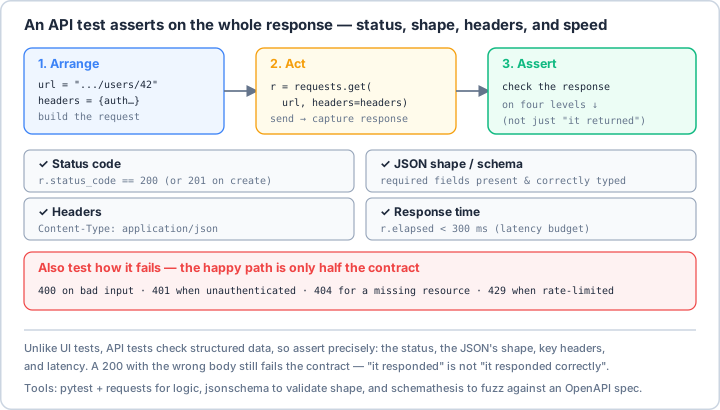
pytest + requests with jsonschema to validate shape.Real-World Scenario: The API Quality Platform 🏆
You're building a comprehensive API testing platform that validates multiple microservices - RESTful APIs, GraphQL endpoints, WebSocket connections, and gRPC services. Your platform must run thousands of tests, validate contracts, measure performance, check security, generate detailed reports, integrate with CI/CD pipelines, and provide real-time monitoring. Let's build a production-ready API testing framework!
# First, install required packages:
# pip install pytest requests pytest-html pytest-cov pytest-benchmark hypothesis jsonschema pydantic locust
import pytest
import requests
import json
import time
import os
from typing import Dict, List, Optional, Any, Union, Callable
from dataclasses import dataclass, field
from datetime import datetime, timedelta
from enum import Enum
import logging
from pathlib import Path
import yaml
import jsonschema
from pydantic import BaseModel, ValidationError
from hypothesis import given, strategies as st
import random
import string
from functools import wraps
# ==================== Test Configuration ====================
class TestLevel(Enum):
"""Test execution levels."""
SMOKE = "smoke"
SANITY = "sanity"
REGRESSION = "regression"
FULL = "full"
@dataclass
class APITestConfig:
"""API test configuration."""
base_url: str
timeout: int = 30
verify_ssl: bool = True
# Authentication
auth_type: Optional[str] = None
auth_credentials: Dict[str, str] = field(default_factory=dict)
# Test settings
test_level: TestLevel = TestLevel.REGRESSION
parallel_execution: bool = True
max_workers: int = 4
# Reporting
generate_html: bool = True
generate_coverage: bool = True
report_dir: str = "./test-reports"
# Performance thresholds
max_response_time: float = 2.0 # seconds
min_throughput: float = 100 # requests per second
# Retry configuration
max_retries: int = 3
retry_delay: float = 1.0
# ==================== Base Test Class ====================
class BaseAPITest:
"""Base class for API tests."""
def __init__(self, config: APITestConfig):
self.config = config
self.session = self._create_session()
self.logger = logging.getLogger(self.__class__.__name__)
# Test metrics
self.metrics = {
"requests_made": 0,
"total_time": 0,
"failures": []
}
def _create_session(self) -> requests.Session:
"""Create configured session."""
session = requests.Session()
session.verify = self.config.verify_ssl
# Set authentication
if self.config.auth_type == "bearer":
token = self.config.auth_credentials.get("token")
session.headers["Authorization"] = f"Bearer {token}"
elif self.config.auth_type == "api_key":
key = self.config.auth_credentials.get("key")
session.headers["X-API-Key"] = key
return session
def make_request(self, method: str, endpoint: str,
**kwargs) -> requests.Response:
"""Make HTTP request with metrics tracking."""
url = f"{self.config.base_url}{endpoint}"
start_time = time.time()
response = self.session.request(
method,
url,
timeout=self.config.timeout,
**kwargs
)
elapsed_time = time.time() - start_time
# Update metrics
self.metrics["requests_made"] += 1
self.metrics["total_time"] += elapsed_time
# Log request
self.logger.info(
f"{method} {endpoint} - {response.status_code} ({elapsed_time:.2f}s)"
)
return response
def assert_response(self, response: requests.Response,
expected_status: int = 200,
expected_schema: Optional[Dict] = None,
expected_headers: Optional[Dict] = None):
"""Common response assertions."""
# Status code
assert response.status_code == expected_status, \
f"Expected status {expected_status}, got {response.status_code}"
# Response time
assert response.elapsed.total_seconds() <= self.config.max_response_time, \
f"Response time {response.elapsed.total_seconds()}s exceeds threshold"
# Headers
if expected_headers:
for header, value in expected_headers.items():
assert header in response.headers, f"Missing header: {header}"
if value:
assert response.headers[header] == value, \
f"Header {header} mismatch"
# Schema validation
if expected_schema:
self.validate_schema(response.json(), expected_schema)
def validate_schema(self, data: Dict, schema: Dict):
"""Validate JSON schema."""
try:
jsonschema.validate(data, schema)
except jsonschema.exceptions.ValidationError as e:
pytest.fail(f"Schema validation failed: {e.message}")
# ==================== Test Data Generator ====================
class TestDataGenerator:
"""Generate test data for API testing."""
@staticmethod
def random_string(length: int = 10) -> str:
"""Generate random string."""
return ''.join(random.choices(string.ascii_letters + string.digits, k=length))
@staticmethod
def random_email() -> str:
"""Generate random email."""
return f"test_{TestDataGenerator.random_string(8)}@example.com"
@staticmethod
def random_phone() -> str:
"""Generate random phone number."""
return f"+1{random.randint(2000000000, 9999999999)}"
@staticmethod
def random_user() -> Dict[str, Any]:
"""Generate random user data."""
return {
"username": f"user_{TestDataGenerator.random_string(6)}",
"email": TestDataGenerator.random_email(),
"password": TestDataGenerator.random_string(12),
"first_name": random.choice(["John", "Jane", "Bob", "Alice"]),
"last_name": random.choice(["Smith", "Doe", "Johnson", "Williams"]),
"age": random.randint(18, 80),
"phone": TestDataGenerator.random_phone()
}
@staticmethod
def random_product() -> Dict[str, Any]:
"""Generate random product data."""
categories = ["Electronics", "Clothing", "Books", "Home", "Sports"]
return {
"name": f"Product {TestDataGenerator.random_string(8)}",
"description": f"Description {TestDataGenerator.random_string(50)}",
"price": round(random.uniform(9.99, 999.99), 2),
"category": random.choice(categories),
"sku": TestDataGenerator.random_string(10).upper(),
"stock": random.randint(0, 1000),
"active": random.choice([True, False])
}
# ==================== API Test Suite ====================
class APITestSuite(BaseAPITest):
"""Comprehensive API test suite."""
def test_health_check(self):
"""Test API health endpoint."""
response = self.make_request("GET", "/health")
self.assert_response(response, expected_status=200)
data = response.json()
assert "status" in data
assert data["status"] == "healthy"
def test_create_user(self):
"""Test user creation."""
user_data = TestDataGenerator.random_user()
response = self.make_request(
"POST",
"/users",
json=user_data
)
self.assert_response(response, expected_status=201)
created_user = response.json()
assert "id" in created_user
assert created_user["email"] == user_data["email"]
return created_user["id"]
def test_get_user(self):
"""Test getting user by ID."""
# Create user first
user_id = self.test_create_user()
# Get user
response = self.make_request("GET", f"/users/{user_id}")
self.assert_response(response, expected_status=200)
user = response.json()
assert user["id"] == user_id
def test_update_user(self):
"""Test user update."""
# Create user
user_id = self.test_create_user()
# Update data
update_data = {
"first_name": "Updated",
"last_name": "Name"
}
response = self.make_request(
"PATCH",
f"/users/{user_id}",
json=update_data
)
self.assert_response(response, expected_status=200)
updated_user = response.json()
assert updated_user["first_name"] == "Updated"
def test_delete_user(self):
"""Test user deletion."""
# Create user
user_id = self.test_create_user()
# Delete user
response = self.make_request("DELETE", f"/users/{user_id}")
self.assert_response(response, expected_status=204)
# Verify deletion
response = self.make_request("GET", f"/users/{user_id}")
assert response.status_code == 404
def test_list_users_pagination(self):
"""Test user listing with pagination."""
# Create multiple users
for _ in range(5):
self.test_create_user()
# Test pagination
response = self.make_request(
"GET",
"/users",
params={"page": 1, "limit": 2}
)
self.assert_response(response, expected_status=200)
data = response.json()
assert "items" in data
assert len(data["items"]) <= 2
assert "total" in data
assert "page" in data
def test_error_handling(self):
"""Test error responses."""
# Test 404
response = self.make_request("GET", "/users/nonexistent")
assert response.status_code == 404
error = response.json()
assert "error" in error or "message" in error
# Test 400 - Invalid data
response = self.make_request(
"POST",
"/users",
json={"invalid": "data"}
)
assert response.status_code == 400
# Test 401 - Unauthorized
self.session.headers.pop("Authorization", None)
response = self.make_request("GET", "/users/me")
assert response.status_code == 401
# ==================== Contract Testing ====================
class ContractTest:
"""API contract testing."""
def __init__(self, contract_file: str):
self.contract = self._load_contract(contract_file)
self.logger = logging.getLogger(__name__)
def _load_contract(self, file_path: str) -> Dict:
"""Load API contract (OpenAPI/Swagger)."""
with open(file_path, 'r') as f:
if file_path.endswith('.yaml') or file_path.endswith('.yml'):
return yaml.safe_load(f)
else:
return json.load(f)
def validate_endpoint(self, method: str, path: str,
response: requests.Response) -> bool:
"""Validate response against contract."""
# Find endpoint in contract
endpoint = self.contract["paths"].get(path, {}).get(method.lower())
if not endpoint:
self.logger.warning(f"Endpoint not found in contract: {method} {path}")
return False
# Get response schema
status_code = str(response.status_code)
response_spec = endpoint.get("responses", {}).get(status_code)
if not response_spec:
self.logger.warning(f"Response {status_code} not defined in contract")
return False
# Validate response schema
schema = response_spec.get("content", {}).get("application/json", {}).get("schema")
if schema:
try:
jsonschema.validate(response.json(), schema)
return True
except jsonschema.ValidationError as e:
self.logger.error(f"Contract validation failed: {e}")
return False
return True
# ==================== Performance Testing ====================
class PerformanceTest:
"""API performance testing."""
def __init__(self, config: APITestConfig):
self.config = config
self.results = []
self.logger = logging.getLogger(__name__)
def load_test(self, endpoint: str, method: str = "GET",
num_requests: int = 100,
concurrent_users: int = 10,
**kwargs) -> Dict[str, Any]:
"""Run load test on endpoint."""
import concurrent.futures
url = f"{self.config.base_url}{endpoint}"
def make_request():
start_time = time.time()
try:
response = requests.request(
method,
url,
timeout=self.config.timeout,
**kwargs
)
elapsed = time.time() - start_time
return {
"success": response.status_code < 400,
"status_code": response.status_code,
"response_time": elapsed
}
except Exception as e:
return {
"success": False,
"error": str(e),
"response_time": time.time() - start_time
}
# Run concurrent requests
start_time = time.time()
with concurrent.futures.ThreadPoolExecutor(max_workers=concurrent_users) as executor:
futures = [executor.submit(make_request) for _ in range(num_requests)]
results = [f.result() for f in concurrent.futures.as_completed(futures)]
total_time = time.time() - start_time
# Calculate metrics
successful = sum(1 for r in results if r["success"])
response_times = [r["response_time"] for r in results if "response_time" in r]
metrics = {
"total_requests": num_requests,
"successful_requests": successful,
"failed_requests": num_requests - successful,
"success_rate": successful / num_requests * 100,
"total_time": total_time,
"requests_per_second": num_requests / total_time,
"avg_response_time": sum(response_times) / len(response_times),
"min_response_time": min(response_times),
"max_response_time": max(response_times),
"p50_response_time": self._percentile(response_times, 50),
"p95_response_time": self._percentile(response_times, 95),
"p99_response_time": self._percentile(response_times, 99)
}
self.results.append(metrics)
return metrics
def _percentile(self, values: List[float], percentile: int) -> float:
"""Calculate percentile."""
if not values:
return 0
sorted_values = sorted(values)
index = int(len(sorted_values) * percentile / 100)
return sorted_values[min(index, len(sorted_values) - 1)]
def stress_test(self, endpoint: str,
initial_users: int = 1,
max_users: int = 100,
step: int = 10,
duration: int = 60) -> List[Dict]:
"""Run stress test with increasing load."""
stress_results = []
for users in range(initial_users, max_users + 1, step):
self.logger.info(f"Testing with {users} concurrent users")
# Calculate requests for duration
requests_per_user = duration # 1 request per second per user
total_requests = users * requests_per_user
result = self.load_test(
endpoint,
num_requests=total_requests,
concurrent_users=users
)
result["concurrent_users"] = users
stress_results.append(result)
# Stop if performance degrades
if result["success_rate"] < 95 or result["avg_response_time"] > 5:
self.logger.warning("Performance threshold breached, stopping test")
break
return stress_results
# ==================== Security Testing ====================
class SecurityTest:
"""API security testing."""
def __init__(self, base_url: str):
self.base_url = base_url
self.vulnerabilities = []
self.logger = logging.getLogger(__name__)
def test_sql_injection(self, endpoint: str, param: str) -> bool:
"""Test for SQL injection vulnerability."""
sql_payloads = [
"' OR '1'='1",
"1; DROP TABLE users--",
"' UNION SELECT * FROM users--",
"admin'--",
"1' AND 1=1--"
]
for payload in sql_payloads:
try:
response = requests.get(
f"{self.base_url}{endpoint}",
params={param: payload},
timeout=5
)
# Check for SQL errors in response
error_patterns = [
"SQL syntax",
"mysql_fetch",
"ORA-01756",
"PostgreSQL",
"SQLite"
]
response_text = response.text.lower()
for pattern in error_patterns:
if pattern.lower() in response_text:
self.vulnerabilities.append({
"type": "SQL Injection",
"endpoint": endpoint,
"param": param,
"payload": payload
})
return True
except Exception as e:
self.logger.debug(f"SQL injection test error: {e}")
return False
def test_xss(self, endpoint: str, param: str) -> bool:
"""Test for XSS vulnerability."""
xss_payloads = [
"<script>alert('XSS')</script>",
"<img src='x' onerror='alert(1)'>",
"javascript:alert('XSS')",
"<body onload='alert(1)'>"
]
for payload in xss_payloads:
try:
response = requests.get(
f"{self.base_url}{endpoint}",
params={param: payload},
timeout=5
)
# Check if payload is reflected without encoding
if payload in response.text:
self.vulnerabilities.append({
"type": "XSS",
"endpoint": endpoint,
"param": param,
"payload": payload
})
return True
except Exception as e:
self.logger.debug(f"XSS test error: {e}")
return False
def test_authentication(self) -> Dict[str, bool]:
"""Test authentication security."""
results = {
"requires_auth": False,
"rate_limiting": False,
"secure_headers": False,
"https_only": False
}
# Test if API requires authentication
response = requests.get(f"{self.base_url}/users", timeout=5)
results["requires_auth"] = response.status_code == 401
# Check for security headers
headers = response.headers
security_headers = [
"X-Content-Type-Options",
"X-Frame-Options",
"X-XSS-Protection",
"Strict-Transport-Security"
]
results["secure_headers"] = all(h in headers for h in security_headers)
# Check HTTPS
results["https_only"] = self.base_url.startswith("https://")
# Check rate limiting
results["rate_limiting"] = "X-RateLimit-Limit" in headers
return results
# ==================== Test Runner ====================
class APITestRunner:
"""Orchestrate API test execution."""
def __init__(self, config: APITestConfig):
self.config = config
self.logger = logging.getLogger(__name__)
self.results = {
"passed": 0,
"failed": 0,
"skipped": 0,
"errors": []
}
def run_tests(self, test_class, test_methods: Optional[List[str]] = None):
"""Run tests from test class."""
test_instance = test_class(self.config)
# Get test methods
if not test_methods:
test_methods = [m for m in dir(test_instance) if m.startswith("test_")]
for method_name in test_methods:
try:
method = getattr(test_instance, method_name)
self.logger.info(f"Running {method_name}")
method()
self.results["passed"] += 1
self.logger.info(f"✅ {method_name} passed")
except AssertionError as e:
self.results["failed"] += 1
self.results["errors"].append({
"test": method_name,
"error": str(e)
})
self.logger.error(f"❌ {method_name} failed: {e}")
except Exception as e:
self.results["failed"] += 1
self.results["errors"].append({
"test": method_name,
"error": str(e)
})
self.logger.error(f"💥 {method_name} error: {e}")
def run_performance_tests(self, endpoints: List[Dict[str, Any]]):
"""Run performance tests on endpoints."""
perf_test = PerformanceTest(self.config)
for endpoint_config in endpoints:
endpoint = endpoint_config["endpoint"]
method = endpoint_config.get("method", "GET")
self.logger.info(f"Performance testing {method} {endpoint}")
metrics = perf_test.load_test(
endpoint,
method,
num_requests=endpoint_config.get("requests", 100),
concurrent_users=endpoint_config.get("users", 10)
)
# Check thresholds
if metrics["avg_response_time"] > self.config.max_response_time:
self.logger.warning(
f"Response time {metrics['avg_response_time']:.2f}s "
f"exceeds threshold {self.config.max_response_time}s"
)
if metrics["requests_per_second"] < self.config.min_throughput:
self.logger.warning(
f"Throughput {metrics['requests_per_second']:.1f} req/s "
f"below threshold {self.config.min_throughput} req/s"
)
def run_security_tests(self, endpoints: List[str]):
"""Run security tests on endpoints."""
sec_test = SecurityTest(self.config.base_url)
for endpoint in endpoints:
self.logger.info(f"Security testing {endpoint}")
# Test common vulnerabilities
sec_test.test_sql_injection(endpoint, "id")
sec_test.test_xss(endpoint, "search")
# Test authentication
auth_results = sec_test.test_authentication()
for check, passed in auth_results.items():
if not passed:
self.logger.warning(f"Security check failed: {check}")
if sec_test.vulnerabilities:
self.logger.error(f"Found {len(sec_test.vulnerabilities)} vulnerabilities!")
for vuln in sec_test.vulnerabilities:
self.logger.error(f" {vuln['type']} at {vuln['endpoint']}")
def generate_report(self):
"""Generate test report."""
report = {
"timestamp": datetime.now().isoformat(),
"config": {
"base_url": self.config.base_url,
"test_level": self.config.test_level.value
},
"results": self.results,
"summary": {
"total": self.results["passed"] + self.results["failed"],
"pass_rate": self.results["passed"] /
(self.results["passed"] + self.results["failed"]) * 100
if self.results["passed"] + self.results["failed"] > 0 else 0
}
}
# Save report
report_file = Path(self.config.report_dir) / f"test_report_{datetime.now():%Y%m%d_%H%M%S}.json"
report_file.parent.mkdir(parents=True, exist_ok=True)
with open(report_file, 'w') as f:
json.dump(report, f, indent=2)
self.logger.info(f"Report saved to {report_file}")
return report
# ==================== Pytest Integration ====================
@pytest.fixture
def api_client():
"""Pytest fixture for API client."""
config = APITestConfig(
base_url=os.getenv("API_BASE_URL", "http://localhost:8000"),
auth_type="bearer",
auth_credentials={"token": os.getenv("API_TOKEN", "test_token")}
)
return APITestSuite(config)
def test_user_crud_flow(api_client):
"""Test complete user CRUD flow."""
# Create
user_id = api_client.test_create_user()
assert user_id is not None
# Read
api_client.test_get_user()
# Update
api_client.test_update_user()
# Delete
api_client.test_delete_user()
@pytest.mark.parametrize("endpoint,expected_status", [
("/health", 200),
("/users", 401), # Requires auth
("/nonexistent", 404)
])
def test_endpoints(api_client, endpoint, expected_status):
"""Parametrized endpoint testing."""
response = api_client.make_request("GET", endpoint)
assert response.status_code == expected_status
# Example usage
if __name__ == "__main__":
print("🧪 API Testing Automation Examples\n")
# Example 1: Test types
print("1️⃣ API Test Types:")
test_types = [
("Unit Tests", "Test individual endpoints", "Test GET /users/123"),
("Integration Tests", "Test endpoint interactions", "Create user, then login"),
("Contract Tests", "Validate API contracts", "Check OpenAPI schema"),
("Performance Tests", "Measure speed and load", "100 requests/second"),
("Security Tests", "Check vulnerabilities", "SQL injection, XSS"),
("Smoke Tests", "Basic functionality", "Health check passes")
]
for test_type, description, example in test_types:
print(f" {test_type}:")
print(f" {description}")
print(f" Example: {example}\n")
# Example 2: Test configuration
print("2️⃣ Test Configuration:")
config = APITestConfig(
base_url="https://api.example.com",
test_level=TestLevel.REGRESSION,
max_response_time=2.0,
min_throughput=100
)
print(f" Base URL: {config.base_url}")
print(f" Test Level: {config.test_level.value}")
print(f" Max Response Time: {config.max_response_time}s")
print(f" Min Throughput: {config.min_throughput} req/s")
# Example 3: Test data generation
print("\n3️⃣ Test Data Generation:")
user = TestDataGenerator.random_user()
print(" Random user:")
for key, value in user.items():
print(f" {key}: {value}")
# Example 4: Assertions
print("\n4️⃣ Common Assertions:")
assertions = [
"Status code validation",
"Response time check",
"Schema validation",
"Header verification",
"Content validation",
"Error message check"
]
for assertion in assertions:
print(f" • {assertion}")
# Example 5: Performance metrics
print("\n5️⃣ Performance Metrics:")
metrics = {
"requests_per_second": 156.3,
"avg_response_time": 0.245,
"p95_response_time": 0.512,
"p99_response_time": 0.987,
"success_rate": 99.8
}
print(" Load test results:")
for metric, value in metrics.items():
print(f" {metric}: {value}")
# Example 6: Security checks
print("\n6️⃣ Security Testing:")
security_checks = [
"SQL Injection",
"Cross-Site Scripting (XSS)",
"Authentication bypass",
"Rate limiting",
"Security headers",
"HTTPS enforcement"
]
for check in security_checks:
print(f" ✓ {check}")
# Example 7: CI/CD integration
print("\n7️⃣ CI/CD Integration:")
print(" GitHub Actions example:")
print(" - name: Run API Tests")
print(" run: pytest tests/api --html=report.html")
print(" ")
print(" Jenkins example:")
print(" sh 'python -m pytest --cov=api --cov-report=xml'")
# Example 8: Test organization
print("\n8️⃣ Test Organization:")
print(" tests/")
print(" api/")
print(" test_auth.py")
print(" test_users.py")
print(" test_products.py")
print(" performance/")
print(" test_load.py")
print(" test_stress.py")
print(" security/")
print(" test_vulnerabilities.py")
print(" contracts/")
print(" openapi.yaml")
# Example 9: Best practices
print("\n9️⃣ API Testing Best Practices:")
practices = [
"🎯 Test both happy and error paths",
"📊 Use data-driven testing",
"🔄 Make tests idempotent",
"🏷️ Use descriptive test names",
"⚡ Run tests in parallel",
"📝 Generate detailed reports",
"🔍 Test edge cases",
"🛡️ Include security tests",
"⏱️ Set performance thresholds",
"🔧 Integrate with CI/CD"
]
for practice in practices:
print(f" {practice}")
# Example 10: Common pitfalls
print("\n🔟 Common Testing Pitfalls:")
pitfalls = [
("Test dependency", "Tests depend on each other", "Make tests independent"),
("Hard-coded data", "Using fixed test data", "Generate random data"),
("No cleanup", "Leaving test data", "Clean up after tests"),
("Flaky tests", "Intermittent failures", "Add retries and waits"),
("Poor coverage", "Missing test cases", "Test all paths"),
("No monitoring", "Tests without metrics", "Track test metrics")
]
for issue, problem, solution in pitfalls:
print(f" {issue}:")
print(f" Problem: {problem}")
print(f" Solution: {solution}")
print("\n✅ API testing automation demonstration complete!")
Key Takeaways and Best Practices 🎯
- Test All Layers: Unit, integration, contract, performance, and security.
- Automate Everything: From test execution to report generation.
- Use Test Data Generators: Avoid hard-coded test data.
- Validate Thoroughly: Check status, schema, headers, and performance.
- Make Tests Independent: Each test should be self-contained.
- Set Performance Thresholds: Define acceptable response times.
- Include Security Testing: Check for common vulnerabilities.
- Generate Reports: Document test results and metrics.
API Testing Best Practices 📋
Mastering API testing automation ensures your APIs are reliable, performant, and secure. You can now build comprehensive test suites that validate functionality, measure performance, check security, and maintain quality at scale. Whether you're testing microservices, public APIs, or enterprise systems, these testing skills ensure your APIs deliver consistent, high-quality service! 🏆
📓 Learning Journal
Keep a learning journal — digital or physical. After this lesson, take a few minutes to write down:
- Key concepts you learned
- Techniques that clicked for you
- Questions or confusion points to revisit
- Ideas you want to try
- Your progress and feelings about learning this
✍️ This lesson's prompt: This lesson argues that a 200 with the wrong body still breaks the contract, and that failure modes deserve tests too. Which of your past bugs would a schema assertion or an error-path test have caught before release?
📝 Lesson Summary
🎓 Key Takeaways
- An API test follows Arrange → Act → Assert, and the craft is in the assert step — check status code, JSON shape, headers, and latency, not just "did it respond."
- Because responses are structured data, validate their shape with a JSON Schema; a 200 with the wrong body still breaks the contract.
- The happy path is only half the job — assert failure modes (400, 401, 404, 429) too, because how an API rejects bad input is part of its contract.
- Keep tests independent and idempotent with generated data, and wire the suite into CI/CD so every change is validated automatically.
🎉 What You've Accomplished
You can now write API tests that catch real regressions — verifying not just that an endpoint answers, but that it answers correctly, in the right shape, fast enough, and that it fails the way it promises to. That's the safety net that makes confident deployments possible.
❓ Common Questions at This Stage
Isn't checking the status code enough?
No. An endpoint can return 200 while the body is missing fields, has the wrong types, or is stale. Asserting the JSON shape (via a schema), headers, and response time catches the failures a status check alone misses.
Why should I test error responses on purpose?
Because your callers depend on them. A well-designed API's 400/401/404/429 responses are part of its contract — clients branch on them. If you only test success, you'll ship broken error handling that surfaces at the worst time.
How do I stop tests from interfering with each other?
Make each test self-contained: generate fresh data, create what it needs, and clean up afterward. Avoid tests that depend on the order they run in or on data another test left behind.
🔭 Looking Ahead
With a solid testing foundation, you're ready to move into cloud automation — provisioning and driving real infrastructure through SDKs, where the same "assert what actually happened" discipline pays off again.
✅ Before the Next Lesson
- Add a
jsonschemaassertion to one existing test and watch it fail when you tweak the expected shape. - Write one error-path test (e.g. a 404 or 400) for an endpoint you already cover on the happy path.
- Write your Learning Journal entry for this lesson.
🌟 Encouragement for the Journey
Good tests are a gift to your future self — they turn "I hope this still works" into "I know it does." Every assertion you add buys you the freedom to change code fearlessly. You're building that confidence now. Keep going.
Pro Tip: Think of API testing as quality assurance for your digital services - thorough testing prevents problems before they reach production. Start with a solid test structure: organize tests by functionality, use descriptive names, and keep them independent. Generate test data dynamically - hard-coded data leads to brittle tests. Test both success and failure scenarios - your API should handle errors gracefully. Validate everything: status codes, response schemas, headers, and performance metrics. Use contract testing to ensure API compatibility. Performance test regularly to catch degradation early. Include security testing - check for SQL injection, XSS, and authentication issues. Integrate tests into CI/CD pipelines for automatic validation. Generate detailed reports with metrics and coverage. Most importantly: treat test code with the same care as production code - well-maintained tests are your safety net for confident deployments!